Victor "Vic" Morrow (February 14, 1929 — July 23, 1982) was an American actor, whose credits include a starring role in the 1960s TV series Combat!, prominent roles in a handful of other television and cinema dramas, and numerous guest roles on television. He and two others died when a stunt helicopter crashed on them during the filming of Twilight Zone: The Movie.
Early life and family
Morrow was born in the Bronx, New York to a middle class Jewish family,[1] the son of Jean (née Kress) and Harry Morrow, an electrical engineer.[2] When he was 17, Morrow dropped out of high school and joined the U.S. Navy. He married actress Barbara Turner with whom he had two daughters: actress Jennifer Jason Leigh and Carrie Ann Morrow.
Career
Morrow's first movie role was in Blackboard Jungle (1955), after which he went into television. On April 16, 1959, he appeared in the premiere of NBC's 1920s crime drama The Lawless Years in the episode "The Nick Joseph Story."
Morrow then appeared from 1960–1961 as Joe Cannon in three episodes of NBC's The Outlaws with Barton MacLane. On October 6, 1961, he guest starred in the ABC television series Target: The Corruptors! with Stephen McNally and Robert Harland.
He was cast in the lead role in ABC's Combat!, a World War II drama, which aired from 1962–1967. He also worked as a television director. After Combat! ended, he worked in several films. Morrow appeared in two episodes of Australian-produced anthology series The Evil Touch (1973), one of which he also directed. He memorably played the wily local sheriff in director John Hough's road classic Dirty Mary, Crazy Larry, as well as the homicidal sheriff, alongside Martin Sheen, in the 1974 TV film The California Kid, and had a key role in the 1976 comedy The Bad News Bears. He also played Injun Joe in 1973 telefilm Tom Sawyer, which was filmed in Upper Canada Village. A musical version was released in theaters that same year.
Morrow wrote and directed a 1971 Spaghetti Western, produced by Dino DeLaurentis, titled A Man Called Sledge starring James Garner. It was Morrow's first and only big screen outing behind the camera. "Sledge" was filmed in Europe with desert-like settings that were highly evocative of the U.S. southwest.
Death
In the early morning hours of July 23, 1982, Morrow and two children, My-Ca Dinh Le (age 7), and Renee Shin-Yi Chen (age 6), died in an accident while filming on location for the Twilight Zone: The Movie in Ventura County, California. Morrow was playing the role of Bill Connor, a racist who is taken back in time and placed in various situations where he would be a persecuted victim: as a Jewish Holocaust victim, a black man about to be lynched by the Ku Klux Klan, and a Vietnamese man about to be killed by United States soldiers. Morrow, Le, and Chen were filming a scene for the Vietnam sequence in which their characters attempt to escape from a pursuing U.S. Army helicopter out of a deserted Vietnamese village. The helicopter was hovering at about 25 feet above them when pyrotechnic explosions damaged it and caused it to crash on top of them, killing all three instantly.
Morrow is interred in Hillside Memorial Park Cemetery in Culver City, California.[3]
Director John Landis and other defendants, which included producer Steven Spielberg and pilot Dorsey Wingo, were ultimately acquitted of involuntary manslaughter and child endangerment. The parents of Le and Chen sued and settled out of court for an undisclosed amount. Morrow's children also sued and settled for an undisclosed amount.[4]
References
1.^ "About Vic Morrow". Jodavidsmeyer. http://www.jodavidsmeyer.com/combat/personnel/morrow_BIO.html. Retrieved 2009-07-27. 2.^ Donnelley, Paul (2003). Fade to Black: A Book of Movie Obituaries. Omnibus. p. 504. ISBN0711995125. 3.^ "Vic Morrow". Find a Grave. http://www.findagrave.com/cgi-bin/fg.cgi?page=gr&GRid=1902. Retrieved 2009-07-27. 4.^ Noe, Denise. "The Twilight Zone Tragedy: Funerals and Blame" www.trutv.com
Wallace Merle "Wally" Byam (1896-1962) was one of the pioneer manufacturers of the travel trailer. He founded the company, Airstream Inc. From the 1930s until his death in 1962, Byam was a leader in developing both a romance and enthusiasm associated with the automobile and recreational vehicle culture as well as product features as the United States became increasingly focused on highways and automobile travel.
Biography
Byam was born July 4, 1896 in Baker City, Oregon. As a young child he traveled extensively with his grandfather, who led a mule train in Baker, Oregon. Later, as an adolescent, Byam worked as a shepherd. He lived in a two-wheeled shepherd's cart outfitted with a kerosene cook stove, a sleeping bag, and wash pail.
As a young man, Byam signed on with the merchant marines, studied law at Stanford University, owned an advertising agency, and became a magazine publisher. A do-it-yourself magazine he published featured an article describing how to build a travel trailer. When readers complained about the plans, Byam tried them out for himself. Indeed, he discovered the plans were flawed.
Byam was thus inspired to build his own travel trailer. While he considered his first attempt primitive, the design profoundly influenced the evolution of travel trailers. By dropping the floor down between the wheels and raising the ceiling height, his design made it possible for occupants to stand straight upright when inside the trailer. Byam wrote an article describing how to build his trailer for under $100 - this time drawing an enthusiastic response from his readers.
1920s
During the late 1920s, Americans were beginning to take to the roads in greater and greater numbers. Byam's new trailer was a perfect match for the increasingly popular mobile lifestyle. Byam thus began selling sets of his plans for five dollars each. He also sold complete trailer kits, and finished trailers he built in his Los Angeles backyard. His fledgling business survived the crash of 1929. By 1930 he had abandoned advertising and publishing to become a full-time builder of Masonite travel trailers. The Airstream Company was incorporated in 1931.
1934
In 1934, Hawley Bowlus developed the first riveted aluminum trailer, named the "Road Chief." Wally Byam was involved in sales of the these trailers. Bowlus continued to produce his line of trailers, finally ending production in September 1936. William Hawley Bowlus was an aircraft designer who had worked on The Spirit of St. Louis.
1936
On January 17, 1936, the Airstream Trailer Co. introduced the "Clipper," and a well-known American brand was born. The Clipper was a similar shape and length to the Bowlus Road Chief but with the door now located on the side. With its semimonocoque, riveted aluminum body, it had more in common with the aircraft of its day than with its travel trailer predecessors. It could sleep four, thanks to its tubular steel-framed dinette which could convert to a bed. It carried its own water supply, had an enclosed galley, and was fitted with electric lights throughout. The Clipper boasted advanced insulation and a ventilation system, and even offered "air conditioning" that used dry ice.
At $1200, the Clipper was considered an expensive travel trailer. However, market response to the product was strong. Byam's company could not build units fast enough to satisfy the deluge of orders.
Wally Byam's meticulous attention to quality and design helped guide the firm through tough economic times. Of more than 400 travel trailer builders operating in 1936, Airstream was the only one to survive the Great Depression years.
With the onset of World War II, leisure travel and the materials necessary to build trailers both became luxuries the country could not afford. In response to the war, Airstream Trailer Co. closed its doors. Byam decided that the best way to help the war effort was to use his experience with aluminum fabricating in the aircraft industry. He took positions at Lockheed and Curtis Wright for the duration of the war.
1948
When World War II ended, the economy boomed and Americans once again turned their attention towards recreational travel. Byam reopened Airstream; by 1948, the demand for Airstream trailers seemed limitless. Like the Coca-Cola bottle and Zippo lighter, Airstream travel trailers became one of the most recognizable products in the world.
1952
In July 1952, the lease was signed for a facility in Jackson Center, Ohio, to serve the eastern market. By August 1954 the first Ohio-made Airstream rolled off the production line, and the California factory was moved to larger facilities in Santa Fe Springs.
1955
In 1955, Wally travelled to Europe with his wife Stella, in a one-of-a-kind Airstream Bubble to scout the 1956 caravan.
1956
Then in 1956, he travelled to Europe in a Gold Anodized trailer towed by a Cadillac.
Byam's globetrotting adventures were the inspiration for the formation of the nonprofit club, Wally Byam Caravan Club International, to promote the use of Airstreams to travel as much as possible. Founded in Kentville, Nova Scotia, Canada, in 1955, the club is still in existence today, with more than 6,000 member families. In 2007, the club held more than 1400 rallies and caravans.
1962
Wally Byam died on July 22, 1962 at the age of 66. Cause of death was a brain tumor. He is interred at Forest Lawn Memorial Park in Glendale, CA in the Garden of Honor, Columbarium of Honor.
Airstream is now owned by Thor Industries, Inc., the largest travel trailer manufacturer in the world.
2007
The Wally Byam Caravan Club's 50th International Rally took place in Perry, GA June 23-July 4, 2007.
2009
Byam famously led caravans worldwide as publicity exercises for the Airstream brand. His most notable caravan was a 1959 sojourn from Cape Town, South Africa to Cairo, Egypt. A recreation of Byam's legendary Cape Town to Cairo caravan was scheduled to take place in 2009. However, the planned tour was canceled due to safety and political concerns, and the prohibitive insurance costs.
William Mulholland (September 11, 1855 – July 22, 1935) was the head of Los Angeles Department of Water and Power, Los Angeles in Southern California. He was responsible for building the water aqueducts and dams that allowed the city to grow into one of the largest in the world. His methods of obtaining water for the city led to disputes collectively known as the California Water Wars. In 1928, his career ended in ignominy after the St. Francis Dam failed just hours after he had given it a personal safety inspection.
Early life
William Mulholland was born in Belfast, Ireland. His parents Hugh and Ellen Mulholland were Dubliners and they returned to the city a few years after William's birth. His younger brother, also called Hugh, had been born in 1857 . At the time of Mulholland's birth, his father was working as a guard for the Royal Mail. In 1862, when he was seven years old, his mother died. Three years later his father remarried. After having been beaten by his father for receiving bad marks in school, Mulholland ran off to sea. At 15, he was a member of the British Merchant Navy. He spent the next four years as a seaman primarily sailing Atlantic routes. In 1872 he left the sea. He arrived in Los Angeles in 1877.
Initial career in Los Angeles
After arriving in Los Angeles, which at the time had a population of about 9,000, Mulholland quickly decided to return to life at sea as work was hard to find. On his way to the port at San Pedro to find a ship, however, he accepted a job digging a well. After a brief stint in Arizona where he prospected for gold and worked on the Colorado River, he obtained a job as Deputy Zanjero with the newly formed Los Angeles Water Company (LAWC). (In California during the Spanish and Mexican administrations water was delivered to Los Angeles in a large open ditch, or zanja. The man who tended the ditch was known as a zanjero).
In 1880 Mulholland oversaw the laying of the first iron water pipeline in Los Angeles. Mulholland left the employment of the LAWC briefly in 1884 but returned in mid-December of that same year. He left again in 1885 and worked for the Sespe Land and Water Company. As part of his compensation he was granted twenty acres on Sespe Creek. In 1886 he returned to the LAWC and, in October of that year, became a naturalized American citizen. At the end of that year he was made the superintendent of the LAWC. In 1898, the Los Angeles city government decided not to renew the contract with the LAWC. Four years later the Los Angeles Department of Water was established with Mulholland as its head.
Water Superintendent
Mulholland, who was best described as a self-taught engineer, was now laying the foundations that would transform Los Angeles into today's metropolis. Up until then, Los Angeles' growth had been limited due to its geography and arid conditions. As Mulholland's public works began to send thousands of gallons of water across the area, irrigation and expansion quickly followed.[1]
The 233-mile (375 km) Los Angeles Aqueduct, completed in November, 1913, took water from the Owens Valley in the Eastern Sierra, in a project requiring over [5],000 workers and 164 tunnels. Water reached a reservoir in the San Fernando Valley on November 5. At the opening ceremony, Mulholland said of this engineering feat:
“There it is. Take it.”
The words are said to be "the five most famous words in the city's history".[2] Mulholland's power grew, his offices were, at one time, on the top floor of Sid Grauman's Million Dollar Theater. During this time, Mulholland was the favorite to become mayor of Los Angeles but when asked if he was considering running for office he replied "I'd rather give birth to a porcupine backward".
Mulholland also provided technical assistance on the Panama Canal.
California Water Wars
In 1913 the watercourse was diverted for irrigation and drinking water in Los Angeles.The Los Angeles City Water Company's aqueduct project was publicly debated before it acquired significant property in Owens Valley, because it needed voter approval for its bond financing. Once this was given, Mayor Fred Eaton, who had been the superintending engineer of the Los Angeles City Water Company for nine years, stopped at nothing to acquire water rights. These were hard times, and some residents of the Owens Valley were eager to sell out and move south.[3] By 1905, through aggressive purchases, the Los Angeles City Water Company had acquired enough acreage to begin building the city's aqueduct.
After it acquired the first 1,000 acres (4.0 km2) in the Owens Valley, other farmers in the valley raised their prices for their land. Ironically, farmers that resisted the pressure from Los Angeles until 1930 received the highest price for their land. Most farmers sold their land from 1905 to 1925 and received less than Los Angeles was actually willing to pay. By 1928 the Los Angeles aqueduct had drained the 100 sq mi (260 km2) Owens Lake dry. This situation, and the diversion of the Owens River, precipitated the California Water Wars. Owens Valley farmers resisted violently, even dynamiting the aqueduct at Jawbone Canyon. They also opened sluice gates to divert the flow of water. The farmers' most successful tactic was to raise their asking price for their land. Eventually Los Angeles' city administration was forced to negotiate. Bullishly, Mulholland was quoted as saying he "half-regretted the demise of so many of the valley’s orchard trees, because now there were no longer enough trees to hang all the troublemakers who live there."
Reservoir disaster
Mulholland's career effectively ended on March 12, 1928, when the St. Francis Dam, which he had built, failed just hours after he personally inspected the site. The collapse of the central part of the dam sent 12,500,000,000 U.S. gallons (4.7×10¹⁰ l; 1.04×10¹⁰ imp gal) water into the Santa Clarita Valley, north of Los Angeles. Within seconds of the dam wall failing, a 100-foot (30 m) high torrent proceeded down the Santa Clara riverbed at 18 mph (29 km/h), swamping everything in its path until it reached the Pacific Ocean at Ventura. By the next morning rescuers found the town of Santa Paula lay buried under 20 feet (6.1 m) of mud and debris, and other parts of Ventura County were covered up to 70 feet (21 m) in flood deposits. Recovery crews worked for days to dig out bodies and clear away the mud from around Santa Paula. The final death toll was estimated to be 450 killed, which included 42 school children.
Mulholland took full responsibility for the worst US civil engineering disaster of the 20th century and resigned in March 1929. During the subsequent investigation, he said, "the only people I envy in this thing are the dead". Though the inquest placed responsibility for the disaster on improper engineering, design, and governmental inspection, it also recommended that Mulholland not be held responsible because he had no way of knowing that the dam's site contained unstable rock formations (which were ultimately determined to be the cause of failure).[4]
Later life
Shortly before his death, Mulholland provided input on the Hoover Dam and Colorado River Aqueduct project. He died in 1935 and is interred at Forest Lawn Memorial Park Cemetery in Glendale, California.
Legacy
Mulholland Drive (orange) and Mulholland Highway (brown) within Los Angeles County. Mulholland Drive and Mulholland Highway within Los Angeles County are named in his honor.
In fiction, media
A fictionalized version of the story was used as the basis for the 1974 Roman Polanski film Chinatown starring Jack Nicholson, Faye Dunaway and John Huston.
In the 1990s, the artist Frank Black recorded two songs, "Ole Mulholland" (from Teenager of the Year) and "St. Francis Dam Disaster" (from Dog in the Sand) about the life and works of William Mulholland.
External links
PBS - The West - William Mulholland LADWP: William Mulholland
References
1.^ Catherine Mulholland, 2000, William Mulholland and the Rise of Los Angeles, University of California Press, Berkeley, Calif., ISBN 0520217241 2.^ "Water in the desert". http://www.lausd.net/Mulholland_MS/mulholland/canel.htm. 3.^ "William Mulholland". PBS:New Pespectives on The West. http://www.pbs.org/weta/thewest/people/i_r/mulholland.htm. Retrieved 2006-03-30. 4.^ Rohit, Parimal (March 7, 2008). "Remembering the St. Francis Dam - 80 Years Later". The Signal.
Estelle Scher-Gettleman (July 25, 1923 – July 22, 2008),[1] better known by her stage name Estelle Getty, was an American actress, who appeared in film, theatre and television. She is best known for her role as Sophia Petrillo on The Golden Girls from 1985 to 1992, which won her an Emmy and a Golden Globe, on The Golden Palace from 1992 to 1993 and on Empty Nest from 1993 to 1995. In her later years, after retiring from acting, she battled Lewy body dementia.
Life and career
Getty was born Estelle Scher in New York City, the daughter of Sarah and Charles Scher, Jewish immigrants from Poland who worked in the glass business.[2] Getty got her start in the Yiddish theater and also as a comedienne in the Catskills borscht belt resorts, and among her most notable stage roles was as Harvey Fierstein's mother in Torch Song Trilogy during its original Broadway run.
She is best known for her role as Sophia Petrillo on the popular 1980s sitcom The Golden Girls. Her character was the wise-cracking Sicilian mother of Dorothy Zbornak, played by Beatrice Arthur (the other main characters being played by Betty White and Rue McClanahan); in real life, Getty was in fact one year younger than Arthur. Getty won an Emmy Award in 1988 for Outstanding Supporting Actress.
During her time on the The Golden Girls, she wrote an autobiography, with Steve Delsohn, titled If I Knew Then, What I Know Now... So What? (Contemporary Books, 1988).[2] She further capitalized on her success by releasing an exercise video for senior citizens in 1993.
Personal life
Getty was married to Arthur Gettleman (whose name she adapted into her stage name) from 1946 until his death in 2004. Getty had two sons: Carl Gettleman, who lives in California, and Barry Gettleman, who lives in Florida.[3]
In 1991, as later reported in Star magazine, Getty helped to nurse her 29-year-old nephew Steven Scher, who was near death and suffering from the final stages of AIDS. Because Scher's parents lived in England and his friends were no longer able to care for him in Greensboro, North Carolina, Getty had him flown to California and admitted to hospice care. He died in January 1992.
In 2000, Getty stopped making public appearances after revealing she had Parkinson's disease and osteoporosis. In 2002, media reports claimed she was also suffering from Alzheimer's disease. Doctors later discovered she actually had Lewy body dementia; both the Parkinson's and Alzheimer's diagnoses were incorrect.[3] Cast members attempted to talk to her on the phone or in person, but found that she couldn't remember them, or anything about the show. Bea Arthur said that Getty had so much trouble remembering her lines that they should have known something was wrong from the beginning.[4]
In 2003, Lifetime television hosted a Golden Girls reunion, but Getty did not appear due to her failing health.
Death
On July 22, 2008, at approximately 5:30 a.m. PDT, Getty died in her Hollywood Boulevard home in Los Angeles from natural causes three days before what would have been her 85th birthday.[5][6][7]
Estelle Getty was buried in the Plains of Abraham (formerly Section 14) Jewish section, of Hollywood Forever Cemetery in Hollywood, CA. She is interred near other entertainment notables like actors Paul Muni, Lester Allen, Felix Bressart, operatic baritone Arnold Gabor, early Hollywood film producer/screenwriter Jesse James Goldburg, former German filmmakers Joe & Mia May (Mandel), and 007 co-screenwriter Richard W. Maibaum. Allan R. Ellenberger blogged on August 1, 2009 that Estelle's tombstone was installed.
Getty's Golden Girls co-stars reflected upon her death; Rue McClanahan told the Associated Press, "Don't feel sad about her passing. She will always be with us in her crowning achievement, Sophia." Betty White remarked, "The only comfort at this moment is that although Estelle has moved on, Sophia will always be with us." Bea Arthur said in a statement, "Our mother-daughter relationship was one of the greatest comic duos ever and I will miss her." [7] Arthur herself died of cancer less than a year after Getty on April 25, 2009, and on June 3, 2010 Rue McClanahan died of a stroke followed by a brain hemorrhage.
In honor of Getty, Lifetime TV – which aired reruns of The Golden Girls at the time; aired ten episodes of the series featuring the best of Sophia on Friday, July 25, her birthday. Fans voted for their favorite episode on Lifetime's website. The episode "Old Friends" received the most votes and was aired last during the marathon.
Myra Keaton (March 13, 1877 – July 21, 1955) was an American vaudeville performer and film actress. She was the mother of actor Buster Keaton.
Early life and career
Myra Keaton was born Myra Edith Cutler in Modale, Iowa; the daughter of Frank Luke Cutler (1849–1935) and Sarah Elizabeth (née Shaffer; 1850–1887). She had an older brother, Burt Melvin Cutler, and a half-brother, Clinton M. Cutler.
As teenagers, Myra and Burt traveled and performed with their father's medicine show. Joe Keaton joined the show while they traveled through Oklahoma Territory in 1893. Myra and Joe married on May 31, 1894, and began performing together in various medicine shows and vaudeville. Their son, silent film actor Buster Keaton (Joseph Frank Keaton), was born October 4, 1895. Their other children included Harry Keaton and Louise Keaton. At the age of four, Buster officially joined the family's vaudeville act, which was billed as "The Three Keatons." Myra and Buster left the act in 1917, as a result of problems arising from Joe Keaton's drinking.[1]
Joe Keaton
All members of the Keaton family occasionally appeared in Buster's silent and sound comedies. Although estranged in later years, Myra was married to Joe until Joe's death in 1946.
Death
Myra Keaton died on July 21, 1955, in Los Angeles, California aged 78. She died while her son, Buster, was on tour in England. She was buried at Glen Haven Memorial Park in Sylmar, California.
References
1.^ Prikryl, Jana, "The Genius of Buster," The New York Review of Books, June 2, 2011, pp. 30–33
Edward Heward Bunker[1] (December 31, 1933 – July 19, 2005) was an American author of crime fiction, a screenwriter, and an actor. He wrote numerous books, some of which have been adapted into films. He was a screenwriter on Straight Time (1978), Runaway Train (1985) and Animal Factory (2000).
Bunker was a bright but troublesome child, who spent much of his childhood in different foster homes and institutions. He started on a criminal career at a very early age, and continued on this path throughout the years, returning to prison again and again. He was convicted of bank robbery, drug dealing, extortion, armed robbery, and forgery. A repeating pattern of convictions, paroles, releases and escapes, further crimes and new convictions continued until he was released yet again from prison in 1975, at which point he finally left his criminal days permanently behind and became a writer. Bunker stayed out of jail thereafter, and instead focused on his career as a writer and actor.
Biography
Bunker was born "on New Year's Eve, 1933"[2] into a troubled family in Los Angeles. His mother, Sarah (née Johnston), was a chorus girl from Vancouver, and his father, Edward N. Bunker, a stage hand.[3][4] His parents lived in a constant state of alcohol-fueled argument. His first clear memories were of his parents screaming at each other and the police arriving to "keep the peace." When they divorced, Bunker ended up in a foster home at the age of five, but he felt profoundly unhappy and ran away. As a result, Bunker went through a progression of increasingly draconian institutions. Consistently rebellious and defiant, young Bunker was subjected to a harsh regime of discipline. He attended a military school for a few months, where peer pressure caused him to take up stealing, but eventually ran away again, ending up in a hobo camp 400 miles away. While Bunker was eventually apprehended by the authorities, this established a pattern he would follow throughout his formative years.
Shoplifting and other crimes of similar scope eventually landed Bunker in Juvenile Hall, where he became acquainted with hardened young criminals. Although Bunker was younger and smaller than the other inmates, he was intelligent, streetwise and extremely literate. He soon learned to hide his fear and embraced the dog-eat-dog mentality that was the norm in his new surroundings. A long string of escapes, problems with the law and different institutions – including a mental hospital – followed.
At the age of fourteen, Bunker was paroled and sent to his aunt. However, the young man was already well on his way to a life of crime and, at the age of sixteen, he was caught on a parole violation. Instead of a reform school or some other institution designed for young offenders, Bunker was sent to prison. This did not chasten Bunker – on the contrary, the young offender was hard and vicious, and proud of it. Bunker believed that he could either be predator or prey, and did his best to establish himself in the former category. In Los Angeles County Jail, he stabbed another inmate – (Bunker claims it was convicted murderer, Billy Cook although circumstantial evidence shows Cook couldn't have been the victim), in the showers, and soon gained a respectful reputation as a fearless young man. Some thought he was unhinged, but in his book Mr. Blue: Memoirs of a Renegade he stated that it was merely a protective mechanism designed to make people leave him alone.
In 1951, the seventeen-year-old Bunker had the dubious honor of being the youngest ever inmate in San Quentin State Prison.[5] While spending time in solitary – known as "the hole" – he was situated close to the death row cell of Caryl Chessman, who was writing on a typewriter.[2] He had already met Chessman earlier, and Chessman sent him an issue of Argosy magazine, in which the first chapter of his book Cell 2455 Death Row was published.[2] Bunker, inspired by his encounter with Chessman, drew upon his literary influences and decided to try to write his own stories.
Career
When Louise Fazenda, a former star of the silent screen and the wife of motion picture producer Hal B. Wallis, with whom Bunker had already struck up a friendship during his earlier time on the outside and with whom he still kept in contact, arranged for him to have a typewriter, Bunker started to write.[2] The resulting work was smuggled out to Wallis, who showed it to her friends. The work was considered to be unpublishable, but Bunker's talent had been recognized. (This manuscript eventually became No Beast So Fierce.)
Bunker was paroled in 1956. Now 22, he was unable to adjust to living in normal society. As an ex-convict, he felt ostracized by "normal" people, although he managed to stay out of trouble for several years. Although Mrs Wallis attempted to help him both with her connections and financially, her behaviour became increasingly erratic. She was diagnosed with a nervous breakdown, and her husband pronounced many of her former friends – including Bunker – personae non gratae in the Wallis household. She died in 1962. For his part, Bunker held down various jobs for a while, including that of a used car salesman, but eventually returned to crime. He orchestrated robberies (although he didn't personally take part in the execution phase), forged checks and engaged in other criminal activities.
Bunker ended up back in jail for 90 days on a misdemeanor charge. He was sent to a low-security state work farm, but escaped almost immediately by climbing over a poorly guarded fence. He remained a fugitive for over a year, but eventually had to resort to armed robbery to survive. He was finally arrested after a failed bank heist and a high-speed car chase.
Bunker then attempted to stay out of jail by pretending to be insane (he went so far as to fake a suicide attempt and claim that the Catholic Church had inserted a radio into his head). The performance convinced the court, and he was declared criminally insane.
Although Bunker was eventually released, he continued a life of crime. In the early 1970s, Bunker ran a profitable drug racket in San Francisco; he was arrested again when the police, who had put a tracking device on his car, followed him to a bank heist. (The police expected Bunker to lead them to a drug deal and were rather shocked by their stroke of luck.) Bunker expected a 20-year sentence, but thanks to the solicitations of influential friends and a lenient judge, he got only five years.
In prison, Bunker continued to write. He finally had his first novel No Beast So Fierce published in 1973, to which Dustin Hoffman purchased the film rights.[2] Bunker was paroled in 1975, having spent eighteen years of his life in various institutions. While he was still tempted by crime, he now found himself earning a living from writing and acting. He felt that his criminal career had been forced by circumstances; now that those circumstances had changed, he could stop being a criminal.
He published his second novel, Animal Factory to favorable reviews in 1977. A 1978 movie called Straight Time based on No Beast So Fierce was not a commercial success, but Bunker participated in the drafting of the screenplay, and also got his first acting part in the movie. Like most of Bunker's parts, it was a fleeting cameo, but Bunker eventually appeared in numerous movies, such as The Running Man, Tango and Cash and Reservoir Dogs (as Mr Blue), as well as the film version of Animal Factory, for which he also wrote the screenplay.
Bunker had better luck robbing banks in real life than he did in the movies. In Reservoir Dogs he played one of two criminals killed during a heist. In The Long Riders, he had an even briefer role as Bill Chadwell - one of two members of the James-Younger Gang killed during a bank robbery in Northfield, Minnesota.
Writing style
Bunker's hard-boiled and unapologetic crime novels are informed by his personal experiences in a society of criminals in general and by his time in the penal system in particular. Little Boy Blue, in particular, draws heavily on Bunker's own life as a young man.
A common theme in his fiction is that of men being sucked into a circle of crime at a very young age and growing up in a vicious world where authorities are at worst cruel and at best incompetent and ineffectual, and those stuck in the system can be either abusers or helpless victims, regardless of whether they're in jail or outside. Bunker maintains that much of his writing is based on actual events and people he has known.
In Bunker's work, there is often an element of envy and disdain towards the normal people who live outside of this circle and hypocritically ensure that those caught in it have no way out. Most of Bunker's characters have no qualms about stealing or brutalizing others and, as a rule, they prefer a life of crime over an honest job, in great part because the only honest career options are badly paying and low-class jobs in retail or manual labor.
Bunker's autobiography, Mr. Blue: Memoirs of a Renegade, was published in 1999.
Personal life
In 1977, Bunker married a young real estate agent, Jennifer. In 1993, their first son, Brendan, was born. The marriage ended in divorce.[6] A diabetic, Bunker died on July 19, 2005 in Burbank, California, following surgery to improve the circulation in his legs.[6] He was 71.
Edward Bunker is buried at Hollywood Forever Cemetery.
Bunker was close friends with Mexican Mafia Leader Joe "Pegleg" Morgan, as well as actor Danny Trejo, who is the godfather of his son, both of whom he first met in Folsom State Prison. Michael Mann based the character of "Nate," played by Jon Voight, on Bunker for his 1995 film, Heat. The film also stars Trejo as a member of Robert De Niro's ("Neil McCauley" - another real life criminal) crew.
Filmography
Straight Time (1978) - Mickey, also co-screenwriter, based on his novel No Beast So Fierce
The Long Riders (1980) - Bill Chadwell
Runaway Train (1985) - Jonah, also co-screenwriter
Slow Burn (1986) - George
The Running Man (1987) - Lenny
Shy People (1987) - Chuck
Miracle Mile (1988) - Nightwatchman
Fear (1988) - Lenny
Tango & Cash (1989) - Captain Holmes
Best of the Best (1989) - Stan
Relentless (1989) - Cardoza
Reservoir Dogs (1992) - Mr. Blue
Love, Cheat andSteal (1993) - Old Con
Distant Cousins (1993) - Mister Benson
Best of the Best 2 (1993) - Spotlight Operator
Somebody to Love (1994) - Jimmy
Shadrach (1998) - Joe Thorton
Animal Factory (2000) - Buzzard, also co-screenwriter, based on his novel
Family Secrets (2001)
13 Moons (2002) - Hoodlum #1
The Longest Yard (2005) - Skitchy Rivers
Nice Guys (2005) - Big Joe
Bibliography
No Beast So Fierce (1973)
The Animal Factory (1977)
Little Boy Blue (1981)
Dog Eat Dog (1995)
Mr. Blue: Memoirs of a Renegade (1999) - issued in US as Education of a Felon (2000)
Stark (2006)
Death Row Breakout and Other Stories (2010) - published posthumously
Further reading
Edward Bunker Education of a Felon: A Memoir St Martin's Press New York 2000
References
1. According to the State of California. California Birth Index, 1905-1995. Center for Health Statistics, California Department of Health Services, Sacramento, California.
2. Dellinger, Robert. Edward Bunker remembers his first sentence. "Two boys went to rob a liquor store." Los Angeles Times, October 1, 2000.
3. Bunker, Edward (August 2001). Education of a Felon: A Memoir. St. Martin's Griffin. p. 55.
4. Edward Bunker Biography (1933-)
5. Baime, Albert. Review of Education of a Felon: A Memoir. Accessed 27 Jan 2008.
6. McLellan, Dennis. Edward Bunker, 71; Ex-Con Wrote Realistic Novels About Crime [obituary]. Los Angeles Times, July 24, 2005.
Jack Pierce (born Janus Piccoula; May 5, 1889 – July 19, 1968) was a Hollywood makeup artist most famous for creating the iconic makeup worn by Boris Karloff in Universal Studios' 1931 adaptation of Mary Shelley's Frankenstein, along with various other classic monster make-ups for Universal Studios.
Early career
After immigrating to the United States from his native Greece as a teenager, Pierce tried his hand at several careers, including a stint as an amateur baseball player. In the opportunist twenties, Pierce embarked on a series of jobs in cinema—cinema manager, stuntman, actor, even assistant director—which would eventually lead to his mastery of in the field of makeup. The small-statured Pierce was never a "leading man" type, and he put his performing career aside to specialize in makeups on other performers. In 1915 he was hired to work on crews for the studio's productions. On the 1926 set of The Monkey Talks, Jack Pierce created the makeup for actor Jacques Lernier who was playing a simian with the ability to communicate. The head of Universal, Carl Laemmle, was won over with the creative outcome. Next came the rictus-grin face of Conrad Veidt in The Man Who Laughs, also a silent Universal picture. Pierce was then immediately hired full-time by the newly established Universal Pictures motion picture studio. The 1930 death of Lon Chaney, who throughout the 1920s had made a name for himself by creating grotesque and often painful horror makeups, opened a niche for Pierce and Universal, Chaney's films provided audiences with the deformed, monstrous faces that Pierce and moviegoers so clearly enjoyed.
Universal's first talkie horror film, Dracula, eschewed elaborate horror makeup. Pierce designed a special color greasepaint for Bela Lugosi for his vampire character, but apparently the actor insisted on applying his own makeup. For all film appearances of the character thereafter, Pierce instituted a different look entirely, recasting Dracula as a man with graying hair and a mustache. The most significant creation during Pierce's time at the studio was clearly Frankenstein, originally begun with Lugosi in the role of the Monster. The preliminary design (from contemporary newspaper accounts and a recollection of the screen test by actor Edward Van Sloan) was similar to the Paul Wegener 1920 German film of The Golem. This is not surprising, since studio head Carl Laemmle, Jr. and director Robert Florey were both familiar with German Expressionist films. When James Whale replaced Florey as director, the concept was radically changed. Pierce came up with a design which was horrific as well as logical in the context of the story. So, where Henry Frankenstein has accessed the brain cavity, there is a scar and a seal, and the now famous "bolts" on the neck are actually electrodes; carriers for the electricity used to revive the stitched-up corpse. How much input director James Whale had into the initial concept remains controversial. Universal loaned out Pierce for the Lugosi film White Zombie. They also loaned out some of the Dracula sets for the troublesome filming. Lugosi had collaborated with Pierce on the look of his devilish character in the film.
Collaboration with Karloff
Pierce's reputation was as bad-tempered, or at least extremely stern, but his relationship with Karloff was a good one. They both cooperated on the design of the now iconic make-up, with Karloff removing a dental plate to create an indentation on one side of the Monster's face. He also endured four hours of make-up under Pierce's hand each day, during which time his head was built up with cotton, collodion and gum, and green greasepaint (designed to look pale on black and white film) was applied to his face and hands. The finished product was universally acclaimed, and has since become the commonly accepted visual representation of Mary Shelley's creation. The Mummy, produced the following year, combines the plot of Dracula with the make-up tricks of Frankenstein, to turn Karloff into an incredibly aged and wrinkled Egyptian prince. Again, Pierce and Karloff's collaboration was critically acclaimed and impressed audiences. Interestingly, that same year Pierce designed the Satanic make-up for Lugosi in White Zombie, although this was an independent film, rather than a Universal production.
On November 20, 1957, Ralph Edwards got Jack Pierce reunited with a smiling Boris Karloff on the celebrity biography program This is Your Life. On that night's program, Jack unveiled some memories of working together with Karloff on the Universal film lot. Karloff, the special guest of the night, was pleasantly surprised to see Jack Pierce once again, and called him the greatest makeup man in the business.
Universal Studios Monster Maker
As the head of Universal's make-up department, Pierce is credited with designing and creating the iconic make-ups for films like Frankenstein, The Mummy (1932), The Wolf Man (1941), and their various sequels associated with the characters. Utilizing his "out of the kit" techniques, Pierce's make-ups were often very grueling and took a considerable amount of time to apply. Pierce was always reluctant to use latex appliances, favoring his technique of building facial features out of cotton and collodion (a strong smelling liquid plastic), or nose putty. Pierce eventually started using latex appliances, most notably a rubber nose for Lon Chaney, Jr. in The Wolf Man (1941) (the edges of the appliance are clearly visible through most of the film), and a rubber head piece for Boris Karloff in Bride of Frankenstein (1935) and Son of Frankenstein (1939).
With Lon Chaney, Jr.
Pierce was not especially liked around Universal, which in part led to his demise at the studio. His most notorious relationship being with Lon Chaney, Jr., the two despised each other. Both worked on four Wolf Man films and three Mummy films at Universal. Chaney claimed that Pierce compounded difficulties in the long uncomfortable process with the adding on of sticky appliances. Lon's Wolf Man make-up partially consisted of yak hair being glued to his face, and having it singed with a hot iron. Chaney furthermore claimed, Pierce would purposely burn him with the hot iron. Chaney also had an allergic reaction to the make-up Pierce used on him in The Ghost of Frankenstein. Later, Chaney suffered with Pierce's laboriously wrapped bandages for three Mummy films. In Jack's defense, the use of the fused elements of make-up was a needful 8 hour task for the desired effect that Pierce was looking for, and Chaney was well known for not working well with others on set.
Outside of his unusual horror makeups, a recurring signature of Pierce's makeup was to give actors a widow's peak hairline. Bela Lugosi and his Spanish-language counterpart Carlos Villarias both wore widow's peak toupees in their respective versions of Dracula in 1931, and Lugosi's makeup for 1932's White Zombie included an even more severe widow's peak. Pierce shaved the hairline of Boris Karloff and turned it into an arrow-like widow's peak for the 1934 film The Black Cat, and had comedian Bud Abbott augment his thinning hairline with a widow's peak toupee in his early films with Lou Costello. Pierce even gave Lon Chaney, Jr. a low, pointed hairline in such Inner Sanctum films as Strange Confession and 1943's Son of Dracula. For 1938's Service Deluxe, a comedy in which Vincent Price made his film debut, Pierce flattened Price's natural widow's peak with hair plugs.
Unfortunately for Pierce, throughout the 1940s, make up artists were dropping their "out of the kit" techniques in favor of molded foam latex appliances that were cheaper, quicker, and more comfortable for the actors. Pierce, always known as a stubborn man, continually resisted this way. The old regime at Universal was gone by the late 40s and new studio heads were looking for quicker, more cost-effective make-ups. Pierce was eventually let go from Universal in 1946 after over a decade of creating make-ups. It had become difficult for him to adapt to more modern and less costly methods. Jack was a man of tradition to his own executed designs. In the 1950s, things took a turn for the worse as television broadcasting came onto the scene. The Hollywood studios saw television as competition. Universal started the process of cutting their costs by selling needless studio assets, and trashing the unnecessary things they thought at the time were questionable.
Pierce's final credit is as makeup artist for the TV show Mister Ed from 1961 to 1964. He died in 1968 from uremia.
Legacy
Jack Pierce's enduring work at Universal has become a huge influence to many in the entertainment field, including make-up artists Rick Baker and Tom Savini. Jack Pierce was an innovator in the world of screen entertainment and material design. Pierce understandably felt he never got the recognition he deserved and died a bitter man. Finally, in 2003, Pierce was recognized with a lifetime achievement award from the Hollywood Make-up Artist and Hair Stylist Guild.
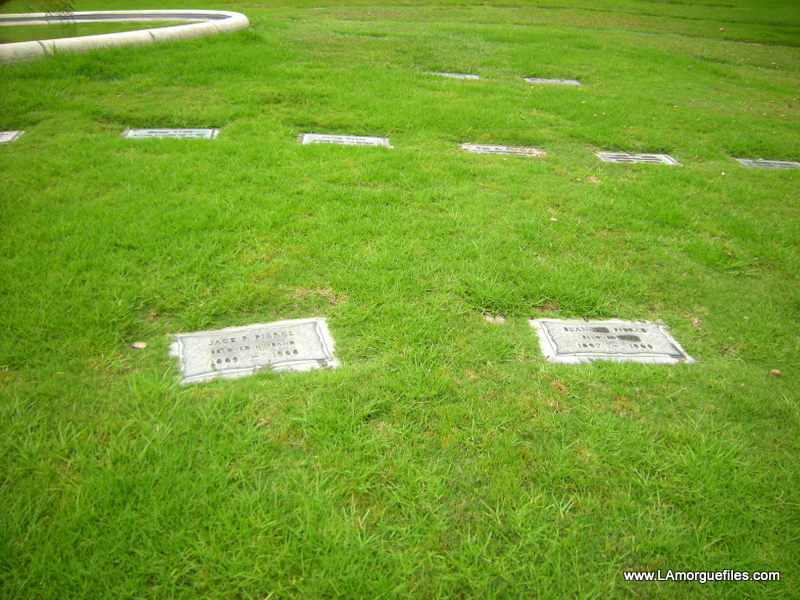
Jack Pierce died in 1968 and is buried with his wife Blanche at Forest Lawn Cemetery Glendale.
In recent years, there is a strong desire to give Pierce a Hollywood Boulevard star for his popular lasting triumphs that have been preserved for decades on the movies he worked on. Pierce undeniably created screen icons to last beyond his lifetime. His contributions still continue to attract droves of attention to his astonishingly memorable, entirely original designs.


.jpg)

.jpg)
.jpg)


.jpg)


.jpg)
.jpg)
.jpg)


.jpg)
.jpg)
.jpg)
.jpg)


.jpg)
.jpg)
.jpg)

.png.jpg)

.jpg)
.jpg)


.jpg)