Saturday, September 27, 2014

Actress AUDREY LONG 1922-2014 RIP


Audrey Long (April 12, 1922 – September 19, 2014) Memorial Video

Audrey Long was an American actress who appeared mainly in low-budget films in the 1940s and early 1950s. Some of her more notable film performances include Tall in the Saddle (1944) opposite John Wayne, Wanderer of the Wasteland (1945), Born to Kill (1947), and Desperate (1947). Long died on September 19, 2014.

Audrey Long was born on April 12, 1922 in Orlando, Florida. She was educated at St. Margaret's School for Girls in Tappahannock, Virginia, Los Gatos High School in Los Gatos, California, and Disputana High School. Her father, C. S. Long, was an Episcopal minister, who became a naturalized American citizen and served as a United States Navy Chaplain. Long worked as a model before becoming an actress.

In 1942, Long made her screen debut in The Male Animal playing a student. That same year, she appeared in Yankee Doodle Dandy as a receptionist. Other bit parts followed in 1943. In May 1943, Long appeared in the Broadway play Sons and Soldiers in the role of Dora Applegate.

In 1944, Long appeared as a leading lady opposite John Wayne in Tall in the Saddle, playing the role of Clara Cardell. The following year she appeared in another Western film, Wanderer of the Wasteland, playing the role of Jeanie Collinshaw.

In 1947, Long had featured roles in two films noirs, Desperate with Steve Brodie and Born to Kill playing Claire Trevor's sister and Lawrence Tierney's wife. She appeared in several low-budget films from 1948 through 1951. In 1952, Long made her last film, Indian Uprising, playing the role of Norma Clemson. She retired from acting that year.

In January 1945, Long married Edward Rubin, a dialogue director; the marriage ended in divorce in 1951. Long married British novelist Leslie Charteris on April 26, 1952 in Montecino, California. Charteris was best known for his novels chronicling the adventures of Simon Templar, in the literary series The Saint. The couple traveled extensively with Charteris using their travel locations for his Saint novels. The two remained married until his death in 1993.

Upon her death, she was cremated and her ashes were placed in a large urn which contains the ashes of her late husband Leslie Charteris. The inscription on the urn reads "Love Never Dies."


Actor DON KEEFER 1916-2014 RIP


Donald Hood "Don" Keefer (August 18, 1916 – September 7, 2014) was an American actor known for the versatility of his roles. He was born in Highspire in Dauphin County near Harrisburg, Pennsylvania. A founding member of The Actors Studio, Keefer's film debut was as Bernard in the 1951 film, Death of a Salesman, based on the Arthur Miller play. His longest-lasting roles were in ten episodes each of the CBS series, Gunsmoke, starring James Arness, and Angel, a 1960-1961 sitcom featuring French-American actress Annie FargĂ©.

Keefer appeared in dozens of television series, including the early anthologies, Fireside Theatre, Armstrong Circle Theatre, The Philco Television Playhouse, the United States Steel Hour, Alcoa Presents: One Step Beyond, and The DuPont Show with June Allyson. In 1957, Keefer appeared as McNair in the episode "Ito of Attu" of ABC Navy Log. That same year, he appeared with David Janssen as the character "Reagan" in "Big Score" of the CBS series, Richard Diamond, Private Detective. In 1958, he appeared as Ed Locke in the episode "Wild Green Yonder" of the syndicated crime drama State Trooper, starring Rod Cameron. In 1959, Keefer appeared as John Alastair in the episode "Death Is a Red Rose" of the Craig Stevens NBC crime drama Peter Gunn. Keefer was cast three times on CBS's anthology, Alfred Hitchcock Presents, as Dr. Elkins in "The Indestructible Mr. Weems" (1957), as Pete Williams in "The Percentage" (1958), and as a tax clerk in "The Kiss-Off" (1961). He had small roles in some feature films, including Sleeper.

Keefer appeared as Cromwell in the 1968 episode "Assignment: Earth" of the NBC science fiction series Star Trek. Earlier, he was cast in three episodes of CBS's The Twilight Zone: as Dan Hollis in "It's a Good Life" (1961), as Spiereto in "Passage on the Lady Anne" (1963), and Fred Danziger in "From Agnes - With Love" (1964).

On May 7, 1950, Keefer married the former Catherine McLeod (July 2, 1921—May 11, 1997), formerly of Texas. At the time of her death, the Keefers were living in Sherman Oaks in the San Fernando Valley of Los Angeles County, California. There are three Keefer sons, Donald McLeod, John H., and Thomas James. He died at the age of 98 on September 7, 2014.


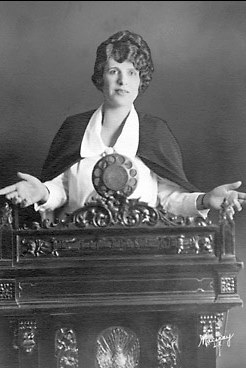
L.A. Evangelist Aimee Semple McPherson's Accidental Overdose 1944 Forest Lawn Glendale


Aimee Semple McPherson (October 9, 1890 – September 27, 1944), also called Sister Aimee, was a Canadian-born evangelist and media celebrity in the 1920s and 1930s. She founded the Foursquare Church. McPherson has been noted as a pioneer in the use of modern media, especially radio, which she drew upon through the growing appeal of popular entertainment in North America.


International Church of the Foursquare Gospel

Weary of constant traveling and having no place to raise a family, McPherson had settled in Los Angeles, where she maintained both a home and a church. McPherson believed that by creating a church in Los Angeles, her audience would come to her from all over the country, she could plant the seed of the Foursquare gospel and tourists would take it home to their communities, thus taking the traveling out of her preaching, while still reaching the masses. For several years she continued to travel and raise money for the construction of a large, domed church building in the Echo Park area of Los Angeles, named Angelus Temple. She raised more than expected and altered the original plans to build a "megachurch" that would draw many followers throughout the years. The church was dedicated on January 1, 1923. It had a seating capacity of 5,300 people and was filled to capacity three times each day, seven days a week. At first McPherson preached every service, often in a dramatic scene she put together to attract audiences. The church eventually evolved into its own denomination, called the International Church of the Foursquare Gospel, which focused on the nature of Christ's character, that he was savior, baptizer with the Holy Spirit, healer and coming king. There were four main beliefs, the first being Christ's ability to transform individuals' lives through the act of salvation. The second focused on a holy baptism, the third was divine healing and the fourth was gospel-oriented heed to the premillennial return of Christ.


McPherson often based her sermons around events that took place in her life and then acted them out on Sunday evening. In August 1925, McPherson decided to charter a plane so she would not miss a Sunday sermon. Aware of the opportunity for publicity, she had at least two thousand followers and members of the press at the takeoff site. The plane failed after takeoff and the landing gear collapsed, sending the nose of the plane into the ground. McPherson boarded another plane the same day and used the experience as the narrative of an illustrated Sunday sermon called "The Heavenly Airplane." The stage in Angelus Temple was set up with two miniature planes and a skyline that looked like Los Angeles. In this sermon, McPherson described how the first plane had the devil for the pilot, sin for the engine and temptation as the propeller. The other plane, however, was piloted by Jesus and would lead one to the Holy City (the skyline shown on stage). The temple was filled beyond capacity. On one occasion, she described being pulled over by a police officer, calling the sermon "Arrested for Speeding." McPherson employed a small group of artists, electricians, decorators and carpenters who built the sets for each Sunday's service. Religious music played by an orchestra. Biographer Matthew Avery Sutton wrote, "McPherson found no contradiction between her rejection of Hollywood values for her use of show business techniques. She would not hesitate to use the devil's tools to tear down the devil's house." Collections were taken at every meeting, often with the admonishment, "no coins, please."


McPherson became a strong supporter of William Jennings Bryan during the 1925 Scopes Trial, in which John Scopes was tried for illegally teaching evolution at a Dayton, Tennessee, school. Bryan and McPherson had worked together in the Angelus Temple and they believed social Darwinism had undermined students' morality. According to McPherson, evolution "is the greatest triumph of Satanic intelligence in 5,931 years of devilish warfare, against the Hosts of Heaven. It is poisoning the minds of the children of the nation" She sent Bryan a telegram saying, "Ten thousand members of Angelus temple with her millions of radio church membership send grateful appreciation of your lion hearted championship of the Bible against evolution and throw our hats in the ring with you."[12] She organized "an all night prayer service, a massive church meeting preceded by a Bible parade through Los Angeles."[13]


Reported kidnapping

On May 18, 1926, McPherson went with her secretary to Ocean Park Beach north of Venice Beach to swim. Soon after arriving, McPherson was nowhere to be found. It was thought she had drowned.

McPherson was scheduled to hold a service that day and her mother Minnie Kennedy preached the sermon instead, saying at the end, "Sister is with Jesus," sending parishioners into a tearful frenzy. Mourners crowded Venice Beach and the commotion sparked days-long media coverage fueled in part by William Randolph Hearst's Los Angeles Examiner and stirring a poem by Upton Sinclair to commemorate the tragedy. Daily updates appeared in newspapers across the country and parishioners held day-and-night seaside vigils. One parishioner drowned whilst searching for the body and a diver died from exposure.

Kenneth G. Ormiston, the engineer for KFSG, had also disappeared. Some believed McPherson and Ormiston, who was married, had developed a close friendship and run off together. After about a month her mother received a ransom note (signed by "The Avengers") which demanded a half million dollars, or else kidnappers would sell McPherson into "white slavery.." Kennedy later said she tossed the letter away, believing her daughter was dead.

Shortly thereafter, on June 23, McPherson stumbled out of the desert in Agua Prieta, Sonora, a Mexican town across the border from Douglas, Arizona. She claimed she had been kidnapped, drugged, tortured and held for ransom in a shack by two people, Steve and Mexicali Rose. Her story also alleged that she had escaped from her captors and walked through the desert for about 13 hours to freedom.

However, her shoes showed no hint of a 13-hour walk in the desert but rather, carried grass stains. The shack was not found. McPherson had vanished wearing a bathing suit. She returned fully dressed, wearing a wristwatch (a gift from her mother) which she had not taken on the swimming trip. A grand jury convened on July 8, 1926, but adjourned 12 days later citing lack of evidence to proceed.

Five witnesses claimed to have seen McPherson at a seaside cottage in Carmel-by-the-Sea. One claimed to have seen Mrs. McPherson at the cottage on May 5 (he later went to see her preach at Angelus Temple on August 8, to confirm she was the woman he had seen at Carmel). His story was confirmed by a neighbor who lived next door to the Carmel cottage, by a woman who rented the cottage to Ormiston (under the name "McIntyre"), by a grocery clerk and a Carmel fuel dealer who delivered wood to the cottage.

The grand jury reconvened on August 3 and took further testimony along with documents from hotels, said to be in McPherson's handwriting. McPherson steadfastly stuck to her story, that she was approached by a young couple at the beach who had asked her to come over and pray for their sick child, that she was then shoved into a car and drugged with chloroform. However, when she was not forthcoming with answers regarding her relationship with Ormiston (now estranged from his wife), the judge charged McPherson and her mother with obstruction of justice. To combat the bad newspaper publicity, McPherson spoke freely about the court trials on her private radio station.


Theories and innuendo abounded, that she had run off with a lover, that she had gone off to have an abortion, taken time to heal from plastic surgery or had staged a publicity stunt. The Examiner newspaper then reported that Los Angeles district attorney Asa Keyes had dropped all charges, which he did on January 10, 1927.

The tale was later lampooned by Pete Seeger in a song called "The Ballad of Aimee McPherson," with lyrics claiming the kidnapping had been unlikely because a hotel love nest revealed "the dents in the mattress fit Aimee's caboose."


Milton Berle's claim

In Milton Berle: An Autobiography, Milton Berle claimed he had a brief affair with McPherson in 1930, saying he met McPherson at the Shrine Auditorium in Los Angeles where both were doing a charity show. Upon seeing her for the first time, Berle recalled, "I was both impressed and very curious ... She was all dignity and class when it came her turn. The house went wild when she walked out into the lights." Backstage, she invited him to see the Angelus Temple. Instead, Berle wrote, the two of them went to lunch in Santa Monica, then to an apartment of hers where McPherson changed into something "cooler [...] a very thin, pale blue negligee." Berle said he could see she was wearing nothing underneath and that she only said, "Come in." Berle said they met for the second and last time at the same apartment a few days later, writing, "This time, she just sent the chauffeur for me to bring me straight to the apartment. We didn't even bother with lunch. When I was dressing to leave, she stuck out her hand. 'Good luck with your show, Milton.' What the hell. I couldn't resist it. 'Good luck with yours, Aimee.' I never saw or heard from Aimee Semple McPherson again. But whenever I hear 'Yes, Sir, That's My Baby,' I remember her." Biographer Matthew Avery Sutton commented, "Berle, a notorious womanizer whose many tales of scandalous affairs were not always true, claimed to have had sex with McPherson on this and one other occasion" both during a year when McPherson was often ill and bedridden. Sutton also wrote that Berle's story of a crucifix in her bedroom was not consistent with the coolness of Pentecostal/Catholic relations during that era.


Later life and career

McPherson carried on with her ministry but fell out of favor with the press. She became caught up in power struggles for the church with her mother and daughter and suffered a nervous breakdown in August 1930.

On September 13, 1931, McPherson married again, to actor and musician David Hutton. The marriage got off to a rocky start. Two days after the wedding Hutton was sued for alienation of affection by Hazel St. Pierre (Hutton claimed he had never met her). He eventually settled the case by paying St. Pierre US$5,000. While McPherson was away in Europe, she was angered to learn Hutton was billing himself as "Aimee's man" in his cabaret singing act. The marriage also caused an uproar within the church: The tenets of Foursquare Gospel, as put forth by McPherson herself, held that one should not remarry while their previous spouse was still alive and McPherson's indeed was. McPherson and Hutton separated in 1933 and divorced on March 1, 1934.


Drawing from her childhood experience with the Salvation Army, in 1936 McPherson opened the temple commissary 24 hours a day, seven days a week and became more active in creating soup kitchens, free clinics and other charitable activities as the Great Depression wore on. With the later outbreak of World War II, she became involved in war bond rallies, with sermons linking the church and Americanism.


Death

On September 26, 1944, McPherson went to Oakland, California, for a series of revivals, planning to preach her popular "Story of My Life" sermon. When McPherson's son went to her hotel room at 10:00 the next morning, he found her unconscious with pills and a half-empty bottle of capsules nearby. She was dead by 11:15.

The autopsy did not conclusively determine the cause of death. She had been taking sleeping pills following sundry health problems (including "tropical fever") in the 1940s. The pills found in the hotel room were Seconal, a strong sedative which had not been prescribed for her and how she obtained them was unknown.

The coroner said she most likely died of an accidental overdose compounded by kidney failure. Seconal has a hypnotizing effect which can make a person forgetful about how much medication has been taken and lead to an overdose. There was some conjecture of suicide but most sources generally agree the overdose was accidental as put forth in the coroner's report.

McPherson is buried in Forest Lawn Memorial Park Cemetery in Glendale, California. The Foursquare Gospel church was led by her son Rolf McPherson for 44 years after her death and claims over eight million members worldwide.


Thursday, September 25, 2014

"Get Smart" Actor Don Adams 2005 Hollywood Forever Cemetery


Don Adams (April 13, 1923 – September 25, 2005) was an American actor, comedian and director. In his five decades on television, he was best known as Maxwell Smart (Agent 86) in the TV situation comedy Get Smart (1965–1970, 1995), which he also directed and wrote. Adams won three consecutive Emmy Awards for his portrayal of Smart (1967–1969). He provided the voices for the animated series Tennessee Tuxedo and His Tales (1963–1966) and Inspector Gadget (1983–1986) as their title characters. He voiced Sid Pickles (appeared all episodes) called Mike and Spike (1993-2005).


Personal life

Adams was married: to Adelaide Efantis Adams, Dorothy Bracken Adams and Judy Luciano. His brother, Richard Paul Yarmy also known as Dick Yarmy (February 14, 1932– May 5, 1992), was an actor. His sister, Gloria (Yarmy) Burton, was a writer.


Adams was an avid gambler — according to his longtime friend Bill Dana, "He could be very devoted to his family if you reminded him about it, [but] Don's whole life was focused around gambling."


Death

Don Adams died on September 25, 2005 at Cedars-Sinai Medical Center in Los Angeles, California from a lung infection and lymphoma. Among his eulogists was his decades-long friend, Barbara Feldon. Adams was interred in Hollywood Forever Cemetery in Hollywood, California. His funeral mass was held at the Church of the Good Shepherd in Beverly Hills. Adams was survived by three daughters from his first marriage, two children from his second marriage, and a daughter from his third marriage; he was also survived by five grandchildren and three great-grandchildren.


"The Maltese Falcon" Actress Mary Astor 1987 Holy Cross Cemetery


Mary Astor (born Lucile Vasconcellos Langhanke; May 3, 1906 – September 25, 1987) was an American actress. Most remembered for her role as Brigid O'Shaughnessy in The Maltese Falcon (1941) with Humphrey Bogart, Astor began her long motion picture career as a teenager in the silent movies of the early 1920s.

She eventually made a successful transition to talkies, but almost saw her career destroyed due to public scandal in the mid-1930s. She was sued for support by her parents and was later branded an adulterous wife by her ex-husband during a custody fight over her daughter. Overcoming these stumbling blocks in her private life, Astor went on to even greater success on the screen, eventually winning the Academy Award for Best Supporting Actress for her portrayal of Sandra Kovak in The Great Lie (1941). She was an MGM contract player through most of the 1940s and continued to act in movies, on television and on stage until her retirement from the screen in 1964. Astor was the author of five novels. Her autobiography became a bestseller, as did her later book, A Life on Film, which was specifically about her career.

Director Lindsay Anderson wrote of her in 1990: "...that when two or three who love the cinema are gathered together, the name of Mary Astor always comes up, and everybody agrees that she was an actress of special attraction, whose qualities of depth and reality always seemed to illuminate the parts she played."[1]


Early life

Mary Astor was born Lucile Vasconcellos Langhanke on May 3, 1906 in Quincy, Illinois, the only child of Otto Ludwig Langhanke (October 2, 1871 – February 3, 1943) and Helen Marie de Vasconcellos (April 19, 1881 – January 18, 1947). Both of her parents were teachers.

Her Berlin-born father immigrated to the United States from Germany in 1891 and became a naturalized citizen; her mother was born in Jacksonville, Illinois, of Portuguese and Irish extraction.[2] Langhanke and de Vasconcellos married on August 3, 1904 in Lyons, Kansas. Astor's father was a German teacher at Quincy High School until the U.S. entered World War I. Later on, he began doing light farming. Astor's mother, who had always wanted to be an actress, taught drama and elocution.

Astor was home-schooled in academics and taught to play the piano by her father, who insisted she practice daily. Her piano talents came in handy when she played piano in her films The Great Lie and Meet Me in St. Louis. In 1919, Astor sent a photograph of herself to a beauty contest in Motion Picture Magazine, becoming a semifinalist. Her father then moved the family to Chicago, where he took a position teaching German in public schools. Lucile took drama lessons and appeared in various amateur stage productions.

The following year, she sent another photograph to Motion Picture Magazine, this time becoming a finalist and then runner-up in the national contest. Her father then moved the family to New York, in order for his pretty daughter to become an actress in motion pictures. He managed all her affairs from September 1920 to June 1930.

A Manhattan photographer, Charles Albin, saw a photograph and asked the young girl with haunting eyes and long auburn hair, whose nickname was "Rusty," to pose for him. The Albin photographs were seen by Harry Durant of Famous Players-Lasky and Lucile was signed to a six-month contract with Paramount Pictures. Her name was changed to Mary Astor during a conference between Paramount chief Jesse Lasky, gossip columnist Louella Parsons, and producer Walter Wanger.


Silent movie career

Astor made her debut in the 1920 film The Scarecrow. At age 14, she appeared in the 1921 film Sentimental Tommy, but her small part in a dream sequence wound up on the cutting room floor. Paramount let her contract lapse. She then appeared in some movie shorts with sequences based on famous paintings. She received critical recognition for the 1921 two-reeler The Beggar Maid. Her first feature-length movie was John Smith (1922), which was followed that same year by The Man Who Played God. In 1923, she and her parents moved to Hollywood.

After appearing in several larger roles at various studios, she was signed by Paramount again, this time to a one-year contract at $500 a week. She had appeared in several more movies when John Barrymore saw a photograph of her in a magazine and wanted her cast in his upcoming movie. On loan-out to Warner Bros., she starred with him in Beau Brummel (1924). The older actor wooed the young actress, but their relationship was severely constrained by Astor's parents' unwillingness to let the couple spend time alone together. Mary after all was only seventeen and legally underage. It was only because Barrymore convinced the Langhankes that his acting lessons required privacy that the couple managed to be alone at all. Their secret engagement ended largely because of the Langhankes' interference and Astor's inability to escape their heavy-handed authority, but also because Barrymore became involved with Astor's fellow WAMPAS Baby Star Dolores Costello, whom he later married.

In 1925, Astor's parents bought a Moorish style mansion with 1-acre (4,000 m2) of land known as "Moorcrest" in the hills above Hollywood. The Langhankes not only lived lavishly off of Astor's earnings, but kept her a virtual prisoner inside Moorcrest. Moorcrest is notable not only for its ornate style, but its place as the most lavish residence associated with the Krotona Colony, a utopian society founded by the Theosophical Society in 1912. Built by Marie Russak Hotchener, a Theosophist with no formal architectural training, the house combines Moorish and Mission Revival styles and contains such Arts and Crafts features as art glass windows (whose red lotus design Astor called "unfortunate"), and Batchelder tiles. Moorcrest, which recently has undergone a multi-million-dollar renovation, is still standing. Before the Langhankes bought it, it was rented by Charlie Chaplin, whose tenure is memorialized by an art glass window featuring the Little Tramp.

Astor's parents were not Theosophists, though the family was friendly with both Marie Hotchener and her husband Harry, both prominent TS members. Marie Hotchener was the person who negotiated Astor's right to a $5 a week allowance (at a time when she was making $2500 a week) and the right to go to work unchaperoned by her mother. The following year when she was 19, Astor, fed up with her father's constant physical and psychological abuse as well as his control of her money, climbed from her second floor bedroom window and escaped to a hotel in Hollywood, as recounted in her memoirs. Hotchener facilitated her return by persuading Otto Langhanke to give Astor a savings account with $500 and the ability to come and go as she pleased. Nevertheless, she did not gain control of her salary until she was 26 years old, at which point her parents sued her for financial support. Astor settled the case by agreeing to pay her parents $100 a month. Otto Langhanke put Moorcrest up for auction in the early 1930s, hoping to get more than the $80,000 he had been offered for it; it went for $25,000.

Astor went on appearing in movies at various studios. When her Paramount contract ended in 1925, she was signed at Warner Bros. Among her assignments was another role with John Barrymore, this time in Don Juan (1926). She was named one of the WAMPAS Baby Stars in 1926, along with Mary Brian, Dolores Costello, Joan Crawford, Dolores del RĂ­o, Janet Gaynor, and Fay Wray.

On loan to Fox Film Corporation, Astor starred in Dressed To Kill (1928), which received good reviews. That same year, she starred in the sophisticated comedy Dry Martini at Fox. She later said that, while working on the latter, she "absorbed and assumed something of the atmosphere and emotional climate of the picture." She said it offered "a new and exciting point of view; with its specious doctrine of self-indulgence, it rushed into the vacuum of my moral sense and captivated me completely." When her Warner Bros. contract ended, she signed a contract with Fox for $3,750 a week.

In 1928, she married director Kenneth Hawks at her family home, Moorcrest. He gave her a Packard automobile as a wedding present and the couple moved into a home high up on Lookout Mountain in Los Angeles above Beverly Hills.

As the movie industry made the transition to talkies, Fox gave her a sound test, which she failed because the studio found her voice to be too deep. Though this was probably due to early sound equipment and the inexperience of technicians, the studio released her from her contract and she found herself out of work for eight months in 1929.


New beginnings

Astor took voice training and singing lessons during her time off, but no roles were offered. Her acting career was then given a boost by her friend, Florence Eldridge (wife of Fredric March), in whom she confided. Eldridge, who was to star in the stage play Among the Married at the Majestic Theatre in Downtown Los Angeles, recommended Astor for the second female lead. The play was a success and her voice was deemed suitable, being described as low and vibrant.

She was happy to be back at work, but her happiness soon ended. On January 2, 1930, while filming sequences for the Fox movie Such Men Are Dangerous, Kenneth Hawks was killed in a mid-air plane crash over the Pacific. Astor had just finished a matinee performance at the Majestic when Florence Eldridge came to her with the news. She was rushed from the theatre and taken to Eldridge's apartment; a replacement, Doris Lloyd, stepped in for the next show. Astor remained with her friend, Eldridge, at her apartment for some time, but she soon went back to work. Shortly after her husband's death, she debuted in her first "talkie," Ladies Love Brutes (1930) at Paramount, which co-starred friend Fredric March.

While her career picked up, her private life remained difficult. After working on several more movies, she suffered delayed shock over her husband's death and had a nervous breakdown. During the months of her illness, she was attended to by Dr. Franklyn Thorpe, whom she married on June 29, 1931.

In May 1932, the Thorpes purchased a yacht and sailed to Hawaii. Astor was expecting a baby in August, but gave birth in June in Honolulu. The child, a daughter, was named Marylyn Hauoli Thorpe: her first name combined her parents' names and her middle name is Hawaiian.

When they returned to Southern California, Astor freelanced and gained the pivotal role of Barbara Willis in MGM's Red Dust (1932) with Clark Gable and Jean Harlow. In late 1932 though, Astor signed a featured player contract with Warner Bros. Meanwhile, besides spending lavishly, her parents invested in the stock market, which turned out in many instances to be unprofitable. They still lived in Moorcrest, Astor had dubbed it a "white elephant", and she refused to maintain the house. She had to turn to the Motion Picture Relief Fund in 1933 to pay her bills.

In 1933, she appeared as the female lead, Hilda Lake, the niece of the murder victims, in The Kennel Murder Case, co-starring with William Powell playing detective Philo Vance. Film critic William K. Everson pronounced it a "masterpiece" in the August 1984 issue of Films in Review. Unhappy with her marriage, she took a break from movie making in 1933 and went to New York by herself. While there, enjoying a whirlwind social life, she met the playwright George Kaufman and they had an affair, which she documented in her diary.[3]


Scandals

A legal battle drew press attention on Astor in 1936. Dr. Franklyn Thorpe divorced Astor in 1935 and a custody battle resulted over their four-year-old daughter, Marylyn.[4] Thorpe threatened to use Astor's diary in the proceedings, which told of her affairs with many celebrities, including George S. Kaufman.[5] The diary was never formally offered as evidence during the trial, but Thorpe and his lawyers constantly referred to it, and its notoriety grew.[6] Astor admitted that the diary existed and that she had documented her affair with Kaufman, but maintained that many of the parts that had been referred to had been forgeries, following the theft of the diary from her desk. The diary was deemed inadmissible as a mutilated document, and a judge ordered it be sealed and impounded. Astor claimed it was then destroyed, with her permission.[7]

Astor had just begun work as Edith Cortwright, opposite Walter Huston in the title role of Dodsworth as news of the diary became public. Producer Samuel Goldwyn was urged to fire her, as her contract had a morality clause, but Goldwyn refused and the movie went on to be a hit.[5]


Career continues

Ultimately, the scandals caused no harm to Astor's career, which was actually revitalized because of the custody fight and the huge amount of publicity it generated; Dodsworth (1936), with Walter Huston, was released to rave reviews, and the public's acceptance assured the studios that she was still a viable commercial property.

In 1937, she returned to the stage in well-received productions of Noël Coward's Tonight at 8:30, The Astonished Heart, and Still Life. She also began performing regularly on radio. Some of her best movies were still to come, including The Prisoner of Zenda (1937), John Ford's The Hurricane (1937), Midnight (1939) and Brigham Young (1940).

In John Huston's The Maltese Falcon (1941), Astor was cast in her best known role as scheming temptress Brigid O'Shaughnessy. The film also starred Humphrey Bogart, with Peter Lorre and Sydney Greenstreet.

Another noteworthy performance was her Oscar-winning role as Sandra Kovak, the selfish, self-centered concert pianist, who willingly gives up her child, in The Great Lie (1941). George Brent played her intermittent love interest, but the film's star was Bette Davis. Davis wanted Astor cast in the role after watching her screen test and seeing her play Tchaikovsky's Piano Concerto No. 1. She then recruited Astor to collaborate with her on rewriting the script, which Davis felt was mediocre and needed work to make it more interesting. Astor further followed Davis's advice and sported a brazenly bobbed hairdo for the role.

The soundtrack of the movie during the scenes where she plays the concerto, with violent hand movements on the piano keyboard, was actually dubbed by pianist Max Rabinovitch. Davis deliberately stepped back to allow Astor to shine in her key scenes. As a result of her performance, Astor won the Academy Award for Best Supporting Actress, thanking Bette Davis and Tchaikovsky in her acceptance speech. Astor and Davis became good friends.

Astor was not propelled into the upper echelon of movie stars by these successes, however. She always declined offers of starring in her own right. Not wanting the responsibility of top billing and having to "carry the picture," she preferred the security of being a featured player.

In 1942 she was reunited with Humphrey Bogart and Sydney Greenstreet in John Huston's Across the Pacific. Though usually cast in dramatic or melodramatic roles, Astor showed a flair for comedy as The Princess Centimillia in the Preston Sturges film, The Palm Beach Story (1942) for Paramount.

In February 1943, Astor's father, Otto Langhanke, died in Cedars of Lebanon Hospital as a result of a heart attack complicated by influenza. His wife and daughter were both at his bedside.

That same year, Astor signed a seven-year contract with MGM, which turned out to be a regrettable mistake. She was kept busy playing what she considered mediocre mother roles which she called "Mothers for Metro." After Meet Me In St. Louis (1944), the studio allowed her to make her Broadway debut in Many Happy Returns (1945). The play was a miserable failure, but Astor received good reviews.

On loan-out to 20th Century Fox, she played a wealthy widow in Claudia and David (1946). She was also loaned to Paramount to play Fritzi Haller in Desert Fury (1947) in which she played the tough owner of a saloon and casino in a small mining town.

Before Helen Langhanke died of a heart ailment in January 1947, Astor said she sat in the hospital room with her mother, who was delirious and did not know her, and listened quietly as Helen told her all about terrible, selfish Lucile. After her death, Astor said she spent countless hours copying her mother's diary so she could read it and was surprised to learn how much she was hated.

Back at MGM, Astor went on being cast in undistinguished, colorless mother roles. One exception was when she played a prostitute in the film noir Act of Violence (1948). The last straw came when she was cast as Marmee March in Little Women (1949). Astor found no redemption in playing what she considered another humdrum mother and became despondent. The studio wanted to renew her contract, promising to give her better roles, but she declined the offer.


Middle years

At the same time, Astor's drinking was getting much worse. She admitted to having a problem with alcohol as far back as the 1930s, but it had never interfered with her work schedule or performance. She hit bottom in 1949 and went into a sanitarium for alcoholics.

In 1951, she made a frantic call to her doctor and told him she had taken too many sleeping pills. She was taken to a hospital and the police reported that she had attempted suicide, this being her third overdose in two years, and the story made headline news. She maintained it had been an accident.

That same year, she joined Alcoholics Anonymous and converted to Roman Catholicism. She credited her recovery to a priest, Peter Ciklic, also a practicing psychologist, who encouraged her to write about her experiences as part of therapy. She also separated from her fourth husband, Thomas Wheelock (a stockbroker she had married on Christmas Day 1945), but did not actually divorce him until 1955.

In 1952, she was cast in the leading role of the stage play The Time of the Cuckoo, which was later made into the movie Summertime (1955), and subsequently toured with it. After the tour, Astor lived in New York for four years and worked in the theatre and on television.

Her TV debut was in The Missing Years (1954) for Kraft Television Theatre. She acted frequently in TV during the ensuing years and appeared on most of the big shows of the time, including The United States Steel Hour, Alfred Hitchcock Presents, Rawhide, Dr. Kildare, Burke's Law, and Ben Casey. In 1954, she appeared in the episode "Fearful Hour" of the Gary Merrill NBC series Justice in the role of a desperately poor and aging film star who attempts suicide to avoid being exposed as a thief.[8] She also played an ex-film star on the Boris Karloff-hosted "Thriller," in an episode titled "Rose's Last Summer."

She starred on Broadway again in The Starcross Story (1954), another failure.

She returned to Southern California in 1956. She then went on a successful theatre tour of Don Juan in Hell directed by Agnes Moorehead and co-starring Ricardo Montalban.

Astor's memoir, My Story: An Autobiography, was published in 1959, becoming a sensation for its day and a bestseller. It was the result of Father Ciklic urging her to write. Though she spoke of her troubled personal life, her parents, her marriages, the scandals, her battle with alcoholism, and other things about her life, she did not mention the movie industry or her career in any detail. In 1971, another book was published, A Life on Film, where she discussed her career. It too became a bestseller. Astor also tried her hand at fiction, writing the novels The Incredible Charley Carewe (1960), The Image of Kate (1962), The O'Conners (1964), Jahre und Tage (1964) (a German translation of The Image of Kate), Goodbye, Darling, be Happy (1965), and A Place Called Saturday (1968).

She appeared in several movies during this time, including A Stranger in My Arms (1959). She made a comeback in Return to Peyton Place (1961) playing Roberta Carter, the domineering mother who insists the "shocking" novel written by Allison Mackenzie should be banned from the school library, and received good reviews for her performance. According to film scholar Gavin Lambert, Astor invented memorable bits of business in her last scene of that film, where Roberta's vindictive motives are exposed.


Later life

After taking a trip around the world in 1964, Astor was lured away from her Malibu home, where she was spending time gardening and working on her third novel, to make what she decided would be her final movie appearance.

She was offered the small role as a key figure, Jewel Mayhew, in the murder mystery Hush... Hush, Sweet Charlotte, starring her friend Bette Davis. She filmed her final scene with Cecil Kellaway at Oak Alley Plantation in southern Louisiana. In "A Life on Film," she described her character as "a little old lady, waiting to die." Astor decided it would serve as her swan song in the movie business. After 109 movies during a career spanning 45 years, she turned in her Screen Actors Guild card and retired.

She later moved to Fountain Valley, California, where she lived near her son, Tono del Campo (from her third marriage to Mexican-born film editor Manuel del Campo) and his family, until 1971. That same year, suffering from a chronic heart condition, she then moved to a small cottage on the grounds of the Motion Picture and Television Country House, the industry's retirement facility in Woodland Hills, where she had her own private table when she chose to eat in the resident dining room.[3] She was photographed by Life magazine riding an adult tricycle on the grounds.

In 1980, she appeared in the television documentary series Hollywood: A Celebration of the American Silent Film, produced by Kevin Brownlow, in which she discussed her roles during the silent film period.[9]


Astor died on September 25, 1987, at age 81, of respiratory failure due to pulmonary emphysema while a patient in the hospital in the Motion Picture House complex. She is interred in Holy Cross Cemetery, Culver City.[3]

Mary Astor has a star on the Hollywood Walk of Fame at 6701 Hollywood Boulevard in Hollywood. She has been quoted as saying: "There are five stages in the life of an actor: Who's Mary Astor? Get me Mary Astor. Get me a Mary Astor type. Get me a young Mary Astor. Who's Mary Astor?"[10]


References

1.^ Lindsay Anderson "Mary Astor," Sight and Sound, Autumn 1990, reprinted in Paul Ryan (ed) Never Apologise: The Collected Writings, 2004, London: Plexus, p431-36, 431

2.^ Distinguished Americans and Canadians of Portuguese Descent

3.^ "Mary Astor Dies at 81 – A 'Maltese Falcon' Star." Los Angeles Times. (09/26/1987) Accessed on August 14, 2007.

4.^ Mary Astor, 81, Is Dead; Star of 'Maltese Falcon'

5.^ Mary Astor Profile

6.^ Trivia – Mary Astor scandal

7.^ Mary Astor, "A Life on Film," Dell Publishing 1967, New York pp125-127

8.^ "Justice". The Classic TV Archive. Retrieved February 8, 2011.

9.^ Brownlow, Kevin; Gill, David (1980). Hollywood: A Celebration of the American Silent Film. (video). Thames Video Production.

10.^ Astor, Mary. A Life on Film. Dell Publishing Company, 1969

11.^ uncredited

12.^ scenes deleted

Wednesday, September 24, 2014

Susan Atkins - Manson Family Murderer Dies in Prison 2009


Susan Denise Atkins (May 7, 1948 – September 24, 2009) was a convicted American murderess who was a member of the "Manson family," led by Charles Manson. Manson and his followers committed a series of nine murders at four locations in California, over a period of five weeks in the summer of 1969. Known within the Manson family as Sadie Mae Glutz, Atkins was convicted for her participation in eight of these killings, including the most notorious, "Tate/LaBianca" murders. She was sentenced to death, which was subsequently commuted to life in prison. Incarcerated from October 1, 1969 until her death, Atkins was the longest-incarcerated female inmate in the California penal system, having been denied parole 18 times.


Susan Atkins died on September 24, 2009, at the Central California Women's facility in Chowchilla. A prison spokesperson announced to reporters that her death was due to natural causes. Her husband, James Whitehouse, subsequently released the following statement:

"Susan passed away peacefully surrounded by friends and loved ones and the incredible staff at the Skilled Nursing Facility at the Central California Women's Facility ... Her last whispered word was 'Amen.' No one (on) the face of the Earth worked as hard as Susan did to right an unrightable wrong."


Tuesday, September 23, 2014

Father of PSYCHO Writer Robert Bloch 1994 Westwood Village Cemetery


(This photo is from my 1989 interview with RB.)

Robert Albert Bloch (April 5, 1917 – September 23, 1994) was a prolific American writer, primarily of crime, horror and science fiction.

Bloch wrote hundreds of short stories and over twenty novels, usually crime fiction, science fiction and, perhaps most influentially, horror fiction (Psycho). He was one of the youngest members of the Lovecraft Circle. H. P. Lovecraft was Bloch's mentor and one of the first to seriously encourage his talent. He was a contributor to pulp magazines such as Weird Tales in his early career, and was also a prolific screenwriter. He was the recipient of the Hugo Award (for his story "That Hell-Bound Train"), the Bram Stoker Award, and the World Fantasy Award. He served a term as president of the Mystery Writers of America. Robert Bloch was also a major contributor to science fiction fanzines and fandom in general. In the 1940s, he created the humorous character Lefty Feep in a story for Fantastic Adventures. He also worked for a time in local vaudeville and tried to break into writing for nationally-known performers. He was a good friend of the science fiction writer Stanley G. Weinbaum. In the 1960s, he wrote three scripts for Star Trek. In 2008, The Library of America selected Bloch’s story “The Shambles of Ed Gein” for inclusion in its two-century retrospective of American True Crime.

Life

Bloch was born in Chicago, the son of Raphael "Ray" Bloch (1884 - 1952), a bank cashier, and his wife Stella Loeb (1880 - 1944), a social worker, both of German-Jewish descent.

Bloch died in 1994 in Los Angeles. He was cremated and interred in the Room of Prayer columbarium at Westwood Village Memorial Park Cemetery in Los Angeles.


Career

During the 1930s, Bloch was an avid reader of the pulp magazine Weird Tales. H. P. Lovecraft, a frequent contributor to that magazine, became one of his favorite writers. As a teenager, Bloch befriended and corresponded with Lovecraft, who gave the promising youngster advice on his own fiction-writing efforts.[1] Bloch's first professional sales, at the age of just seventeen, were to Weird Tales with the short stories "The Feast in the Abbey" and "The Secret in the Tomb". Bloch's early stories were strongly influenced by Lovecraft. Indeed, a number of his stories were set in, and extended, the world of Lovecraft's Cthulhu Mythos. It was Bloch who invented, for example, the oft-cited Mythos texts De Vermis Mysteriis and Cultes des Goules.

The young Bloch appears, thinly disguised, as the character "Robert Blake" in Lovecraft's story "The Haunter of the Dark", which is dedicated to Bloch. In this story, Lovecraft kills off the Bloch character, repaying a courtesy Bloch earlier paid Lovecraft with his tale "The Shambler from the Stars", in which the Lovecraft-inspired figure dies; the story goes so far as to use Bloch's then-current street address in Milwaukee. (Bloch even had a signed certificate from Lovecraft [and some of his creations] giving Bloch permission to kill Lovecraft off in a story.) Bloch later wrote a third tale, "The Shadow From the Steeple," picking up where "The Haunter of the Dark" finished.

After Lovecraft's death in 1937, Bloch continued writing for Weird Tales, where he became one of its most popular authors. He also began contributing to other pulps, such as the science fiction magazine Amazing Stories. He gradually evolved away from Lovecraftian imitations towards a unique style of his own. One of the first distinctly "Blochian" stories was "Yours Truly, Jack the Ripper", which was published in Weird Tales in 1943. The story was Bloch's take on the Jack the Ripper legend, and was filled out with more genuine factual details of the case than many other fictional treatments.[2] Bloch followed up this story with a number of others in a similar vein dealing with half-historic, half-legendary figures such as the Man in the Iron Mask ("Iron Mask," 1944), the Marquis de Sade ("The Skull of the Marquis de Sade," 1945) and Lizzie Borden ("Lizzie Borden Took an Axe...," 1946).

Campaign manager for Carl Zeidler

In 1939, Bloch was contacted by James Doolittle, who was managing the campaign for a little-known assistant attorney in Milwaukee, Wisconsin named Carl Zeidler. He was asked to work on his speechwriting, advertising, and photo ops, in collaboration with Harold Gauer. They created elaborate campaign shows; in Bloch's 1993 autobiography, Once Around the Bloch, he gives an inside account of the campaign, and the innovations he and Gauer came up with — for instance, the original releasing-balloons-from-the-ceiling shtick. He comments bitterly on how, after Zeidler's victory, they were ignored and not even paid their promised salaries. He ends the story with a wryly philosophical point:

If Carl Zeidler had not asked Jim Doolittle to manage his campaign, Doolittle would never have contacted me about it. And the only reason Doolittle knew me to begin with was because he read my yarn ("The Cloak") in Unknown. Rattling this chain of circumstances, one may stretch it a bit further. If I had not written a little vampire story called "The Cloak," Carl Zeidler might never have become mayor of Milwaukee.

Psycho and screenwriting

Bloch became most famous as the author of the novel Psycho, one of the first examples of modern urban horror relying on realism rather than the supernatural[citation needed], which was adapted by Joseph Stefano into the screenplay for the 1960 film of the same name, directed by Alfred Hitchcock. He had written an earlier split-personality short story, "The Real Bad Friend," which appeared in the February, 1957 Mike Shayne Mystery Magazine, that foreshadowed the 1959 novel Psycho. His best-known work as a screenwriter is probably The Night Walker (1964), which he wrote for William Castle, although he also penned several scripts for the original series of Star Trek including "What Are Little Girls Made Of?," "Wolf in the Fold," and "Catspaw." He seemed happiest, among his television work, with his contributions to the Boris Karloff-hosted series Thriller.

Bloch also contributed to Harlan Ellison's science fiction anthology, Dangerous Visions. His story, "A Toy for Juliette," evoked both the Marquis de Sade and Jack the Ripper. In fact, Ellison's own contribution to the anthology was a direct follow-up of Bloch's, and was titled "The Prowler in the City at the Edge of the World."

Writings on Bloch

An early reference work by Australia's Graeme Flanagan, Robert Bloch: A Bio-Bibliography (1979) includes valuable material including interviews with Bloch and memoirs by fellow writers such as Harlan Ellison, Mary Elizabeth Counselman and Fritz Leiber.

Randall D. Larson has authored three reference books about Robert Bloch: The Robert Bloch Reader's Guide (1986, a literary analysis of Bloch's entire output through 1986), The Complete Robert Bloch (1986, an illustrated bibliography of Bloch's writing), and The Robert Bloch Companion (1986, collected interviews). In addition, an issue of Paperback Parade magazine (No. 39, August 1994) contains two articles by Larson on collecting Bloch - "Paperblochs: Robert Bloch in Paperback" and "Robert Bloch in Paperback."

There is an essay on Bloch's work, with particular reference to the novels Psycho and The Scarf, in S. T. Joshi's book The Modern Weird Tale (2001). Joshi examines Bloch's literary relationship with Lovecraft in a further essay in The Evolution of the Weird Tale (2004).

A new essay collection focusing on a range of Bloch's work is Robert Bloch: the Man Who Collected Psychos, edited by Benjamin J. Szumskyj (McFarland, 2009).


Bibliography

Novels

The Scarf (1947, rev. 1966)
Spiderweb (1954)
The Kidnapper (1954)
The Will to Kill (1954)
Shooting Star (1958) (note: published in a double volume with the ss collection Terror in the Night)
This Crowded Earth (1958)
Psycho (1959) (adapted into the 1960 film, Psycho, directed by Alfred Hitchcock; later remade in 1998 by Gus Van Sant)
The Dead Beat (1960)
Firebug (1961)
The Couch (1962)
Terror (1962)
Ladies Day / This Crowded Earth (1968)
The Star Stalker (1968)
The Todd Dossier (1969)
Sneak Preview (1971)
It's All in Your Mind (1971)
Night World (1972)
American Gothic (1974)
Strange Eons (1978) (a Cthulhu Mythos novel)
There Is a Serpent in Eden (1979)
Psycho II (1982) (unrelated to the film of the same name)
Night of the Ripper (1984)
Unholy Trinity (1986) (collects The Scarf, The Couch and The Dead Beat)
Lori (1989)
Screams: Three Novels of Suspense (collects The Will to Kill, Firebug and The Star Stalker)
Psycho House (1990) (unrelated to the films Psycho II, Psycho III or Psycho IV: The Beginning)
The Jekyll Legacy (1991)
Yours Truly, Jack the Ripper (1991) (Pulphouse; a 100-copy hardbound signed edition of Bloch's famous short story)
The Thing (1993) (Pretentious Press; a limited edition of 85 copies, only 9 bound in cloth, of the author's first appearance in print - a parody of H.P. Lovecraft which originally appeared in the April 1932 issue of The Quill, his Lincoln High School literary magazine)
Psycho - The 35th Anniversary Edition (1994) (Gauntlet Press; limited edition of 500 copies; the last work to be signed by Bloch before his death; includes a new intro by Richard Matheson and a new Afterword by Ray Bradbury)

Short-story collections

The Opener of the Way (1945)
Sea Kissed (1945)
Terror in the Night (1958) (note: published in a double volume with the novel Shooting Star)
Pleasant Dreams: Nightmares (1960)
Blood Runs Cold (1961)
Nightmares (1961)
More Nightmares (1961)
Yours Truly, Jack the Ripper (1962)
Atoms and Evil (1962)
Horror 7 (1963)
Bogey Men (1963)
House of the Hatchet (1965)
The Skull of the Marquis de Sade (1965)
Tales in a Jugular Vein (1965)
Chamber of Horrors (1966)
The Living Demons (1967)
Dragons and Nightmares (1968)
Bloch and Bradbury (1969)
Fear Today, Gone Tomorrow (1971)
House of the Hatchet (1976)
The King of Terrors (1977)
The Best of Robert Bloch (1977)
Cold Chills (1977)
Out of the Mouths of Graves (1978)
Such Stuff as Screams Are Made Of (1979)
Mysteries of the Worm (1981)
Midnight Pleasures (1987)
Lost in Space and Time With Lefty Feep (1987)
The Complete Stories of Robert Bloch: Volume 1: Final Reckonings (1987)
The Complete Stories of Robert Bloch: Volume 2: Bitter Ends (1987)
The Complete Stories of Robert Bloch: Volume 3: Last Rites (1987)
Fear and Trembling (1989)
Mysteries of the Worm (rev. 1993) from Chaosium books
The Early Fears (1994)
Flowers from the Moon and Other Lunacies (1998)
The Lost Bloch: Volume 1: The Devil With You! (1999)
The Lost Bloch: Volume 2: Hell on Earth (2000)
The Lost Bloch: Volume 3: Crimes and Punishments (2002)
The Reader's Bloch: Volume 1: The Fear Planet and Other Unusual Destinations (2005)
The Reader's Bloch: Volume 2: Skeleton in the Closet and Other Stories (2009)

Non-fiction

The Eighth Stage of Fandom (1962)
Out of My Head (1986)
Once Around the Bloch: An Unauthorized Autobiography (1993)
Robert Bloch: Appreciations of the Master (1995)

Movies

The following is a list of films based on Bloch's work. For some of these he wrote the original screenplay; for others, he supplied the story or a novel (as in the case of Psycho) on which the screenplay was based.

Psycho (1960)
The Couch (1962)
The Cabinet of Dr Caligari (1962)
Strait-Jacket (1964)
The Night Walker (1964)
The Skull (1965)
The Psychopath (1966)
Torture Garden (1967)
The Deadly Bees (1967)
The House That Dripped Blood (1970)
Asylum (1972)
The Cat Creature (Tv movie 1973)
The Dead Don't Die (Tv movie 1974)
The Amazing Captain Nemo (1978)
Psycho (1998)

References

1.^ Haining, Peter (1975). The Fantastic Pulps. Victor Gollancz Ltd. ISBN 0-575-02000-8.
2.^ Zinna, Eduardo. "Yours Truly, Jack the Ripper". Casebook: Jack the Ripper.