Thomas Leo McCarey (October 3, 1898 – July 5, 1969) was a three-time Academy Award winning American film director, screenwriter and producer. He was involved in nearly 200 movies, the most well known today being Duck Soup, Make Way for Tomorrow, The Awful Truth, Going My Way and An Affair To Remember.[1]
While focusing mainly on screwball comedies during the 1930s, McCarey turned towards producing more socially conscious and overtly religious movies during the 1940s, ultimately finding success and acclaim in both genres. McCarey was one of the most popular and established comedy directors of the pre-World War II era.
Career
Born in Los Angeles, California, McCarey attended St. Joseph’s Catholic school and Los Angeles High School.[2] His father was Thomas J. McCarey, whom the Los Angeles Times called "the greatest fight promoter in the world." Leo McCarey would later make a boxing comedy with Harold Lloyd called The Milky Way (1936).[3]

Leo McCarey graduated from the University of Southern California law school[4] and besides the law tried mining, boxing, and songwriting[5] before becoming an assistant director to Tod Browning in 1919.[2] It was McCarey's boyhood friend, the actor and future fellow director David Butler, who referred him to Browning.[6] Browning convinced McCarey, despite his photogenic looks, to work on the creative side as a writer rather than as an actor. McCarey then honed his skills at the Hal Roach Studios. Roach had hired him as a gagman in 1923, after McCarey had impressed him with his sense of humor, following a game of handball together at a sports club. McCarey initially wrote gags for the Our Gang series and other studio stars, then produced and directed shorts, including two-reelers with Charley Chase. Chase would in fact become McCarey's mentor. Upon the comedian's death in 1940, McCarey was quoted as saying, "Whatever success I have had or may have, I owe to his help because he taught me all I know." The two men were especially compatible, as they both enjoyed a hobby on the side trying to write popular songs. While at Roach, McCarey, according to later interviews, cast Stan Laurel and Oliver Hardy together and guided development of their onscreen characters, thus creating one of the most enduring comedy teams of all time. He only officially appeared as director of the duo's shorts We Faw Down (1928), Liberty (1929) and Wrong Again (1929), but wrote many screenplays and supervised the direction by others. By 1929, he was vice-president of production for the studio. Less well known from this period are the shorts he directed with Max Davidson when Roach put together the Irish-American McCarey with the Jewish-American actor for a series of "dialect comedies." These shorts such as Pass The Gravy have been rediscovered in recent years, after their exhibition in 1994 at the Giornate del Cinema Muto in Pordenone Italy. Pass The Gravy was added to the National Film Registry at the Library of Congress in 1999.[7]


In the sound era McCarey focused on feature-film direction, working with many of the biggest stars of the era, including Gloria Swanson (Indiscreet, 1931), Eddie Cantor (The Kid From Spain, 1932), the Marx Brothers (Duck Soup, 1933), W.C. Fields (Six of a Kind, 1934), and Mae West (Belle of the Nineties, 1934).

A series of six films at Paramount came to a crashing halt with his production of Make Way For Tomorrow in 1937. While the story of an elderly couple who have to be separated for economic and family reasons during the Depression was not without humor in its treatment, the results were too unpopular at the box office and the director was let go. Nonetheless the film was recognized early on for its importance by being selected for the permanent collection of the recently formed Museum Of Modern Art in New York City. In later years it became canonical, and even considered by some as McCarey's masterpiece, due to perceptive champions such as Bertrand Tavernier, Charles Silver and Robin Wood.

Later in 1937, invited to Columbia, McCarey earned his first Academy Award for Directing for The Awful Truth, with Irene Dunne and Cary Grant, a screwball comedy that launched Cary Grant's unique screen persona, largely concocted by McCarey (Grant copied many of McCarey's mannerisms). Along with the similarity in their names, McCarey and Cary Grant shared an eerie physical resemblance, making mimicking McCarey's intonations and expressions even easier for Grant. As writer/director Peter Bogdanovich notes, "After The Awful Truth, when it came to light comedy, there was Cary Grant and then everyone else was an also-ran." After the success of The Awful Truth McCarey could have become, like Frank Capra , a Columbia contract director with a certain independence, but went his own way, selling the story that would become The Cowboy And The Lady to Sam Goldwyn and moving to RKO for three films. A car accident in 1940 prevented him from directing his production of My Favorite Wife, a kind of follow up to The Awful Truth with the same two stars, so it was turned over to Garson Kanin though McCarey worked on some of the editing.[8]


McCarey was a devout Roman Catholic and deeply concerned with social issues. During the 1940s, his work became more serious and his politics more conservative. In 1944 he directed Going My Way, a story about an enterprising priest, the youthful Father Chuck O'Malley, played by Bing Crosby, for which he won his second Best Director Oscar and Crosby won a Best Actor Oscar. His share in the profits of this smash hit gave McCarey the highest reported income in the U.S. for 1944, and its follow-up, The Bells of St. Mary's (1945), which paired Crosby with Ingrid Bergman and made by McCarey's newly formed production company, was similarly successful. According to Paul Harrit in Great Directors, McCarey acknowledged that the film is largely based on his aunt, Sister Mary Benedict, who died of typhoid.[2]
McCarey testified as a friendly witness early on in the hearings of the Un-American Activities Committee in Congress, which was concerned about supposed Communist activity in Hollywood. The public reacted negatively to some of his films after World War II. For instance, his anti-communist film My Son John (1952) failed at the box office. But five years later, he co-wrote, produced, and directed An Affair to Remember starring Cary Grant and Deborah Kerr, a remake (with precisely the same script) of his 1939 film Love Affair with Irene Dunne and Charles Boyer.[9] In 1993, the hugely popular rom-com Sleepless In Seattle by Nora Ephron made such frequent references to An Affair To Remember that it gave the older film a whole new lease of life in revivals, cable TV, and video, with the result that it is probably McCarey's most popular and accessible film today.
He followed this hit with Rally 'Round the Flag, Boys! (1958), a comedy starring Paul Newman and Joanne Woodward. Some years later he directed his last picture, the poorly received Satan Never Sleeps (1962), like My Son John a somewhat strident critique of Communism.
Auteurist critic Andrew Sarris has said McCarey "represents a principle of improvisation in the history of the American film."[10] Through most of his career, McCarey's filming method, rooted in the silents, was to drastically alter the story ideas, bits of business, and dialogue in the scripts previously provided to the studios and the actors. He would usually sit at a piano and doodle as the sometimes exasperated crew waited for inspiration. As Bing Crosby said about Going My Way "I think probably 75 per cent of each day's shooting was made up on the set by Leo."[11] While this technique was responsible for a certain awkwardness and some rough edges in the finished works, many of McCarey's scenes had a freshness and spontaneity lacking in the typical mainstream Hollywood cinema. He was not the only director of his time to work this way: fellow comedy directors Gregory La Cava, Howard Hawks and George Stevens – the last also a Roach graduate – were known for their use of improvisation on the set.
French director Jean Renoir once paid the great tribute of saying that "Leo McCarey understood people better than any other Hollywood director."[12] American critic George Morris may have said it even better: "Leo McCarey was a very special man, with a very special understanding of the human heart."
Quotes
"I only know I like my characters to walk in clouds, I like a little bit of the fairy tale. As long as I'm there behind the camera lens, I'll let somebody else photograph the ugliness of the world." - Leo McCarey[13]
"It's larceny to remind people of how lousy things are and call it entertainment."[3]
"I have a theory...with a very exact name: "the ineluctability of incidents," which is applied to the construction of all of my films. To formulate it another way: if something happens, some other thing inevitably flows from it. Like night and day follow each other, events are linked together, and I always develop my story in this way, in a series of incidents, of events which succeed each other and provoke each other. I never really have intrigue."[14]
Death
Leo McCarey died on July 5, 1969, aged 70, from emphysema.[1][15] He was interred in the Holy Cross Cemetery in Culver City, California. His brother, director Ray McCarey, had died 21 years earlier.In 1978, Leo McCarey's production records, including scripts,budgets, and correspondence were donated to the Charles Feldman Library at the American Film Institute in Beverly Hills.[16]
Partial filmography
(As director, unless otherwise specified)
Isn't Life Terrible? (1925 short)
Mighty Like a Moose (1926 short)
Sugar Daddies (1927 short)
Pass the Gravy (1928 short)
Should Married Men Go Home? (1928 short), also writer
Habeas Corpus (1928 short)supervisor
We Faw Down (1928 short)
Liberty (1929 short), also writer
Wrong Again (1929 short)
Big Business (1929 short), supervisor and uncredited writer
Indiscreet (1931)
Duck Soup (1933)
Belle of the Nineties (1934)
Six of a Kind (1934)
Ruggles of Red Gap (1935)
The Milky Way (1936)
Make Way for Tomorrow (1937), also producer
The Awful Truth (1937), also producer
The Cowboy and the Lady (1938), writer
Love Affair (1939), also producer
My Favorite Wife (1940), producer and writer
Once Upon a Honeymoon (1942), also writer and uncredited producer
Going My Way (1944), also producer
The Bells of St. Mary's (1945), also producer and writer
Good Sam (1948), also producer and writer
My Son John (1952)
An Affair to Remember (1957), also producer and writer
Rally 'Round the Flag, Boys! (1958), also producer
Satan Never Sleeps (1962), also producer
Academy Awards
Wins[17]
1937 Best Director: The Awful Truth
1944 Best Director: Going My Way
1944 Best Writing (Original Story): Going My Way
Nominations
1939 Best Writing (Original Story): Love Affair
1940 Best Writing (Original Story): My Favorite Wife
1945 Best Director: The Bells of St. Mary's
1952 Best Writing (Motion Picture Story): My Son John
1957 Best Music, Song: "An Affair To Remember" from An Affair to Remember
References
1. "Leo McCarey, Director, is Dead. Won Oscars for Going My Way. Was Also a Winner in 1937 of Academy Award for 'The Awful Truth'". New York Times. July 6, 1969.
2. Harrit, Paul. "Leo McCarey", Great Directors, Issue 23, Senses of Cinema
3. Bann, Richard W., "Leo McCarey at Hal Roach Studios, 1998
4. "Leo McCarey Biography". Biography.com.
5. "Leo McCarey", Harvard Film Archive
6. Jacques Lourcelles, Anthologie Du Cinema, 1973
7. Max Davidson, by Richard M. Roberts and Robert Farr, Classic Images, July 2002
8. Gene Fowler, Minutes Of The Last Meeting, Viking Press, 1954
9. Leo McCarey Biography, Turner Classic Movies
10. Andrew Sarris, The American Cinema, 1968
11. Remembering Leo McCarey, Action Magazine, September–October 1969
12. Reported by Andrew Sarris in "The American Cinema". New York: E.P. Dutton and Co., 1968, p. 100
13. "Leo McCarey", They Shoot Pictures, Don't They
14. Interview by Serge Daney and Jean-Louis Noames, Cahiers Du Cinema, February 1965
15. Obituary Variety, July 9, 1969, page 55.
16. Variety. April 5th, 1978
17. "Oscars.org -- Leo McCarey". Academy of Motion Picture Arts and Sciences.
Brenda Joyce (February 25, 1917[3] – July 4, 2009[4]) was an American film actress. She was born Betty Graftina Leabo in Excelsior Springs, Missouri, although family and friends referred to her as Graftina.
Career
Although she appeared in many B-movies of the 1940s, she had a prominent supporting role in the major 1939 film The Rains Came opposite George Brent (above) and Myrna Loy, and was cast as Maris Hanover in the 1942 film, Little Tokyo, U.S.A.. She is best-remembered as the seventh actress to play Jane in the Tarzan series of films. She succeeded Maureen O'Sullivan in the series and appeared in the role five times.
Her first four appearances as Jane were opposite Johnny Weissmuller. However, her last performance as Jane, in Tarzan's Magic Fountain (1949), was with Lex Barker as Tarzan. Joyce and Karla Schramm, from the silent era, were the only two actresses to play Jane opposite two different actors playing Tarzan.
Personal life
Brenda Joyce retired from acting in 1949. She was married to Owen Ward from 1941 until their divorce in 1949; they had three children, Pamela Ann, Timothy Owen and Beth Victoria.
Death
Joyce died on July 4, 2009 in a nursing home in Santa Monica, California.[4] Her ashes are at Westwood Village Cemetery.
Selected filmography
Public Deb No. 1 (1940)
Thumbs Up (1943)
References
1. "Brenda Joyce Brenda Joyce, who died on July 4 aged 97, swung to fame opposite Johnny Weissmuller and then Lex Barker as the seventh actress to play Jane in the durable Tarzan series of films.". The Daily Telegraph (London). July 24, 2009.
2. http://sfscope.com/2009/07/actress-brenda-joyce-dies.html
3. Other sources indicate 1912 or 1915 as her year of birth. A friend of Joyce's confirmed after her death that she was 92, making 1917 the most likely date of birth.
4. Barnes, Mike (July 17, 2009). "'Tarzan' actress Brenda Joyce dies". Hollywood Reporter.
Joe "Curly Joe" DeRita (July 12, 1909 – July 3, 1993), born Joseph Wardell, was an American actor and comedian who is best known for his stint as the sixth member of the Three Stooges, and the second to be billed as Curly, under the persona of "Curly Joe."
Early life
DeRita was born into a show-business family in Philadelphia, Pennsylvania, the son of Florenz (DeRita) and Frank Wardell, and of French-Canadian and English ancestry.[2] He was the youngest of his 5 brothers. Wardell's father was a stage technician, his mother a professional stage dancer, and the three often acted on stage together from his early childhood. Taking his mother's maiden name, DeRita, the actor joined the burlesque circuit during the 1920s, gaining fame as a comedian. During World War II, DeRita joined the USO, performing through Britain and France with such celebrities as Bing Crosby and Randolph Scott.
Career with the Three Stooges
The Three Stooges (Curly Howard, Larry Fine and Moe Howard) had been making short comedies for Columbia Pictures since 1934. Curly suffered a stroke on May 6, 1946, forcing him to retire. He died on January 18, 1952 at the age of 48. His brother Shemp Howard, the original third Stooge before leaving the act in 1932 for a solo career, only wanted to be a temporary replacement. Joe DeRita was also starring in his own series at Columbia (in such entries as The Good Bad Egg, Wedlock Deadlock, Slappily Married, and Jitter Bughouse). Stooges producer-director Jules White attempted to recruit Joe DeRita for the Three Stooges, because he wanted "another Curly." However, the strong-willed DeRita refused to change his act or imitate another performer, and White eventually gave up on DeRita (DeRita's own short-subject contract was not renewed after four films, the final entry being Jitter Bughouse).[3] DeRita returned to burlesque, and recorded a risque LP in 1950 called Burlesque Uncensored.
When Shemp Howard died unexpectedly of a Heart Attack on November 22, 1955 at age 60, he was succeeded by Joe Besser. Columbia eventually shut down the short-subjects department at the end of 1957, and Besser quit the act to take care of his ailing wife. The two remaining Stooges seriously considered retirement. Then Columbia's television subsidiary, Screen Gems, syndicated the Stooges' old comedies to television, and The Three Stooges were suddenly television superstars.
Moe and Larry now had many job offers, but were in need of a "third Stooge." Larry had seen DeRita in a Las Vegas stage engagement, and told Moe that DeRita would be "perfect for the third Stooge." Howard and Fine invited DeRita to join the act, and this time he readily accepted. When he first joined the act in 1958 (shortly after appearing in a dramatic role in the Gregory Peck western, The Bravados), DeRita wore his hair in a style similar to that of former Stooge Shemp Howard, and did so during initial live stage performances. However, with television's restored popularity of the Three Stooges shorts featuring Curly Howard, it was suggested that Joe shave his head in order to look more like "Curly." At first, DeRita sported a crew cut; this eventually became a fully shaven head. Because of his physical resemblance to both Curly and Joe Besser, and to avoid confusion with his predecessors, DeRita was renamed Curly Joe.

The team embarked on a new series of six theatrical Three Stooges films, including 1959's Have Rocket, Will Travel (DeRita's on-screen debut with the Stooges) and Snow White and the Three Stooges. Aimed primarily at children, these films rarely reached the same comedic heights as their shorts and often recycled routines and songs from the older films. (Moe and Larry's advanced ages - Moe was 62 and Larry 57 at the time of the first Curly Joe film - plus pressure from the PTA and other children's advocates, led to the toning-down of the trio's trademark violent slapstick.) While DeRita's physical appearance was vaguely reminiscent of the original "Curly," his characterization was milder, and not as manic or surreal. Curly Joe also showed a bit more backbone, even occasionally talking back to Moe, calling him "buddy boy."

Through the 1960s, DeRita remained a member of the team, participating in animated cartoons (with live-action introductions) and a failed television pilot titled Kook's Tour. However, Larry Fine suffered a paralyzing stroke in January 1970 (thus he died on January 24, 1975 at 72) during production of Kook's Tour, putting all new Stooges-related material on hold. Emil Sitka was named as "the middle stooge", but never got to perform with the team. Before Moe's death on May 4, 1975 at age 77, the Stooges (with Sitka succeeding the deceased Larry) had planned to film an R-rated movie called The Jet Set (later produced with the surviving members of the Ritz Brothers and released as Blazing Stewardesses).
In the 1970s, at an ailing Moe's suggestion, DeRita attempted to form a truly "new" Three Stooges. He recruited burlesque and vaudeville veterans Mousie Garner and Frank Mitchell, who had worked with original Stooges organizer Ted Healy decades earlier in an abortive attempt to replace the Stooges after they had split from Healy (Mitchell had also actually replaced Shemp as the "third stooge" in a 1929 Broadway play), to replace Moe and Larry for nightclub engagements, but DeRita himself was eventually forced by health issues to retire, ending the group.
On August 30, 1983, the Three Stooges received a star on the Hollywood Walk of Fame. Joe Besser was the only stooge to show up at the ceremony because of DeRita's illness; Stooges co-actor Emil Sitka spoke for him. Sometime after the new star award, Besser eventually fell ill with Heart Failure which led to his death on March 1, 1988 at age 80.
Personal life
DeRita was married to a chorus girl named Bonnie Brooks in 1935. After her death in 1965, he married Jean Sullivan.
DeRita is unique among all of the people to have been a member of The Three Stooges in that he was not Jewish.
Death
On July 3, 1993, DeRita died of pneumonia at age 83, at the Motion Picture and Television Country House and Hospital in Woodland Hills, California where Curly and Larry had died previously, nine days before DeRita's 84th birthday. [4] DeRita is interred in a grave at the Pierce Brothers Valhalla Memorial Park Cemetery in North Hollywood, California; his tombstone reads "The Last Stooge," as he outlived Joe Besser by 5 years (although Emil Sitka died in 1998 and Mousie Garner died in 2004, their position as "official" Stooges is debatable as they never appeared on screen in this capacity).
Legacy
With Moe Howard and Larry Fine in 1959
Although DeRita enjoyed working with Moe and Larry and made a living doing it, he was not a fan of the Stooges' humor. He once told an interviewer the following:
“ I don't think the Stooges were funny. I'm not putting you on, I'm telling the truth — they were physical, but they just didn't have any humor about them. Take, for instance, Laurel and Hardy. I can watch their films and I still laugh at them and maybe I've seen them four or five times before. But when I see that pie or seltzer bottle, I know that it's not just lying around for no reason. It's going to be used for something. I was with the Stooges for 12 years and it was a very pleasant association but I just don't think they were funny.[5] ”
Despite his indifference to the team's brand of comedy, he had nothing but respect and appreciation for the Stooges, proudly saying "Moe and Larry were the best. We worked well together and enjoyed every minute of it."[5]
In popular culture
In the spring of 2000, ABC aired a made-for-television movie about the Stooges, with actor Peter Callan playing the role of Joe DeRita.
References
1. Reighter, Frank. The Three Stooges Journal #133 (2010) p. 5
2. http://www.stoogeworld.com/_Biographies/Curly_Joe.htm
3. Forrester, Jeff (2004). The Three Stooges: The Triumphs and Tragedies of the Most Popular Comedy Team of All Time. Donaldson Books.
4. Pace, Eric (1993-07-05). "Curly-joe DeRita, 83, Last of the Three Stooges". The New York Times.
5. Lenburg, Jeff; Howard Maurer, Joan; Lenburg, Greg; (1982, rev. 2012). The Three Stooges Scrapbook, p. 59, 93, Citadel Press.
James Gilmore "Jim" Backus (February 25, 1913 – July 3, 1989) was an American radio, television, film, and voice actor. Among his most famous roles are the voice of nearsighted cartoon character Mr. Magoo, the rich Hubert Updike III on the radio version of The Alan Young Show, Joan Davis's character's husband (a domestic court judge) on TV's I Married Joan, James Dean's character's father in Rebel Without a Cause and Thurston Howell, III on the 1960s sitcom Gilligan's Island. He also starred in his own show of one season, The Jim Backus Show, also known as Hot off the Wire. An avid golfer, Backus made the 36-hole cut at the 1964 Bing Crosby Pro-Am tournament.
Early life
James Gilmore Backus was born February 25, 1913, in Cleveland, Ohio, and raised in Bratenahl, Ohio, a wealthy village surrounded by greater Cleveland. He was the son of Russell Gould Backus, a mechanical engineer,[1] and Daisy Taylor (née Gilmore) Backus. Backus attended Shaw High School in East Cleveland, Ohio. Backus was expelled from the Kentucky Military Institute for riding a horse through the mess hall.
Career
Acting
Backus was acting on radio as early as 1940, playing the role of millionaire aviator Dexter Hayes on Society Girl on CBS.[2] He had an extensive career and worked steadily in Hollywood over five decades, often portraying characters with an "upper-crust," New England-like air, such as Thurston Howell, III in Gilligan's Island. He appeared in A Dangerous Profession (1949) (as well as narrating), Deadline – U.S.A. (1951), with Humphrey Bogart, Pat and Mike (1952), with Spencer Tracy and Katharine Hepburn, Rebel Without a Cause (1955), The Pied Piper of Hamelin (1957), and It's a Mad, Mad, Mad, Mad World (1963). He also made appearances on The Beverly Hillbillies (1962).


Backus was the voice of the nearsighted cartoon character Mr. Magoo. In 1952, he had a brief scene in Don't Bother to Knock with Marilyn Monroe. Years later, when Backus was a frequent talk show guest, he would recount the time Monroe urgently beckoned him into her dressing room. Once there, she exclaimed in her breathy voice, "Do Mr. Magoo!"

He frequently could be heard on prime-time radio programs in the postwar era, including The Jack Benny Program, and portrayed an exceedingly vain character named Hartley Benson on The Mel Blanc Show on the CBS Radio Network; as well as a similar character named Hubert Updike on The Alan Young Show on the NBC Radio Network. He also starred on the short lived variety program The Jim Backus Show on the ABC Radio Network in 1957 and 1958, when that network changed its name to the American Broadcasting Network (ABN) and tried out a "Live and Lively" format of "Big Time Radio" with orchestras and audiences. Backus costarred in the comedy show I Married Joan from 1952 to 1955, portraying the husband of Joan Davis.
In stark contrast to his usual affluent characters, he appeared on The Brady Bunch as an old gold prospector, a role he also played on a Gilligan's Island episode. He also appeared in the final season episode "The Hustler" in which he plays Mike's boss, Mr. Matthews.
Backus stayed with Gilligan's Island between 1964 and 1967 and did revivals of the TV series in TV films made between 1978 and 1982 (though in the third and final film, The Harlem Globetrotters on Gilligan's Island, ill health forced him to only make a cameo appearance). He also did revivals of Mr. Magoo from 1964 to 1977, which included The Famous Adventures of Mr. Magoo and What's New, Mr. Magoo.
In 1977, Backus appeared in "Never Con a Killer," the pilot for the ABC crime drama The Feather and Father Gang.
Writing and recording
Backus and his wife, Henny Backus, co-wrote several humorous books, including: ...Only When I Laugh, his autobiography, Backus Strikes Back, a memoir, Forgive Us Our Digressions: An Autobiography, and What Are You Doing After the Orgy? — the title taken from a line Backus spoke in the 1965 film John Goldfarb, Please Come Home! He also co-wrote the 1971 family film Mooch Goes to Hollywood, about a dog who tries to become a movie star.
In the late 1950s, he made two novelty 45 rpm records, "Delicious" and "Cave Man." In 1974, a full-length comedy LP album was released on the DORE label under the title The Dirty Old Man, with sketches written by Bob Hudson and Ron Landry, who also appear on the album, along with voice-actress Jane Webb. Backus also played the voice of God in the recording of Truth of Truths, a 1971 rock opera based on the Bible.
Television commercials
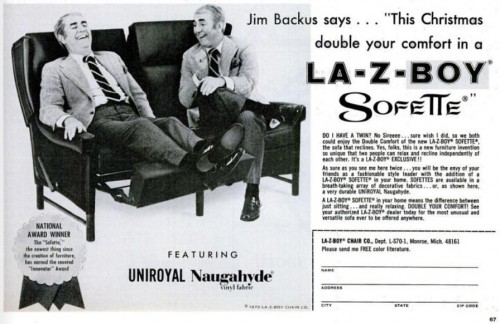
Backus acted in several television commercials. As Mr. Magoo, he also helped advertise the General Electric line of products over the years.[3] He was also spokesman for La-Z-Boy furniture during the 1970s. In the late 1980s, he was reunited with former co-star Natalie Schafer in an advertisement for Orville Redenbacher's Popcorn. They reprized their roles from Gilligan's Island, but instead of still being shipwrecked, the setting was a luxurious study or den. Both performers were rather frail and this would be the last television appearance for both.
Death
On July 3, 1989, Backus died in Los Angeles, California from complications of pneumonia, after suffering from Parkinson's disease for many years.[4] Backus was buried at the southwest corner of Westwood Village Memorial Park Cemetery in Westwood, Los Angeles.
Partial filmography
A-Lad-In His Lamp (1948) (uncredited voice)
Father was a Fullback (1949)
Easy Living (1949)
The Great Lover (1949)
A Dangerous Profession (1949)
One Last Fling (1949)
Ma and Pa Kettle Go to Town (1950)
M (1951)
Bright Victory (1951)
His Kind of Woman (1951)
Half Angel (1951)
Hollywood Story (1951)
The Man with a Cloak (1951)
I'll See You in My Dreams (1951)
I Want You (1951)
Here Come the Nelsons (1952)
Deadline – U.S.A. (1952)
Pat and Mike (1952)
The Rose Bowl Story (1952)
Don't Bother to Knock (1952)
Androcles and the Lion (1952)
Above and Beyond (1952)
Angel Face (1953)
I Love Melvin (1953)
Francis in the Navy (1955)
Rebel Without a Cause (1955)
Meet Me in Las Vegas (1956)
The Opposite Sex (1956)
The Girl He Left Behind (1956)
You Can't Run Away from It (1956)
The Great Man (1956)
Top Secret Affair (1957)
Man of a Thousand Faces (1957)
The Pied Piper of Hamelin (1957)
Macabre (1958)
Ask Any Girl (1959)
The Wild and the Innocent (1959)
Ice Palace (1960)
The Horizontal Lieutenant (1962)
Boys' Night Out (1962)
Zotz! (1962)
The Beverly Hillbillies (1962)
The Wonderful World of the Brothers Grimm (1962)
Mister Magoo's Christmas Carol (1962) (TV) (voice)
Operation Bikini (1963)
My Six Loves (1963)
Critic's Choice (1963)
Johnny Cool (1963)
It's a Mad, Mad, Mad, Mad World (1963)
Sunday in New York (1963)
The Wheeler Dealers (1963)
Advance to the Rear (1964)
Gilligan's Island (1964)
Billie (1965)
John Goldfarb, Please Come Home! (1965)
Hurry Sundown (1967)
Where Were You When the Lights Went Out? (1968)
Hello Down There (1969)
Wake Me When the War Is Over (1969) (TV)
Cockeyed Cowboys of Calico County (1970)
Myra Breckinridge (1970)
The Brady Bunch (1971)
Now You See Him, Now You Don't (1972)
Miracle on 34th Street (1973)
The Girl Most Likely to... (1973) (TV)
Yes, Virginia, There Is a Santa Claus (1974) (TV) (voice)
Crazy Mama (1975)
Friday Foster (1975)
The Magic Pony (1975) (voice)
Pete's Dragon (1977)
Rescue from Gilligan's Island (1978) (TV)
Angels' Brigade (1979)
The Castaways on Gilligan's Island (1979) (TV)
C.H.O.M.P.S. (1979)
The Rebels (1979)
The Harlem Globetrotters on Gilligan's Island (1981) (TV)
Slapstick of Another Kind (1982)
Prince Jack (1985)
References
1. http://www.findagrave.com
2. "Thursday's Highlights" (PDF). Radio and Television Mirror 13 (5): 50. March 1940.
3. General Electric advertisement featuring Mr. Magoo. Life Magazine December 14, 1959
4. Collins, Glenn (July 4, 1989). "Jim Backus, 76, Character Actor Best Known as Mr. Magoo, Dies". The New York Times.