Showing posts with label politics. Show all posts

Friday, October 23, 2020

L.A. Real Estate Businessman Fred Sands 2015 Westwood Village Cemetery


Fred Sands (February 16, 1938 – October 23, 2015) was an American business executive and real estate investor. He served as the Chairman of Vintage Capital Group.


Early life

Fred Sands was born to a Jewish family[1] on February 16, 1938 in Manhattan, New York City.[2][3][4] His father was a taxi driver.[4] He moved to Boyle Heights, Los Angeles, California with his parents in 1945, when he was seven years old.[2][4]

Sands was educated at Roosevelt High School. He attended the University of California, Los Angeles.


Career

Sands established Fred Sands Realtors, a real estate company headquartered in Brentwood, Los Angeles, in the 1960s.[4] Over the years, the company opened 65 offices in California.[4] In 2000, he sold it to Coldwell Banker.[1] The merger was managed by Lloyd Greif.[5]

Sands headed two private investment firms, Vintage Capital Group and Vintage Real estate, both headquartered in Los Angeles. Vintage Capital Group invested in a variety of businesses and industries, specializing in turnarounds of distressed companies and bankruptcies. Vintage Real Estate and Vintage Fund Management were both wholly owned divisions of the Group. The company typically acquired underperforming shopping centers and renovated them.[6][7][8] Among the firm's current projects is South Bay Pavilion, in Carson, California.[9] Fred also owned radio stations and hotels in the past.

Sands was the original estate agent for Mulholland Estates, a gated community in Los Angeles.[10]

Philanthropy

Sands was a co-founder of the Museum of Contemporary Art, Los Angeles,[4] and served as the Vice Chairman of its Board of Trustees.[11] He also served on the Board of Trustees of the Los Angeles Opera.[12]

Sands was appointed by President George W. Bush to the President's Advisory Committee on the Arts and a liaison to the Kennedy Center.[11] He was also appointed by Governor Arnold Schwarzenegger to the California Arts Council.[11]


Personal life

Sands was married to Carla Herd, a philanthropist who serves as President of the Blue Ribbon Board of Directors of the Los Angeles Music Center[2][13] and was appointed United States Ambassador to Denmark by President Donald Trump in 2017. They resided in Bel Air and collected art.[2]

He had a son, Jonathan, and a daughter, Alexandra.[3]


Death

Fred Sands died of a stroke in Boston, Massachusetts on October 23, 2015 at the age of 77.[4] His funeral was held at the Wilshire Boulevard Temple in Los Angeles, California on October 30, 2015.[3][1]

Fred Sands is interred at Westwood Village Memorial Park in Los Angeles, California. 


References

1. Torok, Ryan (October 27, 2015). "Fred Sands, real estate leader and philanthropist, dies at 77". The Jewish Journal of Greater Los Angeles. Los Angeles, California. Retrieved October 27, 2015.
2. Peter Y. Hong, Knowing when to get in, and out, The Los Angeles Times, January 11, 2009
3. Lopez, Matt (October 26, 2015). "Real Estate Mogul Fred Sands Dies At 77." The Beverly Hills Courier. Beverly Hills, California. 
4. Khouri, Andrew (October 27, 2015). "Fred Sands, once the king of high-end L.A. real estate, dies at 77." The Los Angeles Times. 
5. Oldham, Jennifer; Wedner, Diane (December 2, 2000). "Southland Real Estate Giants to Merge." The Los Angeles Times.
6. "Vintage Real Estate buys retail center north of Cincinnati." Los Angeles Business Journal. 2007-07-26. 
7. Hong, Peter Y. (2009-01-11). "Knowing when to get in, and out." Los Angeles Times. 
8. "Vintage Real Estate. (appointments)." Los Angeles Business Journal. 2007-02-19. 
9. Vincent, Roger (2009-07-09). "Fred Sands adds South Bay Pavilion to growing portfolio." Los Angeles Times. 
10. Crouch, Gregory (October 30, 1988). "Subdivision Claims Beverly Hills Style--in Sherman Oaks." The Los Angeles Times. 
11. MOCA Raises $57 Million, Contributes $8.5 Million to Endowment Assets, Art Daily,
 Crouch, Gregory (October 30, 1988). "Subdivision Claims Beverly Hills Style--in Sherman Oaks." The Los Angeles Times. 
12. Los Angeles Opera: Board of Trustees
13. Los Angeles Music Center


Tuesday, September 8, 2020

L.A. Pioneer & Oil Tycoon Edward L. Doheny 1935 Calvary Cemetery


Edward Laurence Doheny /doʊˈhiːni/ (August 10, 1856 – September 8, 1935) was an American oil tycoon who, in 1892, drilled the first successful oil well in the Los Angeles City Oil Field. His success set off a petroleum boom in Southern California, and made him a fortune when, in 1902, he sold his properties.


He then began highly profitable oil operations in Tampico, Mexico's "golden belt," drilling the first well in the nation in 1901. He expanded operations during the Mexican Revolution, and opened large new oil fields in Lake Maracaibo (Venezuela). His holdings developed as the Pan American Petroleum and Transport Company, one of the largest oil companies in the world in the 1920s.


In the 1920s, Doheny was implicated in the Teapot Dome Scandal and accused of offering a $100,000 bribe to United States Secretary of the Interior Albert Fall.[1] Doheny was twice acquitted of offering the bribe, but Fall was convicted of accepting it. Doheny and his second wife and widow, Carrie Estelle, were noted philanthropists in Los Angeles, especially regarding Catholic schools, churches and charities. The character J. Arnold Ross in Upton Sinclair's 1927 novel Oil! (the inspiration for the 2007 film There Will Be Blood) is loosely based on Doheny.


Youth 

Edward L. Doheny was born in 1856 in Fond du Lac, Wisconsin,[1] to Patrick "Pat" and Eleanor Elizabeth "Ellen" (née Quigley) Doheny. The family was Irish Catholic. His father was born in Ireland, and fled Tipperary in the wake of the Great Famine. Patrick tried whaling after reaching Labrador.[2] His mother was born in St. Johns, Newfoundland, and was a school teacher.[3] After Patrick and Ellen married and moved to Wisconsin, Doheny's father became a construction laborer and gardener.[4]

Doheny graduated from high school in his fifteenth year, and was named the valedictorian of his class.[5] Following his father's death several months after his graduation, Doheny was employed by the U.S. Geological Survey. In 1873 he was sent to Kansas with a party to survey and subdivide the Kiowa-Comanche lands. The following year he left the Geological Survey to pursue his fortune prospecting, first in the Black Hills of South Dakota,[1] and then in Arizona Territory and New Mexico Territory.

Early career 

Doheny is listed in the 1880 United States Census as a painter living in Prescott, Arizona.[6] Later in 1880, he was in the Black Range in western Sierra County of south-western New Mexico Territory, living in the rough silver-mining town of Kingston (about 10 miles (16 km) west of Hillsboro), prospecting, mining, and buying and trading mining claims. He worked in the famed Iron King mine, just north of Kingston, which drew men to the area. In Kingston, he met two men who later played important roles in his life: Albert Fall, the future Secretary of the Interior, and Charles A. Canfield, who became his business partner.[7]


Doheny and Canfield together worked the former's Mount Chief Mine with little success.[7] In 1886, Canfield prospected further in the Kingston area, leasing and developing with great success the Comstock Mine (not to be confused with the Comstock Lode of Virginia City, Nevada). Doheny declined to join him in this venture, but Canfield made a small fortune from it. Doheny was eventually reduced to doing odd jobs (including painting) to support his family.[8]

In 1883, in the Black Mountains town of Kingston in the New Mexico Territory, Doheny met and married his first wife, Carrie Louella Wilkins, on August 7.[9] Their daughter, Eileen, was born in December 1885.[9]

In the Spring of 1891, Doheny left New Mexico and moved to Los Angeles, California, attracted by Canfield's success in real estate there. Canfield had previously left New Mexico with $110,000 in cash from his Comstock Mine venture, which he parlayed into extensive real estate holdings during the Los Angeles boom of the later 1880s. With the collapse of the speculative fever, Canfield lost his wealth and land holdings and, by the time Doheny arrived in Los Angeles in 1891, he was deeply in debt.[10]

The two men briefly tried prospecting in the San Diego County area of Southern California, forming the Pacific Gold and Silver Extracting Company there—but without achieving success, they soon returned to Los Angeles.[10] By 1892, Doheny was so poor he could not afford to pay for his boarding room.[11]

Doheny's daughter Eileen was a frail child and died at age seven on December 14, 1892. Her death was caused by heart disease stemming from rheumatic fever, as well as a lung infection.[12] Edward and Carrie's marriage was fragile, owing mostly to the harsh reality of mining life and their many financial problems.[13] Eileen's death further strained the marriage. Nearly a year after Eileen's death, on November 6, 1893, Carrie gave birth to their only son Edward Jr., known as Ned.[14]


Oil wells and success 

While in Los Angeles, Doheny found out that there were local reserves of natural asphalt, which in places came to the surface—notably at the La Brea Tar Pits. Doheny obtained a lease near downtown with $400 in financing from Canfield, who had made some money from the mining industry. In the fall of 1892, Doheny dug a well with picks, shovels, and a windlass, looking for asphalt, from which oil could be refined. When the well (6 by 4 feet (1.8 m × 1.2 m) wide) reached 155 feet (47 m), Doheny devised a drilling system involving a eucalyptus tree trunk.[11] When completed in 1893, the well reached 225 feet (69 m) and produced 40 barrels per day (6.4 m3/d). (The discovery of this well appears in John Jakes's novel California Gold,—as do Doheny and Canfield, as partners with the novel's fictional protagonist, Mack Chance.)


Edward and Carrie Doheny divorced in 1899, when Ned was six years old.[15] Edward gained custody of their son, and remarried. Unable to cope with her losses, the following year Carrie Doheny committed suicide.[16] 


Doheny married his second wife, Carrie "Estelle" Betzold, inside the private Pullman car of Santa Fe Railway executive Almon Porter Maginnis ("Car 214").[17] It was held on the siding in New Mexico Territory on August 22, 1900.[18] Though she bore no children, Carrie raised Ned.[19]


The first well dug in Los Angeles was in 1863, on Hoover Street between Seventh Street and Wilshire Boulevard, by a man named Baker. However, in his book Petroleum in California: A Concise and Reliable History of the Oil Industry of the State, Lionel V. Redpath says the Los Angeles oil industry began with the Doheny and Canfield well at the corner of Patton and West State streets. The well was a small producer, but it pumped steadily for three years, and during that time Doheny and others sunk about three hundred more wells.[20] Doheny and Canfield soon made a fortune by drilling in the area and selling the oil to nearby factories. Later, they helped spur the California oil boom of the early 1900s by persuading railroads to switch from coal to oil to power their locomotives.[11]

Doheny was also a pioneering oil producer in Mexico. In Tampico his company drilled the first well in Mexico in 1901. He expanded operations during the Mexican Revolution, and opened large new oil fields in Mexico's "golden belt" inland from Tampico. It also drilled Cerro Azul No. 4 well—which, in February 1916, became the world's largest-producing well, pumping 260,000 barrels per day (B.P.D.). When the well—drilled by Herbert Wylie—came in, the sound could be heard 16 miles (26 km) away in Casiano, and it shot a stream of oil 598 feet (182 m) into the air, sending oil in a two-mile (three-kilometre) radius. Over the next fourteen years, the well produced over fifty-seven million barrels.[21]


Big Business and Teapot Dome Scandal

Doheny formed the Pan American Petroleum and Transport Company (P.A.T.)—part of which later became the Mexican Petroleum Company (Pemex)—to hold his two Mexican companies (Mexican Petroleum and Huasteca), his Atlantic and Gulf Coasts facilities in the United States, and his California holdings.[21] The company owned 600,000 acres (2400 km²) of land worth about $50,000,000 and secured an additional 800,000 acres (3200 km²) in Mexico in October 1919.

In 1919 the Colombian Petroleum Company, a P.A.T. subsidiary, bought a 75% interest in the Barco oil concession in Colombia.[22] Doheny was also interested in plans to develop the oil industry in Venezuela, and in building a pipeline from Colombia to Venezuela to make it more economical to export the Barco oil from the west coast of Lake Maracaibo.[23] In 1920 Pan American was the largest oil company in the United States, ahead of Sinclair Consolidated Oil Corporation and Standard Oil Company of Indiana. Automobile production was booming and oil prices were high. The Mexican Petroleum Company was the largest in Mexico, and Mexico was the largest oil producer in the world.


In 1922 Albert B. Fall, U.S. Secretary of the Interior, leased the oil field at Elk Hills, California, to the Pan American Petroleum and Transport Company. Around the same time, the Teapot Dome Field in Wyoming was leased to Sinclair Consolidated Oil Corporation. Both oilfields were part of the US Navy's petroleum reserves. Neither lease was subject to competitive bidding. In 1924 rumors about corruption in the deals escalated into the Teapot Dome scandal.[24]


Albert B. Fall shaking hands with Edward L. Doheny

Doheny's reputation was somewhat tainted by a bribe paid to the Secretary of the Interior, Albert B. Fall in 1921. He made the "gift" of $100,000 in connection with obtaining a lease of 32,000 acres (130 km²) of government-owned land used for the Elk Hills Naval Petroleum Reserve near Taft, California. The resulting scandal broke soon after that, over similar bribes Fall accepted for leasing Teapot Dome in Wyoming. Doheny (his son Ned, who had delivered the money, and his assistant Hugh Plunkett, were also indicted) was charged with bribing Fall but, in 1930, was acquitted. Nevertheless, Fall was convicted of accepting the bribe.[25]


Doheny sold a majority of the family's shares in Pan American Petroleum and Transport to Standard Oil of Indiana, in April 1925, but retained all California assets, which he formed into a new company, Pan American Western Petroleum Company. Pan American Eastern Petroleum (the Mexico holdings, the Atlantic and Gulf Coasts holdings in the U.S., refineries, pipelines, and thirty-one tankers), which held the non-California assets, was sold to Standard. Pan American Western returned to its roots as an "upstream" exploration and production company.[26]

At the end of 1925, in order to exploit the oilfields in Lake Maracaibo Pan American Western gained control of Lago Petroleum Corporation from C. Ledyard Blair's Blair and Co.[27] The transaction became the subject of a stockholder action in 1933, which alleged that the bankers, who were represented on the Pan American board, conspired to make excessive profits.[28] In 1926, Venezuelan Eastern Petroleum Corporation reorganized as a subsidiary of Pan American Eastern to buy and develop Venezuelan oil properties.[29]


In the midst of the Teapot Dome scandal, Doheny gave Greystone Mansion (designed by Gordon B. Kaufmann after a design competition) to his son, Edward (Ned) L. Doheny, Jr., and his wife Lucy Marceline Smith (the couple married on June 10, 1914).[30] He built the 46,000-square-foot (4,300 m2) house in 1928, at a cost of $3,188,000, and sold the property and accompanying 400-acre (1.6 km2) ranch to his son for $10.[31]


When a second criminal trial for bribery began to loom for Doheny and Fall in 1929, the pressure on all parties reached a breaking point. The Dohenys tried to persuade Hugh Plunkett to be committed to a mental institute so that he could not then be made to testify against them. On February 16 an argument broke out at about 10pm between Ned and Plunkett, Ned shot Plunkett and then himself.[32] There were rumors that the two were having an affair.[33] The full story was never clear. The police were not called until three hours after the shots had been fired, despite several members of the family being at home and having heard the yelling. The Los Angeles authorities immediately blamed Plunkett in the murder-suicide. In addition to the indictment of Edward Doheny in the Teapot Dome scandal, both Doheny and Plunkett had been indicted in the alleged bribe of Albert Fall—as Ned (accompanied by Plunkett) had delivered the money. They had already gone through some trials.[34] Raymond Chandler, a former oil man, included a thinly veiled account of this event in one chapter of his novel The High Window, presenting it as a bygone, hushed-up case. He had started work for the Dabney Oil Syndicate in 1922 as a bookkeeper and auditor, but was fired a decade later.[35]


Beset by shareholder lawsuits in the wake of Teapot Dome, and the death of Ned, Doheny became a recluse and invalid.[36] When she realized her husband needed an undisturbed home away for a while after the Teapot Dome travails and Ned's death, Carrie Estelle asked architect Wallace Neff to design and build the Ferndale Ranch complex on their Ojai, California property.[37] Hundreds of workers completed the 9,000 square feet (840 m2) house in less than six weeks, including Neff's blueprints, by working day and night.[31][38]

Edward L. Doheny died at his Beverly Hills townhouse on September 8, 1935, of natural causes, a month after his seventy-ninth birthday.[1] His funeral was in St. Vincent's Church in Los Angeles.[39] That year "Estelle Doheny, Doheny's widow, burned hundreds of letters and business documents," what biographer Margaret Leslie Davis describes as the "written remnants of Edward Doheny's life" (p. 4)."[34]


Philanthropy

Doheny contributed money to foundations. He helped fund the construction of St. Vincent de Paul Church. After the shooting death of his son, Edward Jr., he donated $1.1 million in 1932 to University of Southern California (USC) to build the Edward L. Doheny, Jr. Memorial Library.[40] His second wife, Carrie Estelle Doheny, donated her rare book collection to St. John's Seminary in Camarillo, California.


The Doheny Mansion, three miles south-west of Downtown Los Angeles, 
is the centerpiece of the Mount St. Mary's College Doheny Campus.

Doheny, Sr., meanwhile, lived in his own mansion, which he had purchased in 1901.[41] It was part of Chester Place, a gated community of Victorian mansions, and by his death in 1935, Doheny ended up owning most of the houses, as well as the street.[31] Built in 1899 in the French Gothic architectural style, this three-story, twenty-two-room residence was damaged in the 1933 earthquake but was repaired. It is within Mount Saint Mary's University's Doheny campus, where it houses college departments, runs docent tours, and hosts chamber music concerts by The Da Camera Society.

The Dohenys also owned a great deal of coastal land in Dana Point, California, which they donated to the State of California for Doheny State Beach as a memorial to Edward's murdered son Ned. They also donated the funds for the construction of St. Edward the Confessor Roman Catholic Church at its original site. It has since moved to a bluff-top location overlooking Doheny State Beach. The original building is now home to San Felipe de Jesus Roman Catholic Church.

After he began basing his Mexican oil operations near Tampico, Tamaulipas in 1902, Doheny donated much money toward the construction and maintenance of the Cathedral of Tampico there. Also known as The Temple of the Immaculate Conception, it is located in Plaza de Armas in the city. The Doheny Estate has donated money to Loyola Marymount University for the construction of buildings and residence halls, and the land for one of the campuses of Mount St. Mary's College south of downtown Los Angeles.

Doheny took his yacht, the Casiana (named after his first major producing oil well in Mexico, the Casiana No. 7), to Martinique to pick up a friend's brother who worked as a farmer on the island and who was seriously ill. Doheny brought him back to New York City; the steam yacht made the trip in only five days.


In 1944, his widow Carrie Estelle Doheny suffered a hemorrhage that left her partially blind. Realizing the value of good vision, she created and funded the Doheny Eye Institute,[42] which has become a world leader in vision research. She became a major cultural philanthropist in Los Angeles, California as well. When commissioning new buildings for these civic projects, she often chose the renowned Southern California architect Wallace Neff. On her death, she left antiquities and funds to St. John's (Roman Catholic) Seminary located in Camarillo, in Ventura County.

In 1954, Estelle Doheny provided funds and "a quantity of her precious collections in the library building" at St. Mary's of the Barrens seminary in Perryville, Missouri.[43] By November 11, 2000, the Vincentian Fathers signed a contract with Southeast Missouri State University to use the library building. So, "the Doheny treasures were sold."[43]


Edward Doheny and second wife Carrie Estelle Doheny

Family

Doheny and his first wife, Carrie Louella, had a daughter, Eileen, who died in childhood.[44] Their son, Edward L. ("Ned") Doheny, Jr., was the owner of Greystone Mansion and the namesake of Doheny Library at the University of Southern California.

Through Ned's children, Doheny is the great-grandfather of science fiction writer Larry Niven[45] and singer-songwriter Ned Doheny.[46]


Burial

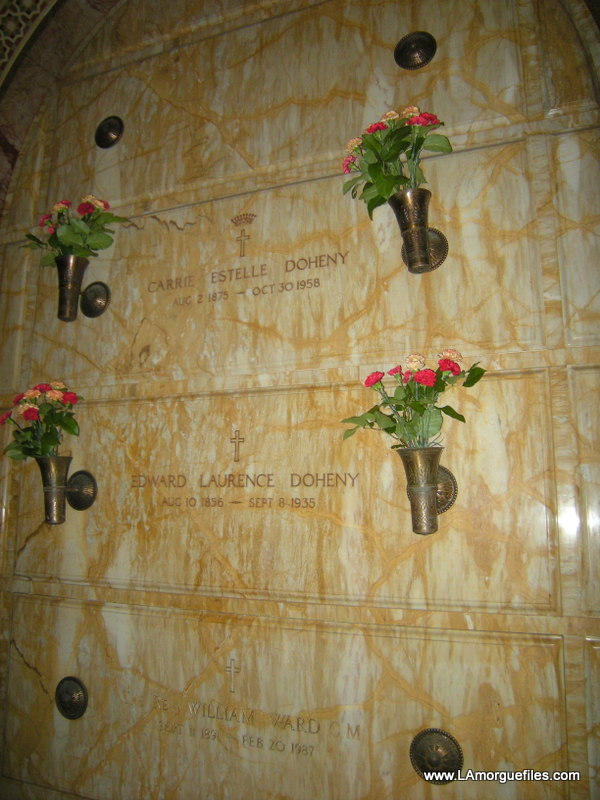
Edward L. Doheny and his wife Carrie Estelle Doheny are interred in Calvary Cemetery in East Los Angeles. 


Legacy

Numerous place names in Southern California are named for him:

Doheny Drive in West Hollywood and Beverly Hills
Doheny Road in Beverly Hills
Doheny Circle in Irvine
Doheny State Beach, on the Pacific coast of Orange County, in Dana Point
The Edward Laurence Doheny Memorial Library at St. John's Seminary, Camarillo, California. (The Carrie Estelle Doheny Memorial Library at the same institution commemorates his widow.)
Doheny Mansion, on Mount Saint Mary's University


Representation in popular culture

Doheny's payment to Albert Fall and the scandal inspired Upton Sinclair's novel, Oil!, based in part on Doheny's life.[11]

Reference to Doheny Beach, in the Beach Boys song "Surfin' USA." Lyrical verse, "...all over Manhattan and down Doheny way, everyone's gone surfin', surfin' USA.."[47]

In the movie There Will Be Blood, which is an adaptation of the novel Oil!, the character of Daniel Plainview portrayed by Daniel Day Lewis is based on Doheny.


References

Bibliography

Ansell, Martin R. (1998), Oil Baron of the Southwest: Edward L. Doheny and the Development of the Petroleum Industry in California and Mexico, Columbus, Ohio: Ohio State University Press, ISBN 978-0-8142-0749-9; a standard scholarly biography

Davis, Margaret Leslie (1998), Dark Side of Fortune: Triumph and Scandal in the Life of Oil Tycoon Edward L. Doheny, Berkeley: University of California Press, ISBN 978-0-520-22909-9; a standard scholarly biography

La Botz, Dan (1991), Edward L. Doheny: Petroleum, Power and Politics in the United States and Mexico, New York: Praeger, ISBN 978-0-275-93599-3; poorly received by reviewers who noted many errors and oversights


Notes

1. "Edward Doheny, Croesus of Oil Empire, Is Dead." The Iola Register. September 9, 1935.
2. Margaret Leslie Davis, Dark Side of Fortune: Triumph and Scandal in the Life of Oil Tycoon Edward L. Doheny (1998), p. 8.
3. Davis. - p. 196.
4. Davis. - p. 9.
5. Davis, Margaret L. (1998). Dark Side of Fortune: Triumph and Scandal in the Life of Oil Tycoon Edward L. Doheny. 1998.
6. Prescott, Yavapai, Arizona. 1880 United States Census. United States Census Bureau. page.462B.
7. Davis. - p. 11, 14.
8. Davis. - pp. 18-19.
9. Davis. - p. 13.
10. Davis. - p. 20.
11. Yewell, John (December 13, 2007). "Black gold gave state its glitter." The Monterey County Herald.
12. Davis. - p. 24.
13. Davis. pp. 16-21.
14. Davis. - p. 29.
15. Davis. - p. 33.
16. Davis. - p. 41.
17. Bonino. - p. 28.
18. Davis. - p. 40.
19. Doheny Foundation Archived 2010-04-19 at the Wayback Machine.
20. Redpath, Lionel V. (1900). Petroleum in California: A Concise and Reliable History of the Oil Industry of the State. pp. 37–38.
21. Davis. - pp. 107-109.
22. Vassiliou, M. S. (2009-09-24). The A to Z of the Petroleum Industry. Scarecrow Press. p. 139. ISBN 978-0-8108-7066-6. 
23. McBeth, B. S. (2002-04-04). Juan Vicente Gómez and the Oil Companies in Venezuela, 1908-1935. Cambridge University Press. p. 95. ISBN 978-0-521-89218-6. 
24. Gross and Gross 1998, p. 78-79.
25. Bennett, Leslie E. (1999). "One Lesson From History: Appointment of Special Counsel and the Investigation of the Teapot Dome Scandal." The Brookings Institution. academic.brooklyn.cuny.edu. 
26. Davis. - p. 186.
27. Swaine 1946, p. 433.
28. Swaine 1946, p. 677.
29. Swaine 1946, p. 434.
30. Davis. - pp. 212-213.
31. Sloper, Don (2006). Los Angeles's Chester Place, Arcadia Publishing, 2006. ISBN 0-7385-4687-9
32. Richard Rayner, John Creel, Anson Lisk. West of Eden by Jean Stein, published by Jonathan Cape 2016.
33. Gayle Chelgren, Patrick 'Ned' Doheny, West of Eden by Jean Stein pub. Jonathan Cape 2016
34. Philip G. Payne, "The Other Side of the Scandal: Review of 'Dark Side of Fortune,'" H-Net Review
35. McCartney, Laton (2008). The Teapot Dome Scandal: How Big Oil Bought the Harding White House and Tried to Steal the Country. New York: Random House.
36. West Adams Heritage Society, biographical sketch of Edward L. Doheny.
37. Davis. - pp. 247-248, 270-272.
38. Davis. - p. 247.
39. Davis. - p. 274.
40. Edward Doheny Archived 2005-11-29 at the Wayback Machine. University of Southern California (USC).
41. Bonino, Mary Ann (also publisher) (2008). The Doheny Mansion: A Biography of a Home. pp. 37–38. ISBN 978-0-9816422-0-8.
42. History Archived 2015-02-15 at the Wayback Machine. Doheny.org.
43. Southeast Missouri State University. "St. Mary's of the Barrens--Perryville, Missouri." Website. Southeast Missouri State University. 
44. Eileen Doheny, Find a Grave
45. "The Niven File" in 'Writers for Relief: An Anthology to Benefit the Survivors of Katrina' .
46. Weiss, Jeff (2 July 2014). "Oil Heir Ned Doheny Should Have Been Famous Decades Ago."  L.A. Weekly. 
47. https://songmeanings.com/songs/view/4883/


Sunday, March 29, 2020

California Governor Buron Rogers Fitts SUICIDE 1973 Forest Lawn Hollywood Hills Cemetery


Buron Rogers Fitts (March 22, 1895 – March 29, 1973) was the 29th lieutenant governor of California, from 1927 to 1928, and Los Angeles County district attorney thereafter until 1940.


Early life

Born in Belcherville, Texas, Fitts received his law degree in 1916 from the University of Southern California, and while a student there worked as a clerk for the prominent attorney Earl Rogers.

Fitts was a severely injured veteran of World War I whose base of political support lay in the American Legion organization of war veterans. He had been shot in the knee in the Battle of Argonne and limped for the rest of his life.[1]


Career

He was appointed deputy district attorney for Los Angeles County in 1920 during the term of Thomas Lee Woolwine and chief deputy in 1924 under Asa Keyes. He was elected lieutenant governor in 1926 and served in the administration of Governor C.C. Young. Fitts's term as lieutenant governor was from January 4, 1927, to November 30, 1928. Governor Young appointed H. L. Carnahan as lieutenant governor on December 4, 1928, to succeed Fitts.

In 1928, Keyes was indicted for bribery (in connection with the Julian Petroleum Company scandal), and Fitts resigned effective November 30 of that year to become a special prosecutor in that case. He was elected district attorney (the county's chief law officer) as well.


Fitts was elected for a second term in 1932, and he investigated the death of Hollywood producer-director-screenwriter Paul Bern, the husband of actress Jean Harlow. Samuel Marx, in his book Deadly Illusions (1990) accuses Fitts of having been bribed by MGM studio officials to accept a fabricated version of Bern's suicide to avoid scandal in Hollywood. 

Fitts was also indicted for bribery and perjury in 1934 for allegedly taking a bribe to drop a statutory rape charge against a millionaire real-estate promoter. He was acquitted two years later. 


He was also accused of using his position to block action against the rapist of Patricia Douglas at the MGM Sales Convention in 1937, a case that was the subject of David Stenn's 2007 documentary film Girl 27.


Fitts was elected to a third term as district attorney in 1936 and remained until 1940, when he was defeated by a reform candidate, John F. Dockweiler. Fitts, J.D. Fredricks (1903–1915), and Steve Cooley (2000-2012) are only Los Angeles County District Attorneys to serve three complete terms.


On March 7, 1937, Fitts was wounded by a volley of shots fired through the windshield of his car.[2] Nobody was ever arrested in that case.


He joined the Army Air Corps in 1942 with the rank of major. He was chief, intelligence, Pacific Overseas Air Technical Services.


Death

Fitts' last residence was in Three Rivers, in Tulare County, California, where he committed suicide by a pistol shot to the head on March 29, 1973, one week after his 78th birthday.

Buron Rogers Fitts is buried at Forest Lawn Hollywood Hills Cemetery. 


References

 Parrish, Michael (2001). For the People: Inside the Los Angeles County District Attorney's Office 1850-2000. Angel City Press. ISBN 978-1883318154.

 "Dist.-Atty. Fitts Shot by Gang of Gunmen." Los Angeles Times. March 8, 1937. 

 For the People — Inside the Los Angeles County District Attorney's Office 1850-2000 (2001) by Michael Parrish. ISBN 1-883318-15-7

 He Usually Lived With a Female: The Life of a California Newspaperman (2006) by George Garrigues. Quail Creek Press. ISBN 0-9634830-1-3

 Deadly Illusions by Samuel Marx and Joyce Vanderveen (Random House, New York, 1990), re-published as Murder Hollywood Style - Who Killed Jean Harlow's Husband? (Arrow, 1994, ISBN 0-09-961060-4)