Thursday, January 7, 2016

"California Gold" Host Huell Howser Dies in Palm Springs 2013


Huell Burnley Howser (October 18, 1945 – January 7, 2013) was an American television personality, actor, and voice artist best known for hosting California's Gold, his human interest show produced by KCET in Los Angeles for California PBS stations. The archive of his video chronicles offers an enhanced understanding of the history, culture, and people of California.


Early life

Howser was born Huell Burnley Howser in Gallatin, Tennessee on October 18, 1945 to Harold Chamberlain and Jewell Havens (Burnley) Howser.[1] Howser's first name is a portmanteau of his parents' names, Harold and Jewell, as Howser explained in the California's Gold episode "Smartsville." He received a B.A. in history from the University of Tennessee, Knoxville, where he also served as student body president. 


Career

After serving in the U.S. Marine Corps and on the staff of U.S. Senator Howard Baker, Howser began his television career at WSMV-TV in Nashville, Tennessee, where he produced television series focused on human interest stories, such as Happy Features[2] and The Happy World of Huell Howser.[3] Howser was also a television personality working for the University of Tennessee.[4]


After working in New York as the host of WCBS-TV's "Real Life" show,[5] Howser moved to Los Angeles, California in 1981 to work as a reporter for KCBS-TV. During 1982 and 1983, he served as weekend host and correspondent for Entertainment Tonight. In 1985 he joined Los Angeles television station KCET, then a PBS affiliate, as a producer of Videolog, a series covering short topics including lint artist Slater Barron[6] among other topics relevant to Los Angeles and adjacent communities.


California's Gold

Howser's television show California's Gold highlights small towns, landmarks, events, or places of interest throughout California that are not well known to the general public. Howser conducted informal, often impromptu interviews with locals involved with the sites he visits. He also produced the shows California's Communities, California's Golden Fairs, Downtown, California's Water, California's Green, California's Golden Coast, California's Golden Parks, Road Trip, Visiting... with Huell Howser, California Missions, Palm Springs, Our Neighborhoods, The Bench, and various specials.


Other work

Articles written by Howser have appeared in Westways, the magazine of the Automobile Club of Southern California.[7]

In 1997, Howser featured prominently as himself alongside Tracey Ullman in character as Ruby Romaine in the Tracey Takes On... episode, "Hollywood."

Howser spearheaded an unsuccessful effort to stop the demolition of buildings designed by African-American architect Paul Williams at the Long Beach Naval Shipyard.[8]

He appeared in the film Who Killed the Electric Car? in his capacity as a reporter, witnessing the demolition and shredding of a Honda EV Plus.[9] In 2011, Howser voiced the Backson in the post-credits scene of Walt Disney Animation Studios's 2011 feature film Winnie the Pooh."


Personal life

Howser lived in the historic El Royale apartments in Los Angeles, California and also had homes in Palm Springs and Twentynine Palms.[10]

Howser mentioned that he was a Methodist during his episode covering the Nevada County Fair on California's Golden Fairs.


Volcano House

Howser purchased the 1,800-square-foot (170 m2) Volcano House, situated on a volcanic cinder cone just outside of Barstow, along with 60 acres (24 ha) of desert and a man-made lake, in 2003.[11] In 2010, Howser put his unusual Newberry Springs, California, residence (the "Volcano House,") on the market for $750,000.[12] In June 2012, The Panther, a student-run newspaper for Chapman University announced that Howser had donated the Volcano House to the school.[13]


Retirement and death

On November 27, 2012, The Sacramento Bee reported that Howser was retiring from making new shows, amid speculation in the television community that he was seriously ill.[14]

On January 7, 2013, Howser died at the age of 67 at his Palm Springs home. He had been battling cancer for several years and his death certificate listed metastatic prostate cancer as the cause of death. Howser's body was cremated and his ashes were scattered at sea off the coast of Los Angeles County.[15]

On January 15, 2013, a memorial was held for Howser, who said before his death that he did not want a funeral.[16]


Legacy

Howser donated his videotaped collection of California's Gold episodes, as well as those of his other series, to Chapman University in 2011. He also donated his personal papers, and a large collection of books on California history to the university.[17] The school established the Huell Howser Archive, which, when completed, will offer the public free access to the entire digitized collection of his life's work. The archive can be accessed at Chapman University as well as on the internet. He also gave his extensive art collection, which consists mostly of "found-object" art collected during his travels, to the university, and endowed the California's Gold Scholarship Fund. Upon his death he bequeathed his remaining two homes to the university, the proceeds from the sale of which will be added to the scholarship fund.[18]

Testimonials to Howser's unique contribution to the celebration of California history and culture immediately were acknowledged in numerous media sources upon word of his death. Gustavo Arellano, OC Weekly editor, called Howser "the greatest Californian since Hiram Johnson,"[19] noting that for Howser, "California was the ultimate temple of the American dream."[20] Such an assessment reflects the high regard in which many Californians hold Howser's achievement of a very media savvy and unabashedly enthusiastic promotion of their state's heritage.


In popular culture

Howser's distinctive enthusiastic style as host of his various travel shows led to him being impersonated and lampooned by many different comedians and radio personalities, such as Adam Carolla,[21] Dana Gould, Ralph Garman, and James Adomian.

Matt Groening has stated he is a fan of Howser,[22] and he featured Howser in two episodes of The Simpsons: "There's Something About Marrying," in which a character named Howell Huser falls off a turnip truck, and "O Brother, Where Bart Thou?," in which the real Howser presents a program similar to Marc Summers' Unwrapped television program. Howser received a voice credit for the episode. The Simpsons episode "A Test Before Trying" commemorated his death with a quick cartoon memorial shot at the end of the episode, stating: "In Memory of Huell Howser, Friend of the Simpsons and a friend of California."


Filmography

Year Title Role

2011 Winnie the Pooh Backson Voice[23]


References

1. Braxton, Greg (January 7, 2013). "Huell Howser dies at 67; TV host profiled California people and places." Los Angeles Times 
2. Dorman, Lee (2009). Images of America: Nashville Broadcasting. Arcadia Publishing. p. 113. ISBN 978-0-7385-6829-4. 
3. William-Ross, Lindsay (15 January 2013). "Vintage Video: 1973's 'The Happy World of Huell Howser'." LAist.com. LAist. Episode aired February 23, 1973 
4. Howser travels to Hawaii with U. of Tennessee football team 
5. Hevesi, Dennis (11 January 2013). "Huell Howser, Folksy Public TV Host, Is Dead at 67." The New York Times. 
6. Sources: 
"Videolog Classics #2." KCET.org. 
Rabe, John (July 6, 2011). "Huell Howser's retiring: An Off-Ramp remembrance." SCPR.org. KPCC – Southern California Public Radio. 
"Classic Huell: Farmers' Market." KCET.org. 
7. Road Trip with Huell Howser articles in Westways Magazine 
8. Williams, Amy (July 7, 1998). "Long Beach Naval Station Falls: Court throws-out celebrity appeal." DailyRepublican.com. The Daily Republican. 
9. Chris Paine (2006). "Who Killed the Electric Car?" Plinyminor / Sony Pictures Classics. 
10. Sources: 
"This is Amazing!" Los Angeles magazine. November 2003.  
Fessier, Bruce (January 8, 2013). "Huell Howser of 'California's Gold' at home in Palm Springs." The Desert Sun. 
11. McNatt, C. (November 9, 2013). "Out of this world." Orange County Register. pp. Home and Garden 1, 3. 
12. "The Volcano House – 50451 Silver Valley Rd., Newberry Springs, CA 92365 – Listing # 09-401249". 2010-04-01. 
13. Oliver, Elizabeth (May 7, 2012). "The Panther – Huell Howser donates volcano house to Chapman." ThePantherOnline.com. The Panther.  
14. Sources: 
Lindelof, Bill (November 27, 2012). "Huell Howser, maker of PBS shows about California, retiring." sacbee.com. Sacramento Bee. 
Collins, Scott. "Huell Howser quietly retires from public TV's 'California's Gold'." Los Angeles Times. 
15. Sources: 
Goolsby, Denise. "TV host Huell Howser spent final days at Palm Springs refuge." The Desert Sun. 
Rokos, Brian; Johnson, Nikie (January 17, 2013). "HUELL HOWSER: Prostate cancer was cause of death." pe.com. The Press-Enterprise. 
Braxton, Greg (January 7, 2013). "Huell Howser dies at 67; TV host profiled California people and places." Los Angeles Times. 
"Howser Didn't Want Memorial, Died of Cancer." 
Romero, Dennis. "Huell Howser Dead." LA Weekly. 
16. Mackie, Drew (January 15, 2013). "Los Angeles Bids Farewell to Huell Howser at Griffith Observatory." KCET.org (KCET). 
17. Day, Patrick Kevin (January 7, 2013). "Huell Howser: Highlights from 'California's Gold' online." LATimes.com. The Los Angeles Times. 
18. Sources: 
"Chapman University, Huell Howser Archive." blogs.chapman.edu. 
"Chapman University Remembers Huell Howser". blogs.chapman.edu.  
Doti, James L. "Huell Howser's vault of 'Gold'." The Orange County Register. 
19. Arellano, Gustavo (January 7, 2013). "Remembering Huell Howser, Fan of OC Weekly, Lover of OC, Antagonist of OC Republicans." OCWeekly.com. 
20. "Remembering Huell, California's great adventurer." Los Angeles Times. 
21. "April 2, 2008 - Mark Walberg and Artie Lange call into the studio; Dana Gould is in the studio." Adam Carolla. April 2, 2008. Archived from the original on July 22, 2011. 
22. Lloyd, Robert (26 July 2009). "The wonder and awe that make up Huell Howser." Los Angeles Times. 
23. "Disney.com Winnie the Pooh." Disney Movies. 


Monday, January 4, 2016

"The Cat and the Canary" Silent Film Actress Flora Finch 1940 Hollywood Forever Cemetery


Flora Finch (June 17, 1867 – January 4, 1940) was an English-born film actress who starred in over 300 silent films, including over 200 for the Vitagraph Studios film company.


Early life and career

Finch was born into a music hall and travelling theatrical family in London and was taken to the United States as a young child. She kept up the family tradition and worked in theatre and the vaudeville circuit right up until her 30s.

She had her first film roles at the American Mutoscope and Biograph Company starting in 1908. There she worked with Fatty Arbuckle, Mack Sennett (with whom she was romantically involved for a short time) and Charlie Chaplin amongst others.


Starting in 1910 at Vitagraph, she was paired with John Bunny for the first of 160 very popular shorts made between 1910 and 1915. These shorts, known as "Bunnygraphs," "Bunnyfinches," and "Bunnyfinchgraphs," established Finch and Bunny as the first popular comedy team in films.


After Bunny's death in 1915 she continued to make comedy shorts, but with less success. She started her own production company, "Flora Finch Productions," but was never able to regain her popularity. One of her best-known roles in the later silent years was Aunt Susan in Paul Leni's The Cat and the Canary (1927). She found film work in the sound era, but only in small supporting parts. The Scarlet Letter (1934) gave her one of her more substantial roles in sound films, and she had a cameo in one of Laurel and Hardy's best-known films Way Out West (1937). Her last film was The Women (1939).

Most of her films are now lost.


Flora Finch died at the Good Samaritan Hospital in Los Angeles from blood poisoning. She was taken to the hospital after a streptococcus infection followed an accidental cut to her arm. The infection spread beyond control and the actress lapsed into a coma from bronchial pneumonia.


Flora Finch is buried at Hollywood Forever Cemetery.


Personal life

Finch was married to Harold March; apparently they had no children.


Partial filmography

Advertisement (1917) 
The Helping Hand (1908) 
Mrs. Jones Entertains (1909) 
Mr. Jones Has a Card Party (1909) 
Those Awful Hats (1909) 
A Wreath in Time (1909) 
His Wife's Mother (1909) 
All on Account of the Milk (1910) 


Her Crowning Glory (1911) 

A Cure for Pokeritis (1912) 
The Great Adventure (1918) 
When Knighthood Was in Flower (1922) 
The Midnight Girl (1925) 
Men and Women (1925) 
A Kiss for Cinderella (1925) 
Captain Salvation (1927) 
The Cat and the Canary (1927) 
Rose of the Golden West (1927) 
Quality Street (1927) 


The Haunted House (1928) 

Sweet Kitty Bellairs (1930) 
Way Out West (1937) 
The Women (1939)


Saturday, January 2, 2016

"Murder, My Sweet" Actor Dick Powell 1963 Forest Lawn Glendale Cemetery


Richard Ewing "Dick" Powell (November 14, 1904 – January 2, 1963) was an American singer, actor, film producer, film director and studio head. Though he came to stardom as a musical comedy performer, he showed versatility and successfully transformed into a hardbitten leading man starring in projects of a more dramatic nature. He was the first actor to portray the private detective Philip Marlowe on screen.


Biography

Powell was born in Mountain View,[2] the seat of Stone County in northern Arkansas. The family moved to Little Rock in 1914, where Powell sang in church choirs and with a local orchestras and started his own band.[3] Powell attended the former Little Rock College, before he started his entertainment career as a singer with the Royal Peacock Band which toured throughout the Midwest. During this time, he married Mildred Maund, a model, but she found being married to an entertainer not to her liking and they soon divorced.[3] Later, he joined the Charlie Davis Orchestra, based in Indianapolis.[3] He recorded a number of records with Davis and on his own, for the Vocalion label in the late 1920s.


Powell moved to Pittsburgh, where he found great local success as the Master of Ceremonies at the Enright Theater and the Stanley Theater.[3] In April 1930, Warner Bros. bought Brunswick Records, which at that time owned Vocalion. Warner Bros. was sufficiently impressed by Powell's singing and stage presence to offer him a film contract in 1932. He made his film debut as a singing bandleader in Blessed Event.[4] He went on to star as a boyish crooner in movie musicals such as 42nd Street, Footlight Parade, Gold Diggers of 1933, Dames, Flirtation Walk, and On the Avenue, often appearing opposite Ruby Keeler and Joan Blondell.[3]


Powell desperately wanted to expand his range, but Warner Bros. would not allow him to do so. As a result, he bought his release from Warner Bros. in 1940.[3] They did cast him in A Midsummer Night's Dream (1935), but as Lysander, another youthful romantic character. This was to be Powell's only Shakespearean role and one he did not want to play, feeling that he was completely wrong for the part. By 1944, Powell felt he was too old to play romantic leading men anymore, so he lobbied to play the lead in Double Indemnity. He lost out to Fred MacMurray, another Hollywood nice guy. MacMurray's success, however, fueled Powell's resolve to pursue projects with greater range.


In 1944, Powell's career changed dramatically when he was cast in the first of a series of films noir, as private detective Philip Marlowe in Murder, My Sweet, directed by Edward Dmytryk. The film was a big hit, and Powell had successfully reinvented himself as a dramatic actor. He was the first actor to play Marlowe – by name – in motion pictures. (Hollywood had previously adapted some Marlowe novels, but with the lead character changed.) Later, Powell was the first actor to play Marlowe on radio, in 1944 and 1945, and on television, in a 1954 episode of Climax! Powell also played the slightly less hard-boiled detective Richard Rogue in the radio series "Rogue's Gallery," beginning in 1945.


In 1945, Dmytryk and Powell reteamed to make the film Cornered, a gripping, post-WWII thriller that helped define the film noir style. He became a popular "tough guy" lead appearing in movies such as Johnny O'Clock and Cry Danger. But in 1948, he stepped out of the brutish type when he starred in Pitfall, a film noir in which a bored insurance company worker falls for an innocent but dangerous woman, played by Lizabeth Scott. Even when he appeared in lighter fare such as The Reformer and the Redhead and Susan Slept Here (1954), he never sang in his later roles. The latter, his final onscreen appearance in a feature film, did include a dance number with costar Debbie Reynolds.


From 1949–1953, Powell played the lead role in the NBC radio theater production Richard Diamond, Private Detective. His character in the 30-minute weekly was a likable private detective with a quick wit. Many episodes ended with Detective Diamond having an excuse to sing a little song to his date, showcasing Powell's vocal abilities. Many of the episodes were written by Blake Edwards. When Richard Diamond came to television in 1957, the lead role was portrayed by David Janssen, who did no singing in the series. Prior to the Richard Diamond series, he starred in Rogue's Gallery. He played Richard Rogue, private detective. The Richard Diamond tongue-in-cheek persona developed in the Rogue series.

In the 1950s, Powell was one of the founders of Four Star Television,[1] along with Charles Boyer, David Niven, and Ida Lupino. He appeared in and supervised several shows for that company. Powell played the role of Willie Dante in Four Star Playhouse, in episodes entitled "Dante's Inferno" (1952), "The Squeeze" (1953), "The Hard Way" (1953), and "The House Always Wins" (1955). In 1961, Howard Duff, husband of Ida Lupino, assumed the Dante role in a short-lived NBC adventure series Dante, set at a San Francisco nightclub called "Dante's Inferno."


Powell guest-starred in numerous Four Star programs, including a 1958 appearance on the Duff-Lupino sitcom Mr. Adams and Eve. He appeared in 1961 on James Whitmore's legal drama The Law and Mr. Jones on ABC. In the episode "Everybody Versus Timmy Drayton," Powell played a colonel having problems with his son. Shortly before his death, Powell sang on camera for the final time in a guest-star appearance on Four Star's Ensign O'Toole, singing The Song of the Marines, which he first sang in his 1937 film The Singing Marine. He hosted and occasionally starred in his Dick Powell's Zane Grey Theater on CBS from 1956–1961, and his final anthology series, The Dick Powell Show on NBC from 1961 through 1963; after his death, the series continued through the end of its second season (as The Dick Powell Theater), with guest hosts.

Powell's film The Enemy Below (1957), based on the novel by Denys Rayner, won the Academy Award for Special Effects.

Powell also directed The Conqueror (1956), starring John Wayne as Genghis Khan. The exterior scenes were filmed in St. George, Utah, downwind of U.S. above-ground atomic tests. The cast and crew totaled 220, and of that number, 91 had developed some form of cancer by 1981, and 46 had died of cancer by then, including Powell and Wayne. This cancer rate is about three times higher than one would expect in a group of this size, and many have argued that radioactive fallout was the cause.[5]


Personal life

Powell was the son of Ewing Powell and Sallie Rowena Thompson.

He was married three times:

Mildred Maund (1925–1927) – although most biographies say they were divorced in 1927, some sources are contradictory. The couple appears on the 1930 census in Pittsburgh, Pennsylvania, where he is working in a theater, and on a 1931 passenger list for the SS Oriente, returning from Havana, Cuba.


Joan Blondell (married September 19, 1936, divorced 1944), with whom he had two children, Norman (her son from a previous marriage, whom Powell adopted) and Ellen.


June Allyson (August 19, 1945, until his death), with whom he had two children, Pamela (adopted) and Richard Powell, Jr. Powell's ranch-style house was used for exterior filming on the ABC TV series, Hart to Hart. Powell was a friend of Hart to Hart actor Robert Wagner and producer Aaron Spelling. The estate, known as Amber Hills, is on 48 acres in the Mandeville Canyon section of Brentwood, Los Angeles. Powell was a major TV executive. His production company, Four Star Television, owned several network shows.


Powell enjoyed general aviation as a private pilot.[6]


Illness and death

On September 27, 1962, Powell acknowledged rumors that he was undergoing treatment for cancer. The disease was originally diagnosed as an allergy, with Powell first experiencing symptoms while traveling East to promote his program. Upon his return to California, Powell's personal physician conducted tests and found malignant growths on his neck and chest.[7]


Powell died at the age of 58 on January 2, 1963. His body was cremated and his remains were interred in the Columbarium of Honor at Forest Lawn Memorial Park in Glendale, California. In a 2001 interview with Larry King, Powell's widow June Allyson confirmed his cause of death was lung cancer due to his chain smoking.[8]


Dick Powell has a star on the Hollywood Walk of Fame at 6915 Hollywood Blvd.[9]


Popular culture references

Frank Tashlin's cartoon satire The Woods Are Full Of Cuckoos (1937) features a caricature of Powell, a bird named "Dick Fowl."

The Travel Channel series Mysteries at the Museum (2013) featured a segment about the fallout from the filming of The Conqueror with American actor Paul Meltzer as director Powell.


Filmography

As Actor

Features

Blessed Event (1932) 
Big City Blues (1932) 
Too Busy to Work (1932) 
The King's Vacation (1933) 
42nd Street (1933) 
Gold Diggers of 1933 (1933) 
Footlight Parade (1933) 
College Coach (1933) 
Convention City (1933) 
Wonder Bar (1934) 
Twenty Million Sweethearts (1934) 
Dames (1934) 
Happiness Ahead (1934) 
Flirtation Walk (1934) 
Gold Diggers of 1935 (1935) 
Broadway Gondolier (1935) 
Broadway Hostess (1935) (Uncredited) 
Page Miss Glory (1935) 
A Midsummer Night's Dream (1935) 
Shipmates Forever (1935) 
Thanks a Million (1935) 
Colleen (1936) 
Hearts Divided (1936) 
Stage Struck (1936) 
Gold Diggers of 1937 (1936) 
On the Avenue (1937) 
The Singing Marine (1937) 
Varsity Show (1937) 
Hollywood Hotel (1937) 
Cowboy from Brooklyn (1938) 
Hard to Get (1938) 
Going Places (1938) 
Naughty but Nice (1939) 
I Want a Divorce (1940) 
Christmas in July (1940) 
Model Wife (1941) 
In the Navy (1941) 
Star Spangled Rhythm (1942) 
Happy Go Lucky (1943) 
Riding High (1943) 
True to Life (1943) 
It Happened Tomorrow (1944) 
Meet the People (1944) 
Murder, My Sweet (1944) (released in the UK as Farewell, My Lovely (1944)) 
Cornered (1945) 
Johnny O'Clock (1947) 
To the Ends of the Earth (1948) 
Pitfall (1948) 
Station West (1948) 
Rogues' Regiment (1948) 
The Carpa Follies (1949) 
Mrs. Mike (1949) 
The Reformer and the Redhead (1950) 
Right Cross (1950) 
Cry Danger (1951) 
The Tall Target (1951) 
You Never Can Tell (1951) 
Callaway Went Thataway (1951) (scenes deleted) 
The Bad and the Beautiful (1952) 
Susan Slept Here (1954) 

Short subjects

The Road Is Open Again (1933) 
Just Around the Corner (1933) 
Hollywood on Parade No. A-9 (1933) 
And She Learned About Dames (1934) 
Hollywood Newsreel (1934) 
A Dream Comes True (1935) 
Hollywood Hobbies (1939) 


As Director

Split Second (1953) 
The Conqueror (1956) 
You Can't Run Away from It (1956) 
The Enemy Below (1957) 
The Hunters (1958)


Radio appearances

Powell was the first actor to play private detective Philip Marlowe on radio, in 1944 and 1945.

Year Program Episode/source

1945–? Rogue's Gallery played detective Richard Rogue 
1949–1953 Richard Diamond, Private Detective played Richard Diamond (NBC radio theater production) 
1952 Stars in the Air The Bride Goes Wild[10]


Notable recordings

"I Only Have Eyes for You" (1934) from the film Dames. "Roses in December" (1937) words and music by Herb Magidson, Ben Oakland and George Jessel. (The song first appeared in The Life of the Party.) ISWC: T-070127274-3 

"Over There"/"Captains of the Clouds" (1942–Decca 4174) Issued early in World War II, the A side brought back a patriotic song that had been popular in World War I. The B side came from a James Cagney film of the same name.[11]

References

1. "Film World Mourns Dick Powell; Jack Carson." St. Petersburg Times. AP. January 4, 1963. 
2. "Dick Powell." Turner Classic Movies. 
3. "Richard Ewing Powell." Dictionary of American Biography (1981) Charles Scribner's Sons, New York 
4. "Dick Powell." International Dictionary of Films and Filmmakers Vol. 3. (2000) Gale, Detroit 
5. Olson, James (2002) Bathsheba's Breast: Women, Cancer and History, Johns Hopkins University Press, Baltimore, Maryland ISBN 0-8018-6936-6 
6. "A Plane Crazy America." AOPA Pilot: 79. May 2014. 
7. "Powell acknowledges cancer treatments" (PDF). Broadcasting: 9. October 1, 1962. 
8. http://edition.cnn.com/TRANSCRIPTS/0107/04/lkl.00.html 
9. Hollywood Walk of Fame 
10. Kirby, Walter (February 24, 1952). "Better Radio Programs for the Week." The Decatur Daily Review. p. 38. 
11. Orodenker, M.H. (March 7, 1942). "On the Records." Billboard. p. 66.


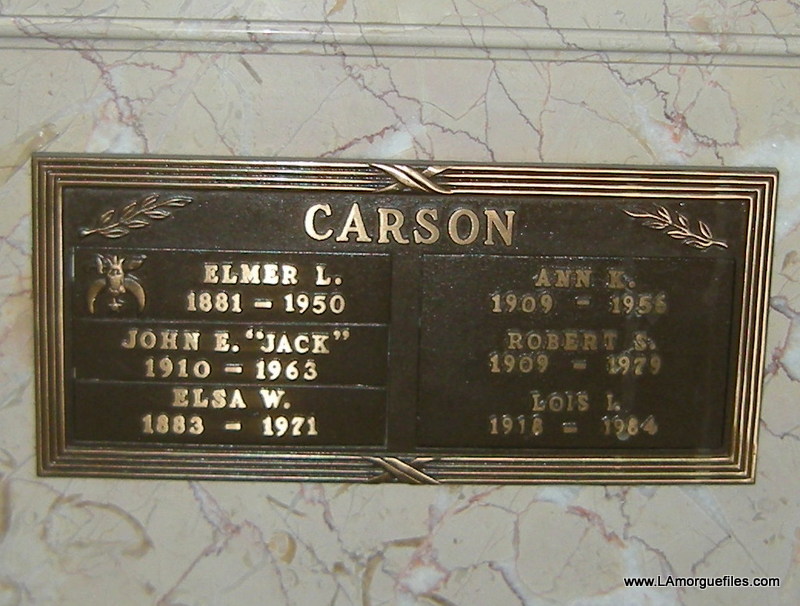
"Mildred Pierce" Actor Jack Carson 1963 Forest Lawn Glendale Cemetery


John Elmer "Jack" Carson (October 27, 1910 – January 2, 1963) was a Canadian-born American-based film actor.[1] Carson was one of the most popular character actors during the "golden age of Hollywood," with a film career spanning the 1930s, '40s and '50s. Though he was primarily used in supporting roles for comic relief, his work in films such as Mildred Pierce (1945) and Cat on a Hot Tin Roof (1958) displayed his mastery of "straight" dramatic actor roles as well. He worked for RKO and MGM (cast opposite Myrna Loy and William Powell in Love Crazy), but most of his memorable work was for Warner Brothers. His trademark character was the wisecracking know-it-all, typically and inevitably undone by his own smug cockiness.


Early years

He was born in Carman, Manitoba, to Elmer and Elsa Carson. In 1914, the family moved to Milwaukee, Wisconsin, which he always thought of as his home town. He attended high school at Hartford School, Milwaukee, and St. John's Military Academy, Delafield, but it was at Carleton College that he acquired a taste for acting. Carson became a U.S. citizen in California in 1949.

Because of his size — 6 ft 2 in (1.9 m) and 220 lb (100 kg), his first stage appearance (in a collegiate production) was as Hercules. In the midst of a performance, he tripped and took half the set with him. A college friend, Dave Willock, thought it was so funny he persuaded Carson to team with him in a vaudeville act — Willock and Carson — and a new career was born. This piece of unplanned business would be typical of the sorts of things that tended to happen to Carson in many of his film roles.

During the 1930s, as vaudeville declined from increased competition from radio and the movies, Willock and Carson sought work in Hollywood. Carson initially landed bit roles at RKO Radio Pictures in films such as Bringing Up Baby (1938), starring Cary Grant and Katharine Hepburn. Radio was another source of employment for the team, starting with a 1938 appearance on the Kraft Music Hall when Bing Crosby hosted the show. This led to a number of other appearances culminating in Carson's own radio show in 1943.

From 1950-51, Jack was one of four alternating weekly hosts of the Wednesday evening NBC Television comedy-variety show Four Star Revue. (The others were veterans Jimmy Durante and Ed Wynn, and up-and-coming young Danny Thomas.) The second season was his last with the show, when it was renamed All Star Revue.


Film career

His success in radio led to the start of a lucrative film career. An early standout role for Carson was as a mock-drunk undercover G-Man opposite Richard Cromwell in Universal Pictures's anti-Nazi action drama entitled Enemy Agent. This led to contract-player status with Warner Brothers shortly thereafter. While there, he was teamed with Dennis Morgan in a number of films, supposedly to compete with the popular Bing Crosby - Bob Hope "Road to …" pictures.


Most of his work at Warner Brothers was limited to light comedy work with Morgan, and later Doris Day (who in her autobiography would credit Carson as one of her early Hollywood mentors). 


Critics generally agree that Carson's best work was in Mildred Pierce (1945), where he played the perpetually scheming Wally Fay opposite Joan Crawford in the title role. Also in 1945 he played the role of Harold Pierson, the second husband of Louise Randall, played by Rosalind Russell, in Roughly Speaking. 


Another role which won accolades for him was as publicist Matt Libby in A Star is Born (1954). 


One of his last film roles was as the older brother "Gooper" in Cat on a Hot Tin Roof (1958).


His TV appearances, extending into the early 1960s, included The Martha Raye Show, The Guy Mitchell Show and The Polly Bergen Show in 1957; Alcoa Theatre and Bonanza (Season 1, Ep.9: "Mr. Henry Comstock") in 1959; Thriller ("The Big Blackout") in 1960; and The Twilight Zone (Season 2, Ep. 14: "The Whole Truth") in 1961.
His TV pilot, Kentucky Kid, was under consideration as a potential series for NBC, but was not picked up by the network. The proposed series would have had Carson playing a veterinarian widower who raises horses and has an adopted Chinese child.

His far-less-famous brother Robert (Bob) was also a character actor.

In 1983, after his death, Jack Carson was inducted into the Wisconsin Performing Artists Hall of Fame along with his film pal, Dennis Morgan, who was also from Wisconsin. [2]


Death

In 1962, while rehearsing the Broadway play Critic's Choice, he collapsed and was subsequently diagnosed with stomach cancer. He died in Encino in 1963, at 52 years of age. The early death of the burly Carson, whose screen image was one of energy and vitality, made front page news, along with the death of fellow actor Dick Powell, who died on the same day. Carson was entombed in Glendale's Forest Lawn Memorial Park Cemetery in The Great Mausoleum, Columbarium of Memory, 3rd Bay, niche 19676 with his parents, brother, and sisters.


Personal life

Carson married four times: Elizabeth Lindy (married 1938, divorced 1939), Kay St. Germain (1941-1950), Lola Albright (1952-1958) and Sandra Jolley (1961–1963), former wife of Forrest Tucker and daughter of character actor I. Stanford Jolley. Carson had a romantic relationship between his second and third marriages with Doris Day in 1950–51,[3] but she left him for Marty Melcher, who would become her third husband.


Partial filmography

Stage Door (1937) with Katharine Hepburn, Ginger Rogers and Lucille Ball 
You Only Live Once (1937) with Henry Fonda 
Two Many Wives (1937) with Anne Shirley 
High Flyers (1937) with Bert Wheeler, Robert Woolsey, and Lupe Vélez 
Vivacious Lady (1938) with Ginger Rogers and James Stewart 
Bringing Up Baby (1938) (uncredited) with Katharine Hepburn and Cary Grant 
Carefree (1938) with Fred Astaire and Ginger Rogers 
The Saint in New York (1938) with Louis Hayward as Simon Templar 
Mr. Smith Goes to Washington (1939) with James Stewart 
Destry Rides Again (1939) with Marlene Dietrich and James Stewart 
I Take This Woman (1940) with Spencer Tracy and Hedy Lamarr 
Enemy Agent (1940) with Richard Cromwell 
Lucky Partners (1940) with Ronald Colman, Ginger Rogers, Spring Byington and Harry Davenport 
Typhoon (1940) with Dorothy Lamour and Robert Preston 
Parole Fixer (1940) with William Henry 
Queen of the Mob (1940) with Ralph Bellamy 
Mr. and Mrs. Smith (1941) with Carole Lombard and Robert Montgomery 


The Strawberry Blonde (1941) with James Cagney and Olivia de Havilland 

Love Crazy (1941) with William Powell and Myrna Loy 
The Bride Came C.O.D. (1941) with James Cagney and Bette Davis 
Navy Blues (1941) with Ann Sheridan 
The Male Animal (1942) with Henry Fonda and Olivia de Havilland 
Larceny Inc (1942) with Edward G. Robinson and Jane Wyman 
Wings for the Eagle (1942) with Ann Sheridan 
Gentleman Jim (1942) with Errol Flynn, Alan Hale, William Frawley and Ward Bond 
The Hard Way (1943) with Ida Lupino 
Princess O'Rourke (1943) with Olivia de Havilland, Robert Cummings and Charles Coburn 
Thank Your Lucky Stars (1942) with Bette Davis, Errol Flynn, Ida Lupino and Olivia de Havilland 
The Doughgirls (1944) with Ann Sheridan and Alexis Smith 


Arsenic and Old Lace (1944) with Cary Grant and Priscilla Lane 

Hollywood Canteen (1944) 
Shine On, Harvest Moon (1944) with Ann Sheridan 
Make Your Own Bed (1944) with Jane Wyman and Alan Hale 
Roughly Speaking (1945) with Rosalind Russell 
Mildred Pierce (1945) with Joan Crawford, Ann Blyth and Eve Arden 
One More Tomorrow (1946) with Ann Sheridan 
The Time, the Place and the Girl (1946) with Dennis Morgan and Janis Paige 


Two Guys from Milwaukee (1946) with Dennis Morgan 

Love and Learn (1947) with Martha Vickers 
April Showers (1948) with Ann Sothern 
Romance on the High Seas (1948) with Janis Paige, Don DeFore, and Doris Day 
Two Guys from Texas (1948) with Dennis Morgan and Dorothy Malone 
April Showers (1948) with Ann Sothern 
John Loves Mary (1949) with Ronald Reagan, Wayne Morris and Edward Arnold 
My Dream Is Yours (1949) with Doris Day 
It's a Great Feeling (1949) with Doris Day 
Bright Leaf (1950) with Gary Cooper, and Lauren Bacall 
The Good Humor Man (1950) with George Reeves, and Lola Albright 
Mr. Universe (1951) with Vince Edwards 
The Groom Wore Spurs (1951) with Ginger Rogers 
Dangerous When Wet (1953) with Esther Williams and Fernando Lamas 
A Star Is Born (1954) with Judy Garland and James Mason 
Red Garters (1954) with Rosemary Clooney 


Phffft! (1954) with Judy Holliday, Jack Lemmon, and Kim Novak 

Ain't Misbehavin' (film) (1955) with Rory Calhoun 
Magnificent Roughnecks (1956) with Mickey Rooney 
Bottom Of The Bottle (1956) with Van Johnson and Joseph Cotton 
The Tattered Dress (1957) with Jeff Chandler, Jeanne Crain, Gail Russell 
The Tarnished Angels (1958) with Rock Hudson, Robert Stack, and Dorothy Malone 
Rally 'Round the Flag, Boys! (1958) with Paul Newman, Joanne Woodward, and Joan Collins 
Cat on a Hot Tin Roof (1958) with Elizabeth Taylor, Paul Newman, and Burl Ives 
The Bramble Bush (1960) with Richard Burton 
King Of The Roaring 20s (1961) with David Janssen 
Sammy the Way Out Seal (1962) with Robert Culp and Billy Mumy


Radio appearances

Year Program Episode/source

1946 Suspense Easy Money[4]

References

1. Obituary Variety, January 9, 1963. 
2. "Hall of Fame a gala premiere." Milwaukee Journal Sentinel, "Let's Go section, Page 2. 
3. Day, Doris; Hotchner, A.E. (Oct 1976) [1975]. Doris Day: Her Own Story (Bantam mass market paperback) (6th printing ed.). New York: William Morrow. p. 108. ISBN 0-553-02888-X. 
4. "Jack Carson Is Suspense Star." Harrisburg Telegraph. November 2, 1946. p. 19.