George Burns (January 20, 1896 – March 9, 1996), born Nathan Birnbaum, was an American comedian, actor, and writer.
His career spanned vaudeville, film, radio, and television, with and without his wife, Gracie Allen. His arched eyebrow and cigar smoke punctuation became familiar trademarks for over three quarters of a century. Beginning at the age of 79, Burns' career was resurrected as an amiable, beloved and unusually active old comedian, continuing to work until shortly before his death, in 1996, at the age of 100.
Gracie Allen's Death
After fighting a long battle with heart disease, Gracie Allen suffered a fatal heart attack in her home on August 27, 1964 at the age of 69. She was entombed in a mausoleum at Forest Lawn Memorial Park Cemetery. In his second book, They Still Love Me in Altoona, Burns wrote that he found it impossible to sleep after her death until he decided to sleep in the bed she used during her illness. He also visited her grave once a month, professing to talk to her about whatever he was doing at the time — including, he said, trying to decide whether he really should accept the Sunshine Boys role Jack Benny had to abandon because of his own failing health. He visited the tomb with Ed Bradley during a 60 Minutes interview on November 6, 1988.
George Burns' Death
In July 1994, Burns fell in his bathtub and had to undergo surgery to remove fluid that had collected on his brain. His health began to decline afterward. All performances celebrating his 100th birthday were canceled. In January 1995, 99 year old Burns made one of his last public appearances at the unveiling of a street named in his honor, and in December of that year, Burns was well enough to attend a Christmas party hosted by Frank Sinatra, where he reportedly caught the flu, which weakened him further. On January 20, 1996, he celebrated his 100th birthday, but was no longer mobile enough to perform or even attend a birthday party taking place that night and instead spent the evening at home. He did release a statement joking how he would love for his 100th birthday, "a night with Sharon Stone."

On March 9, 1996, just forty-nine days after his milestone birthday, Burns died in his Beverly Hills home of cardiac arrest. His funeral was held three days later at the Wee Kirk o' the Heather church in Forest Lawn Memorial Park Cemetery, Glendale. George Burns was buried in his best dark blue suit, light blue shirt and red tie along with three cigars in his pocket, his toupee, his watch that Gracie had given him, his ring, and in his pocket, his keys and his wallet with 10 $100 bills, a five and three ones.
As much as he looked forward to reaching the age of 100, Burns also stated that he looked forward to death, saying that the day he died, he would be with Gracie again in heaven. Upon being interred with Gracie, the crypt's marker was changed to, "Gracie Allen and George Burns—Together Again." George had said that he wanted Gracie to have top billing.
Leonard Gershe (June 10, 1922 - March 9, 2002) was an American playwright, screenwriter, and lyricist.
Born in New York City, Gershe made his Broadway debut as a lyricist for the 1950 revue Alive and Kicking. He wrote the book for Harold Rome's musical stage adaptation of Destry Rides Again in 1959, and in 1969 a play, Butterflies Are Free. Later Gershe wrote another play, Snacks, intended for Tony Danza.
He wrote the lyrics for the "Born in a Trunk" sequence from the Judy Garland/James Mason musical A Star Is Born. In the 1950s, Gershe wrote ten scripts for the Ann Sothern sitcom Private Secretary. He also wrote a number of episodes of The Lucy Show. His screen credits include Funny Face, 40 Carats, and Butterflies Are Free.
Gershe died in Beverly Hills, California from complications from a stroke. His ashes are interred at Westwood Village Memorial Park.
Nominations
1958 Academy Award for Best Writing, Story and Screenplay, Written Directly for the Screen (Funny Face)
1958 Writers Guild of America Award for Best American Musical (Funny Face)
1973 Writers Guild of America Award for Best Comedy Adapted from Another Medium (Butterflies Are Free)
1974 Writers Guild of America Award for Best Comedy Adapted from Another Medium (40 Carats)
Henry Charles Bukowski (August 16, 1920 – March 9, 1994) was an American poet, novelist, and short story writer. Bukowski's writing was heavily influenced by the geography and atmosphere of his home city of Los Angeles, and is marked by an emphasis on the ordinary lives of poor Americans, the act of writing, alcohol, relationships with women, and the drudgery of work. A prolific author, Bukowski wrote thousands of poems, hundreds of short stories, and six novels, eventually having over 60 books in print. In 1986 Time called Bukowski a "laureate of American lowlife."
Death
Bukowski died of leukemia on March 9, 1994, in San Pedro, California, at the age of 73, shortly after completing his last novel, Pulp. The funeral rites, orchestrated by his widow, were conducted by Buddhist monks. An account of the proceedings can be found in Gerald Locklin's book Charles Bukowski: A Sure Bet. Bukowski is buried at Green Hills Cemetery in Rancho Palos Verdes.

His gravestone reads: "Don't Try," a phrase which Bukowski uses in one of his poems, advising aspiring writers and poets about inspiration and creativity. Bukowski explains the phrase in a 1963 letter to John William Corrington as follows: 'Somebody at one of these places ... asked me: "What do you do? How do you write, create?" You don't, I told them. You don't try. That's very important: not to try, either for Cadillacs, creation or immortality. You wait, and if nothing happens, you wait some more. It's like a bug high on the wall. You wait for it to come to you. When it gets close enough you reach out, slap out and kill it. Or if you like its looks you make a pet out of it.'
In 2007 and 2008, there was a movement to save Bukowski's bungalow at 5124 De Longpre Ave. from destruction. The campaign was spearheaded by preservationist Lauren Everett. Oddly, the campaign was derided by some Bukowski fans who took exception to having their hero so recognized, claiming that such recognition lessened his 'outsider' status. (Likewise, a succesful bus tour of Bukowski's former residences, places of work and other sites connected to him is generally lambasted by these same fans who object to the commercialization of his memory.) The cause was covered extensively in the local and international press, including a feature in Beatdom magazine, and was ultimately successful, with the bungalow listed as a Los Angeles Cultural-Historic Monument called Bukowski Court.
Lowell Fulson (March 31, 1921 – March 7, 1999)[1] was a big-voiced blues guitarist and songwriter, in the West Coast blues tradition. Fulson was born in Tulsa, Oklahoma. He also recorded for business reasons as Lowell Fullsom and Lowell Fulsom. After T-Bone Walker, Fulson was the most important figure in West Coast blues in the 1940s and 1950s.[2]
Career
According to some sources, Fulson was born on a Choctaw reservation in Oklahoma. Fulson stated that he was of Cherokee ancestry through his father, but he also claimed Choctaw ancestry. At the age of eighteen, he moved to Ada, Oklahoma, and joined Alger "Texas" Alexander for a few months in 1940,[1] but later moved to California, forming a band which soon included a young Ray Charles and tenor saxophone player, Stanley Turrentine. He recorded for Swing Time in the 1940s, Chess Records (on the Checker label) in the 1950s, Kent Records in the 1960s, and Rounder Records (Bullseye) in the 1970s.
Fulson was drafted in 1943, but left the United States Navy in 1945.[1] His most memorable and influential recordings included: "Three O'Clock Blues" (now a blues standard); the Memphis Slim-penned "Everyday I Have the Blues"; "Lonesome Christmas"; "Reconsider Baby" recorded in 1960 by Elvis Presley and in 1994 by Eric Clapton for his From the Cradle album as well as by Joe Bonamassa); and "Tramp" (co-written with Jimmy McCracklin and later covered by Otis Redding with Carla Thomas, ZZ Top (on 2003's Mescalero), Alex Chilton, and Tav Falco.
"Reconsider Baby" came from a long term contract agreed with Chess Records in 1954. It was recorded in Dallas under Stan Lewis' supervision with a saxophone section that included David "Fathead" Newman on tenor and Leroy Cooper on baritone.[1]
Jackie Brenston played in Fulson's band between 1952 and 1954.
Fulson stayed with the Checker label into 1962, when he moved to the Los Angeles-based Kent Records. 1965's "Black Nights" became his first hit in a decade, and "Tramp," did even better, restoring the guitarist to RandB stardom.[1]
In 1993 at the Paramount Theatre in Oakland, California a show entitled "California Blues - Swingtime Tribute" opened with Fulson plus Johnny Otis, Charles Brown, Jay McShann, Jimmy Witherspoon, Jimmy McCracklin and Earl Brown.[3]
A resident of Los Angeles, Fulson died in Long Beach, California, on March 7, 1999, at the age of 77. His companion Tina Mayfield stated that the causes of death were complications from kidney disease, diabetes, and congestive heart failure. He was the father of four and grandfather of thirteen.[4]
Fulson was interred in Inglewood Park Cemetery, in Inglewood, California.
Contemporary influences
In the 2004 film Ray, a biopic of Ray Charles, Fulson was portrayed by the blues musician Chris Thomas King. ZZ Top's 2003 release Mescalero included their version of "Tramp", citing Fulson's guitar prowess as an inspiration to recreate the song. Redman's 1993 single "Time 4 Sum Aksion" contains a sample from Fulson's song, "Tramp," as does "How I Could Just Kill A Man" from Cypress Hill. "Why Don't We Do It in the Road?" as performed by Fulson, appeared on the soundtrack to the 2007 crime film, American Gangster. Fulson originally covered The Beatles' song on his 1970 album, In A Heavy Bag.[5] Salt-n-Pepa recorded a contemporary version of "Tramp" in 1987, on their Hot, Cool and Vicious album. A cover of Fulson's song "Sinner's Prayer" appeared on Ray Charles' final album, Genius Loves Company (2004).
References
1.^ Allmusic biography - accessed January 2008
2.^ Russell, Tony (1997). The Blues: From Robert Johnson to Robert Cray. Dubai: Carlton Books Limited. pp. 112–13. ISBN 1-85868-255-X.
3.^ Witherspoon still serving up the blues
4.^ Lowell Fulson biography details @ Elvispelvis.com
5.^ "Lowell Fulson Albums". MP3.com.
Nelson Ackerman Eddy (June 29, 1901 - March 6, 1967) was an American singer and movie star who appeared in 19 musical films during the 1930s and 1940s, as well as in opera and on the concert stage, radio, television, and in nightclubs. A classically trained baritone, he is best remembered for the eight films in which he costarred with soprano Jeanette MacDonald. He was one of the first "crossover" stars, a superstar appealing both to shrieking bobby-soxers as well as opera purists, and in his heyday was the highest paid singer in the world.
During his 40-year career, he earned three stars on the Hollywood Walk of Fame (one each for film, recording, and radio), left his footprints in the wet cement at Grauman's Chinese Theater, earned three Gold records, and was invited to sing at the third inauguration of President Franklin Delano Roosevelt. He also introduced millions of young Americans to classical music and inspired many of them to pursue a musical career.
Death
In March 1967, Eddy was singing "Dardanella" at the Sans Souci Hotel in Palm Beach, Florida, when he was stricken on stage with a cerebral hemorrhage. His singing partner, Gale Sherwood, and his accompanist, Ted Paxson, were at his side. He died a few hours later in the early hours of March 6, 1967, at the age of 65. He is interred at Hollywood Forever Cemetery, next to his wife, Ann, who survived him by 20 years.
Whitner Nutting "Whit" Bissell (25 October, 1909 – 5 March 1996) was an American actor.
In a career that began in 1943 with the film Holy Matrimony, Bissell appeared in literally hundreds of films and television series episodes.
Viewers of 1950s low-budget science fiction, horror films and B movies know him as one of "those actors" (perhaps the actor) that always shows up somewhere in such movies.
Bissell appeared in the classic episode "The Trouble with Tribbles" of Star Trek, footage of which was re-used in Star Trek: Deep Space Nine's "Trials and Tribble-ations."
Bissell's most-screened motion picture role is as the undertaker (who sees every man, no matter his race, as "just another future customer") in The Magnificent Seven (1960).
Bissell received a life career award from the Academy of Science Fiction, Fantasy and Horror Films in 1994. He also served for many years on the board of directors of the Screen Actors Guild, as well as representing the actors branch of the Academy of Motion Picture Arts and Sciences board of governors.
Bissell was married three times and had three daughters and a stepson.
Bissell died in 1996 in Woodland Hills, California from the effects of Parkinson's disease. He was interred in the Westwood Village Memorial Park Cemetery in Los Angeles.
John Adam Belushi (January 24, 1949 – March 5, 1982) was a comedian, actor, and musician notable for his work on Saturday Night Live, National Lampoon's Animal House, and The Blues Brothers. He was the older brother of James Belushi.
Early life
John Belushi was born in Chicago, Illinois, the son of Agnes Belushi (née Samaras), a cashier and first-generation Albanian-American, and Adam Belushi (b. 1919), an Albanian immigrant and restaurant operator who left his native village, Qytezë, in 1934 at the age of sixteen.[2][3][4][5] The family's name at the time of immigration was Bellios, or Belliors.[5] Belushi was raised in the Albanian Orthodox church[6] and grew up outside Chicago in Wheaton with a brother Jim, five-and-a-half years his junior. He attended Wheaton Central High School, where he met his future wife, Judy Jacklin, and was a middle linebacker for the school's football team. He attended the University of Wisconsin–Whitewater and the College of DuPage near Chicago.
Career
Belushi's first big break as a comedian occurred in 1971, when he joined The Second City comedy troupe in Chicago. Thanks to a caricature of singer Joe Cocker's intense and jerky stage presence, he was cast in National Lampoon's Lemmings, a parody of Woodstock, which played Off-Broadway in 1972 and also showcased future Saturday Night Live (SNL) performers Chevy Chase and Christopher Guest.
From 1973 to 1975, National Lampoon Inc. aired The National Lampoon Radio Hour, a half-hour comedy program syndicated across the country on approximately 600 stations. When original director Michael O'Donoghue quit in 1974, Belushi took over the reins until the show was canceled. Other players on the show included future SNL regulars Gilda Radner, Bill Murray, Brian Doyle-Murray and Chevy Chase. Belushi married Judy Jacklin (Judy Pisano), an associate producer of The Radio Hour. A number of comic segments first performed on The Radio Hour would be translated into SNL sketches in the show's early seasons.
1975-1979
Belushi achieved national fame for his work on Saturday Night Live, which he joined as an original cast member in 1975. Between seasons of the show, he made one of his best-known movies, Animal House. As several Belushi biographies have noted, on John's 30th birthday (in 1979), he had the number one film in the U.S. (Animal House), the number one album in the U.S. (The Blues Brothers: Briefcase Full of Blues) and Saturday Night Live was the highest-rated late night television program. In the toga party scene in the basement of the fraternity house in Animal House, the uncredited coed dancing with Bluto (Belushi) is his wife. While filming Animal House, Belushi made an appearance at Ithaca College in 1976. When introduced, he came onstage with a chainsaw and cut up the podium.
When interviewed for retrospectives on John Belushi, Dan Aykroyd told stories of John often finishing SNL rehearsals, shows or film shoots and, exhausted, simply walking unannounced into nearby homes of friends or strangers, scrounging around for food and often falling asleep, unable to be located for the following day's work. This was the impetus for the SNL horror-spoof sketch "The Thing That Wouldn't Leave," in which Belushi torments a couple (played by Jane Curtin and Bill Murray) in their home looking for snacks, newspapers and magazines to read, and taking control of their television. SNL also featured a short film by writer Tom Schiller called "Don't Look Back In Anger," where Belushi playing himself as an old man, visits the graves of his now-former cast-members, the last to survive. Ironically, Belushi was the first SNL cast member to die.
Belushi left Saturday Night Live in 1979 to pursue a film career. Belushi would make four more movies; three of them, 1941, Neighbors, and most notably The Blues Brothers were made with fellow SNL alumnus Dan Aykroyd.
Other movie projects
Dan Aykroyd wrote the roles of Dr. Peter Venkman in Ghostbusters and Emmett Fitz-Hume in Spies Like Us with Belushi in mind, and the roles were actually played by Belushi's former SNL castmates Bill Murray and Chevy Chase, respectively. Aykroyd used to joke that the green ghost Slimer in Ghostbusters was "the ghost of John Belushi," given that he had a similar party animal personality.
Released in September 1981, the romantic comedy Continental Divide starred Belushi as Chicago home town hero writer Ernie Souchack who gets put on assignment researching a scientist studying birds of prey in the remote rocky mountains. Belushi's character "Ernie Souchak" was loosely based on popular, now deceased Chicago columnist Mike Royko.
At the time of his death, Belushi was pursuing several movie projects, including Noble Rot, an adaptation of a script by former The Mary Tyler Moore Show writer/producer Jay Sandrich entitled Sweet Deception; noble rot is a benevolent fungus that can infect wine grapes on the vine, helping to produce high quality sweet wines. Belushi was rewriting the script with former Saturday Night Live colleague Don Novello.
Personal life
The "College" sweatshirt Belushi wore in National Lampoon's Animal House was purchased in Carbondale, Illinois, when his brother, Jim, was a student at Southern Illinois University Carbondale.[7]
According to writer/actor Tim Kazurinsky in the book Live From New York, mentor and close friend Belushi was instrumental in getting fellow Second City alumnus Kazurinsky onto Saturday Night Live in 1981. But during his run on the show, Kazurinsky became very stressed out by its demands. He later called Belushi and said that he needed a ride to the airport because he was quitting and moving back to Chicago. Belushi and his wife picked him up but refused to bring him to the airport, at which Belushi told Kazurinsky that the show's atmosphere can get bad, but that he still had access to major broadcasting airwaves. Instead, Belushi took the performer to a psychiatrist whom he saw for a year, while staying with the show during his run.
It was Belushi who recruited the band Fear and brought them to Cherokee Studios to record songs for the soundtrack of Neighbors, a film he and Aykroyd were starring in. Music producing partners Steve Cropper and Bruce Robb remember recording the music, but nobody knows exactly what happened with the final soundtrack, which was ultimately replaced in the film by a traditional movie score. Cherokee Studios was a regular haunt for the original Blues Brothers back in the early days of the band. John Belushi and Dan Aykroyd became fixtures at the recording studio, while fellow Blues Brother and guitar player Steve Cropper called Cherokee his producing home. Whenever they needed a bass player, they were joined by another Blues Brother, Donald "Duck" Dunn. During this time, Cropper along with producing partner and Cherokee owner Bruce Robb worked on a number of music projects with the two comedian/musicians, the band Fear and later Aykroyd's movie "Dragnet." "What can I say? John was excessively talented, and I guess you could say he sort of lived life 'excessively.' I think what happened to John had a sobering effect on a lot of people, me included," said music producer Bruce Robb.
Belushi was generous to his friends and family, often lending them money when they asked. He bought his father a ranch near San Diego, and helped set up his old friends in Chicago with their own businesses. He helped his brother Jim find a spot at Second City, where he himself acted in the early days of his career. His generous side also showed during his time in the Blues Brothers; he often played songs by blues artists he thought could use the money from the royalties.
 Death
On March 5, 1982, Belushi was found dead in his room at Bungalow #3 of the Chateau Marmont on Sunset Boulevard in Los Angeles, California.[8] The cause of death was a speedball, a combined injection of cocaine and heroin. On the night of his death, he was visited separately by friends Robin Williams (at the height of his own drug exploits)[9] and Robert De Niro,[10] each of whom left the premises, leaving Belushi in the company of assorted others, including Cathy Smith. His death was investigated by forensic pathologist Dr. Ryan Norris among others, and while the findings were disputed, it was officially ruled a drug-related accident.
Death
On March 5, 1982, Belushi was found dead in his room at Bungalow #3 of the Chateau Marmont on Sunset Boulevard in Los Angeles, California.[8] The cause of death was a speedball, a combined injection of cocaine and heroin. On the night of his death, he was visited separately by friends Robin Williams (at the height of his own drug exploits)[9] and Robert De Niro,[10] each of whom left the premises, leaving Belushi in the company of assorted others, including Cathy Smith. His death was investigated by forensic pathologist Dr. Ryan Norris among others, and while the findings were disputed, it was officially ruled a drug-related accident.
 Two months later, Smith admitted in an interview with the National Enquirer that she had been with Belushi the night of his death and had given him the fatal speedball shot. After the appearance of the article "I Killed Belushi" in the Enquirer edition of June 29, 1982, the case was reopened. Smith was extradited from Toronto, arrested and charged with first-degree murder. A plea bargain arrangement reduced the charges to involuntary manslaughter, and she served 15 months in prison[11].
In one of Belushi's last TV appearances, he filmed a cameo for the comedy series Police Squad!. At the suggestion of the show's producer, Robert K. Weiss, Belushi was filmed, face down in a swimming pool, dead. The footage was part of a running gag where the episode's guest-star would not survive past the opening credit sequence without meeting some gruesome end. Also, as noted in one of the commentary tracks on the DVD, John nearly drowned during the filming of the scene. The scene never aired.
Belushi and his friend Dan Aykroyd were slated to present the Academy Award for Best Visual Effects at the 54th Academy Awards, an event held less than four weeks after his death. Aykroyd presented the award alone, commenting on the stage "My partner would have loved to have been here to present this award, given that he was something of a visual effect himself."
Belushi is interred in Abel's Hill Cemetery on Martha's Vineyard Chilmark, Massachusetts. His tombstone reads "I may be gone, but Rock and Roll lives on." His gravestone is not above his body. It was moved after operators of the cemetery had found many signs of vandalism and rowdiness where his body lies. He also has a cenotaph at Elmwood Cemetery in River Grove, Illinois.
Two months later, Smith admitted in an interview with the National Enquirer that she had been with Belushi the night of his death and had given him the fatal speedball shot. After the appearance of the article "I Killed Belushi" in the Enquirer edition of June 29, 1982, the case was reopened. Smith was extradited from Toronto, arrested and charged with first-degree murder. A plea bargain arrangement reduced the charges to involuntary manslaughter, and she served 15 months in prison[11].
In one of Belushi's last TV appearances, he filmed a cameo for the comedy series Police Squad!. At the suggestion of the show's producer, Robert K. Weiss, Belushi was filmed, face down in a swimming pool, dead. The footage was part of a running gag where the episode's guest-star would not survive past the opening credit sequence without meeting some gruesome end. Also, as noted in one of the commentary tracks on the DVD, John nearly drowned during the filming of the scene. The scene never aired.
Belushi and his friend Dan Aykroyd were slated to present the Academy Award for Best Visual Effects at the 54th Academy Awards, an event held less than four weeks after his death. Aykroyd presented the award alone, commenting on the stage "My partner would have loved to have been here to present this award, given that he was something of a visual effect himself."
Belushi is interred in Abel's Hill Cemetery on Martha's Vineyard Chilmark, Massachusetts. His tombstone reads "I may be gone, but Rock and Roll lives on." His gravestone is not above his body. It was moved after operators of the cemetery had found many signs of vandalism and rowdiness where his body lies. He also has a cenotaph at Elmwood Cemetery in River Grove, Illinois.
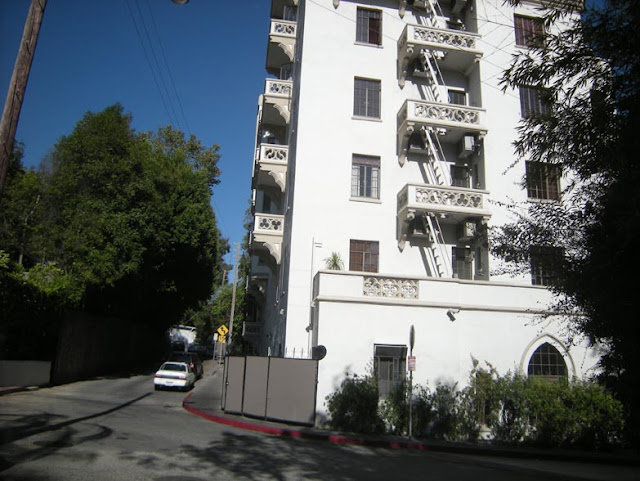
 If you stop by the Chateau Marmont, don't expect to be able to visit the scene of Belushi's demise - unless you plan on staying the night. Belushi was riding a crest of popularity in 1982, and had more than enough money to hole up in one of the hotel's exclusive bungalows, which are accessible only to guests holding room keys.
But if you slip around behind the hotel and walk the sidewalk along Monteel Road, you can peer down into the area of the tree-shaded bungalows. Belushi's last binge occurred either in Bungalow 3 or Bungalow 2 - there seems to be an equal number of contentions for each locale.
-- The Dark Side of Hollywood - LA Daily News
If you stop by the Chateau Marmont, don't expect to be able to visit the scene of Belushi's demise - unless you plan on staying the night. Belushi was riding a crest of popularity in 1982, and had more than enough money to hole up in one of the hotel's exclusive bungalows, which are accessible only to guests holding room keys.
But if you slip around behind the hotel and walk the sidewalk along Monteel Road, you can peer down into the area of the tree-shaded bungalows. Belushi's last binge occurred either in Bungalow 3 or Bungalow 2 - there seems to be an equal number of contentions for each locale.
-- The Dark Side of Hollywood - LA Daily News

 Tributes
John Belushi's life is detailed in the 1985 biography Wired: The Short Life and Fast Times of John Belushi by Bob Woodward. Many friends and relatives of Belushi, including his wife Judy, Dan Aykroyd and Jim Belushi, agreed to be interviewed at length for the book, but later felt the final product was exploitative and not representative of the John Belushi they knew. The book was later adapted into a feature film in which Belushi was played by Michael Chiklis. Belushi's friends and family boycotted the film, which proved to be critical and caused the movie to be a box-office flop.
Tributes
John Belushi's life is detailed in the 1985 biography Wired: The Short Life and Fast Times of John Belushi by Bob Woodward. Many friends and relatives of Belushi, including his wife Judy, Dan Aykroyd and Jim Belushi, agreed to be interviewed at length for the book, but later felt the final product was exploitative and not representative of the John Belushi they knew. The book was later adapted into a feature film in which Belushi was played by Michael Chiklis. Belushi's friends and family boycotted the film, which proved to be critical and caused the movie to be a box-office flop.
Belushi was portrayed by actors Eric Siegel in Gilda Radner: It's Always Something, Tyler Labine in Behind the Camera: The Unauthorized Story of Mork and Mindy (which also features his friendship with Robin Williams), and Michael Chiklis in Wired.
His widow later remarried and is now Judith Belushi Pisano. Her biography (with co-biographer Tanner Colby) of John, Belushi: A Biography is a collection of first-person interviews and photographs, and was published in 2005.
On April 1, 2004, 22 years after his death, Belushi was honored with a star on the Hollywood Walk of Fame, after a ten-year lobby by James Belushi and Judith Belushi Pisano. Among those present at the ceremony were Dan Aykroyd, Chevy Chase, Ted Danson, Mary Steenburgen, and Tom Arnold.
In 2006, Biography Channel aired the "John Belushi" episode of Final 24, a documentary following Belushi in the last 24 hours leading to his death.
Filmography
Tarzoon: Shame of the Jungle (1975) (voice) (1979 American dubbed version)
Animal House (1978)
The Rutles: All You Need Is Cash (1978)
Goin' South (1978)
Old Boyfriends (1979)
1941 (1979)
The Blues Brothers (1980)
Continental Divide (1981)
Neighbors (1981)
SNL characters and impersonations
Recurring characters
Samurai Futaba
Captain Ned, one of Miles Cowperthwaite's cronies
Jacob Papageorge alias 'Joliet' Jake Blues, from the Blues Brothers
Jeff Widette, from the Widettes
Kevin (from The Mall sketches)
Kuldorth (from The Coneheads)
Larry Farber (one half of the Farber couple [the wife, Bobbi, was played by Gilda Radner])
Lowell Brock, from the HandL Brock commercials
Matt Cooper, from the Land Shark sketches
Pete, from the Olympia Cafe
Steve Beshekas (who was in real life a good friend of Belushi's since community college)
Frank Leary, one of St. Mickey's Knights of Columbus
Celebrity impersonations
Al Hirt
Babe Ruth
Bert Lance
Cesar Romero
Dino De Laurentiis
Ed Ames
Ed Asner
Elizabeth Taylor
Elvis Presley
Franklin D. Roosevelt
Fred Silverman
George Wallace
Henry Kissinger
Hermann Göring
Jack Kerouac
Jawaharlal Nehru
Jimmy Hoffa
Joe Cocker
John Lennon
Julia Child
Leonid Brezhnev
Ludwig van Beethoven
Marlon Brando
Menachim Begin
Richard Daley
Robert Blake
Roy Orbison
Sam Peckinpah
Sanjay Gandhi
Steve Rubell
Sun Myung Moon
Tip O'Neill
Truman Capote
Vasiliy Alekseyev
William Shatner
Woody Hayes
Yasser Arafat
 References
1.^ It’s The Artie Talkin’ - DIMP interviews Artie Lange from dvdinmypants.com
References
1.^ It’s The Artie Talkin’ - DIMP interviews Artie Lange from dvdinmypants.com
2.^ Belushi's SNL Bio from NBC.com
3.^ John Belushi Biography (1949-1982) from filmreference.com
4.^ Books Of The Times; Close-Up Of John Belushi from the New York Times
5.^ They Were Belushis (or Blues Brothers) from genealogywise.com
6.^ The religion of John Belushi, actor, comedian from adherents.com
7.^ The party's over: Some say SIUC has finally shed rowdy school image, a May 8, 2006 article from The Southern Illinoisan
8.^ "John Belushi, Manic Comic of TV and Films Dies.". New York Times. "John Belushi, the manic, rotund comedian whose outrageous antics and spastic impersonations on the Saturday Night Live television show propelled him to stardom in the 1970's, was found dead yesterday in a rented bungalow in Hollywood, where he had launched a film career in recent years. The 33-year-old actor ..."
9.^ Robin Williams, television biography from the Biography Channel, 7/7/06.
10.^ John Belushi Dies at the Chateau Marmont from franksreelreviews.com
11.^ Figure in John Belushi Case Freed From California Prison - New York Times


.jpg)
.jpg)
.jpg)
.jpg)
.jpg)


