Les Brown, Sr. (March 14, 1912 – January 4, 2001) and the Band of Renown are a big band that began in the late 1930s, initially as the group Les Brown and His Blue Devils that Brown led while a student at Duke University. The band now performs under the direction of his son Les Brown, Jr.

Les Brown was a big band leader and composer, best known for his nearly seven decades of work with the group Les Brown and His Band of Renown (1938-2001). After graduating from New York Military Academy in 1932, Les Brown attended college at Duke University from 1932-1936. There he led the group Les Brown and His Blue Devils, who performed regularly on Duke's campus and up and down the east coast. Brown took the band on an extensive summer tour in 1936. At the end of the tour, while some of the band members returned to Duke to continue their education, others stayed on with Brown and continued to tour, becoming in 1938 the Band of Renown. A few years later, in 1945, this band brought Doris Day into prominence with their recording of "Sentimental Journey." The song's release coincided with the end of WWII in Europe and became the unofficial homecoming theme for many veterans. The band had nine other number-one hit songs, including "I've Got My Love to Keep Me Warm."

Les Brown and the Band of Renown performed with Bob Hope on radio, stage and TV for almost fifty years. They did 18 USO Tours for American troops around the world, and entertained over three million people. Before the Super Bowls were televised, the Bob Hope Christmas Specials were the highest-rated programs in television history. Tony Bennett was "discovered" by Bob Hope and did his first public performance with Les and the Band.
The first feature length film that Les and the band appeared in was the war-time movie "Seven Days Leave" starring Victor Mature and Lucille Ball. "Rock-A-Billy Baby," a low budget 1957 film, was the Band of Renown's second movie and in 1963, they appeared in Jerry Lewis' comedy "The Nutty Professor."
Les Brown and the Band were also the house band for the Steve Allen show (1959-1961) and the Dean Martin Variety Show (1963-1972). Brown and the band performed with virtually every major performer of their time, including Frank Sinatra, Ella Fitzgerald, and Nat "King" Cole.
Les Brown Sr. died in 2001 and is interred in the Westwood Village Memorial Park Cemetery in Los Angeles, California.
In 2001, Les Brown Jr. became the full-time leader of the Band of Renown. They continue to perform throughout the world and have a regular big band show in Branson, Mo. Les Brown Jr. also hosts a national radio show on the Music Of Your Life network. Les Jr. was a television actor in the 1960s (Gunsmoke, General Hospital, Gilligan's Island), a rock musician and producer who worked with Carlos Santana, and a concert promoter for many country music artists including Merle Haggard and Loretta Lynn. In 2004 Les Brown Jr. received the Ambassador of Patriotism award from the POW Network.
Sheriff Andy Taylor: You could put a sign in the window saying 'Two Chairs - No Waiting.'
Floyd Lawson: Two chairs... and I've got the magazines to swing it!
Andy Taylor: Well, as Mark Twain said, everybody complains about the weather but nobody does anything about it.
Floyd Lawson: Did he say that?
Andy Taylor: Mm-hmm.
Floyd Lawson: I thought Calvin Coolidge said that.
Andy Taylor: No, no Floyd, Calvin Coolidge didn't say that.
Floyd Lawson: What'd Calvin Coolidge say?
[Goober thinks he has whiplash]
Goober Pyle: Floyd made the diagnosis.
Andy Taylor: Floyd, what do you know about whiplash?
Floyd Lawson: What do you mean? A barber does a lot of work around the back of the neck.
[after a haircut at Floyd's]
Andy Taylor: Floyd.
Floyd Lawson: What's the matter?
Andy Taylor: My sideburns.
Floyd Lawson: Your sideburns - what's the matter with your sideburns?
Andy Taylor: Why, they're both even.
Floyd Lawson: Well, I'll be dogged. How'd that happen?
Andy Taylor: I declare, Floyd, I believe you're getting the hang of it. And looka there - they're the right length and everything.
Howard Terbell McNear (January 27, 1905 – January 3, 1969) was an American film, television and radio character actor. McNear is best remembered as Floyd Lawson, the barber in The Andy Griffith Show.
Career
McNear was born in Los Angeles, California to Luzetta M. Spencer and Franklin E. McNear. He worked in radio from the late 1930s, distinguishing himself in the 1938–1940 radio serial Speed Gibson of the International Secret Police as ace operator Clint Barlow. McNear could be effective in such authoritative roles, but he gravitated more toward character roles, often comic.
He enlisted as a private in the U.S. Army Air Corps on November 17, 1942 during World War II.
He created the role of Doc Charles Adams in CBS Radio's Gunsmoke (1952–1961). McNear was under contract to CBS for many years and was featured in many of the network's radio and TV programs. From 1955 to 1960 he appeared frequently, in various quirky roles, in the popular radio detective series Yours Truly, Johnny Dollar. In the TV sitcom Leave It to Beaver, McNear made an appearance as a barber named Andy, a role which proved prophetic.

McNear was best known for his performances as the vague, chatty barber Floyd Lawson on The Andy Griffith Show. In that role, McNear replaced actor Walter Baldwin, who was deemed too elderly for the part. McNear later said that he didn't replace anyone, but was playing Floyd Lawson, Jr. During the third season, McNear suffered a stroke that rendered him unable to walk though his speech remained intact. Griffith, who realized how much the Floyd character added to the show's dynamic, urged that he return to the role if possible. McNear resumed the role (after being off the show for almost a year and a half), with the production crew accommodating his disability. In his appearances on the show before the stroke, he is seen standing and working in his barber shop (and also walking freely). After the stroke, he is usually seen seated (in his barber chair or a park bench, etc.). The stagehands constructed a stand for him, which allowed him to stand and appear to be working, usually to comb hair (one-handed, of course). There was a case (after the stroke) where the sequence of camera shots made it appear that his character did indeed take some steps. His last appearance on the show was in the episode "Goober's Contest," which wrapped up the 1966-1967 season.

It has been said by his fellow cast members of The Andy Griffith Show that McNear's real-life personality was more like his character than any other cast member.
Death
McNear died in the San Fernando Valley from the effects of a stroke. After his passing in 1969, Howard McNear was interred in the Los Angeles National Cemetery, a former U.S. Veterans Administration cemetery in Los Angeles. He was survived by his wife Helen and son Christopher.
Tribute
In two episodes of the comedy sketch program Second City Television, actor Eugene Levy played McNear's Floyd the Barber. His first appearance as Floyd the Barber was in a parody of The Godfather, in the opening scene as Amerigo Bonasera, in which he asks the Don to hurt Opie for breaking his barber pole. The last line delivered by Floyd is "Ohh, and would you kill Howard Sprague for me?", referring to Howard Sprague, a character from the Andy Griffith Show. His other appearance was The Merv Griffith Show (a combination parody of the Andy Griffith Show and the Merv Griffin Show), in which he is in his barber shop cutting hair and at a surprise party for Gomer.
Selected filmography
Film
1953 The Long, Long Trailer Joe Hittaway Uncredited
1954 Drums Across the River Stilwell
1956 You Can't Run Away from It Vernon, Second proprietor
1957 The Fuzzy Pink Nightgown John Myers Uncredited
1958 Bell, Book and Candle Andy White - Shep's Co-Publisher
1959 Good Day for a Hanging Olson
1959 Anatomy of a Murder Dr. Dompierre
1959 It Started with a Kiss Emile Uncredited
1959 -30- Editor Alternative title: Deadline Midnight
1960 Heller in Pink Tights Photographer of dead gunmen
1961 The Last Time I Saw Archie General Williams
1961 Voyage to the Bottom of the Sea Congressman Parker
1961 Blue Hawaii Mr. Chapman
1961 The Errand Boy Dexter Sneak
1962 Follow that Dream George
1963 Irma la Douce Concierge
1963 The Wheeler Dealers Mr. Wilson Alternative title: Separate Beds
1964 Kiss Me, Stupid Mr. Pettibone
1965 Love and Kisses Mr. Frisby
1966 The Fortune Cookie Mr. Cimoli Alternative title: Meet Whiplash Willie
Television
1955 Waterfront Mike Baxter 1 episode
1955 Willy Sherman 1 episode
1955-1958 The George Burns and Gracie Allen Show Mr. Jansen 2 episodes
1956 Lassie Professor Scott 1 episode
1956 I Love Lucy Mr. Crawford 1 episode
1958 The Thin Man Mr. Dingle 1 episode
1958 Playhouse 90 Bertram 1 episode
1958 Leave It to Beaver Andy the Barber 1 episode
1959 The Donna Reed Show Wilbur Wilgus 2 episodes
1959 The Gale Storm Show Parker 1 episode
1960 Richard Diamond, Private Detective Dr. Braun 1 episode
1960 The Tab Hunter Show Plumber 1 episode
1960 Laramie Waldo 1 episode
1960 Have Gun - Will Travel Samuels 1 episode
1960-1962 The Flintstones Doctor (Voice) 3 episodes
1961 Klondike Augustus Brown 1 episode
1961 Alfred Hitchcock Presents Mr. Maxwell 1 episode
1961 Mister Ed Harry Sweetzer 1 episode
1961-1967 The Andy Griffith Show Floyd Lawson 80 episodes
1962 Pete and Gladys Professor Sheboyan 1 episode
1962 The Wide Country Agent Carmody 1 episode
1965 Honey West Mr. Tweedy 1 episode
1965 Please Don't Eat the Daisies Mr. Arnold 1 episode

Footnotes
1.^ Record of Howard McNear, Social Security Death Index.
2.^ Record of Howard T. McNear. Ancestry.com. California Death Index, 1940-1997 [database on-line]. Provo, UT, USA: The Generations Network, Inc., 2000.
3.^ Ancestry.com community; Howard T. McNear
4.^ Radio Broadcast Log Of: Speed Gibson of the International Secret Police
5.^ National Archives and Records Administration. U.S. World War II Army Enlistment Records, 1938-1946 [database on-line]. Provo, UT, USA: The Generations Network, Inc., 2005.
6.^ Gunsmoke Radio series information
7.^ Golden Age of Radio
8.^ Leave it to Beaver episode info, "The Shave"
9.^ Howard McNear biography
10.^ Find a Grave, Howard McNear
11.^ "Howard McNear, Actor, 63; On Andy Griffith Show", The New York Times, Jan. 7, 1969, p. 38.
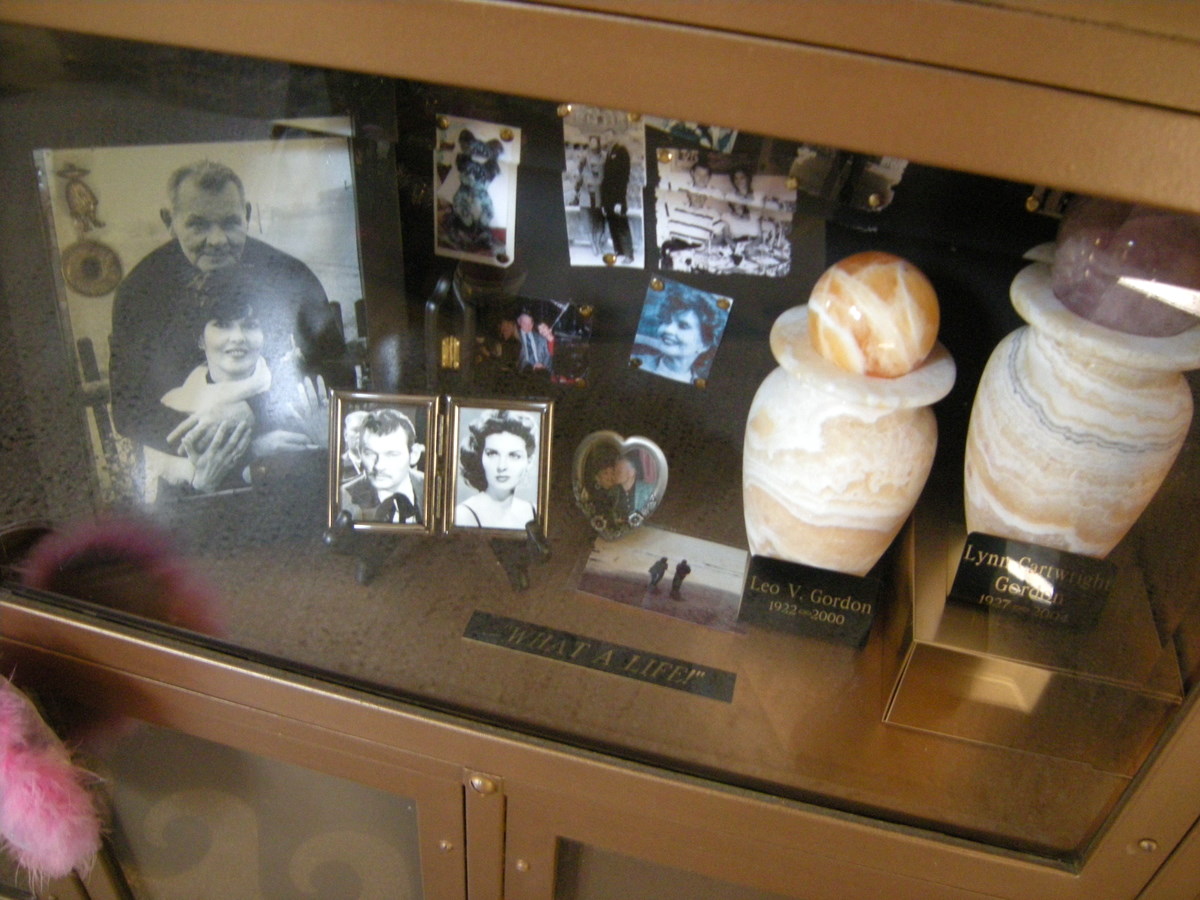
Lynn Cartwright (February 27, 1927 – January 2, 2004) was an American character actress probably best known for her performance as the older version of Geena Davis' character, Dottie Hinson, in the 1992 film A League of Their Own.
She was born Doralyn E. Cartwright in McAlester, Oklahoma, the daughter of U.S. Congressman Wilburn Cartwright and his wife Carrie. She had a sister, Wilburta, who was a successful artist. She was also related to former Oklahoma Legislator Buck Cartwright and former Oklahoma Attorney General Jan-Eric Cartwright.
Her acting career spanned from 1957 to 1992 and included smaller roles in largely forgettable films such as Black Patch (1957), The Cry Baby Killer (1958), The Wasp Woman (1960), The Girls on the Beach (1965), Son of Hitler (1978) and Lovelines (1984).
She was also involved with a repertory theatre group in Burbank, California.
Cartwright was married to actor/writer Leo Gordon until his death in 2000. She died from complications of dementia after having suffered a fall in which she fractured her hip. Her interment was located in Hollywood Forever Cemetery.
Leo Vincent Gordon (December 2, 1922 - December 26, 2000) was an American movie and television character actor as well as a screenplay writer. He specialized in playing brutish bad guys during more than forty years in film and television.
In contrast to his screen persona, Gordon was a quiet, thoughtful and intelligent man who generally avoided the Hollywood spotlight. He was widely regarded by his fellow actors and his directors as a well-prepared professional. In 1997, he received the "Golden Boot Award" for his many years of work in Westerns. In accepting the award, the actor simply flashed a smile for his fans and remarked "Thank God for typecasting!"
After struggling with a brief illness, Gordon died in his sleep at age 78 at his Los Angeles home from cardiac failure. He and his wife's ashes are interred at the Hollywood Forever Cemetery in Los Angeles.
Erroll Louis Garner (June 15, 1923[1] – January 2, 1977) was an American jazz pianist and composer known for his swing playing and ballads. His best-known composition, the ballad "Misty," has become a jazz standard. Allmusic.com calls him "one of the most distinctive of all pianists" and a "brilliant virtuoso."[2]
Career
Born in Pittsburgh, Pennsylvania, to an African American family in 1923 , Erroll began playing piano at the age of three. He attended George Westinghouse High School, as did fellow pianists Billy Strayhorn and Ahmad Jamal. Garner was self-taught and remained an "ear player" all his life – he never learned to read music.[3] At the age of seven, Garner began appearing on radio station KDKA in Pittsburgh with a group called the Candy Kids. By the age of 11, he was playing on the Allegheny riverboats. At age 14 in 1937, he joined local saxophonist Leroy Brown.
He played locally in the shadow of his older pianist brother Linton Garner and moved to New York in 1944. He briefly worked with the bassist Slam Stewart, and though not a bebop musician per se, in 1947 played with Charlie Parker on the famous "Cool Blues" session. Although his admission to the Pittsburgh music union was initially refused because of his inability to read music, they eventually relented in 1956 and made him an honorary member.[3] Garner is credited with having a superb memory of music. After attending a concert by the Russian classical pianist Emil Gilels, Garner returned to his apartment and was able to play a large portion of the performed music by recall.[3]
Short in stature (5 foot 2 inches), Garner performed sitting on multiple telephone directories, except when playing in New York City, where a Manhattan phone book was sufficient.[3][4] He was also known for his occasional vocalizations while playing, which can be heard on many of his recordings. He helped to bridge the gap for jazz musicians between nightclubs and the concert hall.
Erroll Garner suffered a cardiac arrest on January 2, 1977 in an ambulance going to Cedars Sinai Hospital in Los Angeles.
Until his death, he made many tours both at home and abroad, and produced a large volume of recorded work. Garner is buried in Pittsburgh's Homewood Cemetery. He was, reportedly, The Tonight Show host Johnny Carson's favorite jazz musician; Garner appeared on Carson's show many times over the years.
Playing style
Errol Garner headlining with Oscar Pettiford and J.C. Heard at Three Deuces nightclub on 52nd Street, May 1948
Called "one of the most distinctive of all pianists" by Allmusic.com, Garner showed that a "creative jazz musician can be very popular without watering down his music" or changing his personal style.[2] He is referred to as a "brilliant virtuoso who sounded unlike anyone else", using an "orchestral approach straight from the swing era but …open to the innovations of bop."[2] Garner's ear and technique owed as much to practice as to a natural gift. His distinctive style could swing like no other, but some of his best recordings are ballads, such as his best-known composition, "Misty." "Misty" rapidly became a jazz standard – and was famously featured in Clint Eastwood's Play Misty for Me (1971).
Garner may have been inspired by the example of Earl Hines, a fellow Pittsburgh resident but 18 years his senior, and there were resemblances in their elastic approach to timing and the use of the right-hand octaves. As it is especially shown by Garner's early recordings, another clear influence on him was the stride piano style of James P. Johnson and Fats Waller. His definitive style, though, was unique and had neither obvious forerunners nor imitators. A key factor in his sound was the independence of his hands (hands with thick, stubby fingers, typically deemed unsuitable for piano playing).
Garner would often play behind or ahead of the beat with his right hand while his springy left hand rocked steady, creating insouciance and tension in the music, which he would resolve by bringing the timing back into sync. The independence of his hands also was evidenced by his masterful use of three against four figures and more complicated cross rhythms between the hands.
What makes Garner's playing easy to recognize is his trademark introductions, which seem to make no sense until breaking dramatically into his exposition of the tune. Sometimes cacophonous and at other times strange, his intros produced a sense of excitement and anticipation and humor. One of the more important aspects of his style of improvisation was that it generally stayed close to the melodic theme and the novelty lay in voicings.
Garner bridged the gap between stride and straight-ahead styles. Often identified as a stride player, his right hand had the trappings of modernity, elements of Cole and Wilson delineations … He was one of our greatest anomalies, with hands barely reaching an octave, he came to define a medium filled with technical prowess on his own terms. His style might best be described as orchestral, as his creations often maintained the energy and diversity of an entire band.
Works
His recording career started out in the late 1940s when several sides such as "Fine and Dandy" and "Sweet 'n' Lovely" were cut. However, his 1955 live album Concert by the Sea was a best-selling jazz album in its day and features Eddie Calhoun on bass and Denzil Best on drums. This recording of a performance at the Sunset Center, a former church in Carmel-by-the-Sea, California, that was to be shared with Korean War veterans at a nearby army base, was made using relatively primitive sound equipment, but for George Avakian the decision to release the recording was easy. Other notable works include 1951's Long Ago and Far Away and 1974's Magician, both of which see Garner perform a number of classic standards in his own style. Often the trio was expanded to add Latin percussion, usually a conga, with electric results.
In 1964, Garner appeared in the UK on the music series Jazz 625 (625 referring to the PAL 625-line format) broadcast on the BBC's new second channel. The programme was hosted by Steve Race, who introduced Garner's trio with Eddie Calhoun on bass and Kelly Martin on drums. While working the keyboard hard, Garner had perspiration streaming down his face as the programme made close shots of his hands.[5]
Discography
Serenade To Laura (1945)
Giants of the Piano (back to back with Art Tatum) (1947 Hollywood recordings with Red Callender and Hal West) Vogue LP LAE 12209
Early in Paris (1948) Blue Music Group
Penthouse
Serenade (1949)
Erroll Garner (August 1949) Los Angeles recordings with John Simmons, Alvin Stoller (2 Vols Joker LP BM 3718-3719)
Erroll Garner (no date, circa 1951) with Wyatt Ruther and Fats Heard Philips B 07015 L
Erroll Garner plays for dancing (no date, circa 1951) Philips B 07622 R
Solo flight (no date, circa 1951) Philips B 07602 R
Erroll Garner at the Piano (1951-3 material) with Wyatt Ruther and Fats Heard, CBS reissue LP 62311
Mambo Moves Garner (1954) Mercury MG20055
Plays Misty (1954) Mercury SR60662
Gems (1954) Columbia CL583
Music for Tired Lovers, with Woody Herman singing (!) (1954) Columbia CL651
Concert by the Sea (1955) Columbia CL535
Contrasts (1955)
Solitaire (1955)
Afternoon of an Elf (1955) Mercury MG20090
The One and Only Erroll Garner (1956)
The Most Happy Piano (1956) Columbia CL939
He's Here! He's Gone! He's Garner! (1956)
Other Voices, with orchestra (1957) Columbia CL1014
Soliloquy (1957) Columbia CL1060
Paris Impressions Vol.#1 (1958) Columbia CL 1212
Paris Impressions (1958) Columbia #1216, double album
Erroll Garner One World Concert (1961) Reprise R9-6080 B
Informal Piano Improvisations (1962) Baronet B-109
Erroll Garner Plays Gershwin and Kern (1964) Mercury 826 224-2
Erroll Garner Amsterdam Concert (Concert 7 November 1964) Philips LP BL7717/632 204 BL
Erroll Garner Plays (1965) Ember LP FA 2011
Campus Concert (1966) MGM SE-4361
That's my Kick (1967) MGM SE-4463
Up in Erroll's room - featuring the Brass Bed (1968) Vanguard NSLP 28123
Feeling is Believing (1970) Mercury SR61308
Gemini (1972) London Records XPS617
Magician (1974) London Records APS640
Play it Again Erroll ( Reissued 1974) Columbia CL33424 double album
The Elf-The Savoy Sessions (1976) Savoy SJL 2207 double album
Long Ago and Far Away (1987)
Body and Soul (1991) Columbia CK47035
Biographies
James M Doran Erroll Garner: The Most Happy Piano, Scarecrow Press, 1985. ISBN 978-0810817456
References
1.^ California Death Index 1940-1997 Ancestry.com
2.^ Erroll Garner at Allmusic
3.^ John Wilson, "Erroll Garner, Jazz Pianist, 53; Composed 'Misty,' 'That's My Kick'", New York Times, January 3, 1977, p. 23.
4.^ John Wilson, "Return of Erroll Garner; Phone Book Is Still His Prop at Village Gate", New York Times, May 29, 1965, p. 16.
5.^ "Garner's Serendipitous Hit", Wall Street Journal, 17 Sep 2009.
Julia Phillips (April 7, 1944 – January 1, 2002) was an American film producer and author. She co-produced three of the most prominent films of the 1970s — The Sting, Taxi Driver, and Close Encounters of the Third Kind — and was the first female producer to win an Academy Award for Best Film.
In 1991, Phillips published an infamous tell-all memoir of her years as a Hollywood producer, entitled You'll Never Eat Lunch in This Town Again, which became a bestseller.
Early life
Born Julia Miller in New York City, she received her B.A. in Political Science from Mount Holyoke College in 1965, where she met Michael Phillips, whom she married, and whom she would later divorce. She worked for a time editing articles for magazines, and moved from there into the film industry.

Film career
In 1973, The Sting won the Academy Award for Best Picture and made Phillips the first woman to win an Oscar as a producer (an award shared by Tony Bill and Phillips' then-husband Michael Phillips). In 1977, Taxi Driver, produced by the Phillipses, was nominated for Best Picture. Her third major film, Close Encounters of the Third Kind, was produced with Michael Phillips and associate producer/production manager Clark Paylow. One of the film's stars, François Truffaut, publicly criticized Phillips as incompetent, a charge she rejected, writing that she had essentially nursed Truffaut through his self-created nightmare of implied hearing loss, sickness and chaos during the production.[1] Phillips was also a notorious drug user (cocaine especially), which she herself chronicled in detail in her memoirs. The side-effects of cocaine addiction caused her to be fired from Close Encounters of the Third Kind during post-production.[2] She worked very little in Hollywood after that, basically disappearing from public notice until she published her memoirs.
Publishing success
In 1991 Phillips wrote the no-holds-barred autobiography You'll Never Eat Lunch in This Town Again about her experiences in Hollywood. The book topped the New York Times bestseller list but its revelations about high-profile film personalities and Hollywood's drug/film production culture, casting couch mentality made her one of the most despised people in the film industry. In 1995, she followed up her story with a second book, Driving Under the Affluence, which is mostly about the impact her first book's reception had on her life. In 2000, she also helped Matt Drudge write his Drudge Manifesto.[3]

Death
Phillips died in West Hollywood, California, at the age of 57, from cancer on New Year's Day, 2002, and was interred in the Hillside Memorial Park Cemetery in Culver City, California.
Filmography
The Sting (1973)
Taxi Driver (1976)
Close Encounters of the Third Kind (1977)
Further reading
You'll Never Eat Lunch in This Town Again by Julia Phillips (Random House, 1991), ISBN 0-394-57574-1
References
1.^ *Phillips, Julia (1991). You'll Never Eat Lunch in This Town Again. New York: Random House. ISBN 0-394-57574-1. p 274 et seq.
2.^ *Morton, Ray (2007). Close Encounters of the Third Kind: The Making of Steven Spielberg's Classic Film. New York: Applause Theater and Cinema Books. ISBN 978-1-55783-710-3. p 259
3.^ Matt Drudge and Julia Phillips (2000). "Drudge Manifesto, Chapter one online". Denver Post. Retrieved 2007-03-02.
Cesar Julio Romero, Jr. (February 15, 1907 – January 1, 1994) was a Cuban American film and television actor, best known for his portrayal of The Joker in the 1960s television series Batman. In 1966, the show was transferred to movie theaters, and Romero became the first actor to portray the Joker in a motion picture.
Romero was born in New York to prosperous Cuban parents. That lifestyle, however, changed dramatically when his parents lost their sugar import business and suffered losses in the Stock Market Crash of 1929. Fortunately, Romero's Hollywood earnings allowed him to support his large family, all of whom followed him to the West Coast, years later. Romero lived on and off with various family members, especially his sister, for the rest of his life.
In October 1942, he voluntarily enlisted in the U.S. Coast Guard and served in the Pacific Theatre. He reported aboard the Coast Guard-manned assault transport USS Cavalier (APA-37) in November, 1943 and saw action at Tinian and Saipan. He preferred to be a regular part of the crew and was eventually promoted to the rank of chief Boatswain's Mate.
Romero played "Latin lovers" in films from the 1930s until the 1950s, usually in supporting roles. Initially, he attracted attention in Hollywood when he starred as The Cisco Kid in six westerns made between 1939 and 1941. Romero's skill at both dancing and comedy can be seen in the classic 20th Century Fox films he starred in opposite Carmen Miranda and Betty Grable, such as Week-End in Havana and Springtime in the Rockies, in the 1940s.
As well as being an accomplished ballroom dancer, Romero was also a dramatic actor, as he demonstrated in The Thin Man (1934), in which he played a villainous supporting role opposite the film's main star William Powell. Many of Romero's films from this early period saw him cast in small character parts, such as Italian gangsters and East Indian princes. He also appeared in a comic turn as a subversive opponent to Frank Sinatra and his crew in Ocean's Eleven.
20th Century Fox, along with mogul Darryl Zanuck, personally selected Romero to co-star with Tyrone Power in the Technicolor historical epic, Captain from Castile (1947), directed by Henry King. While Power played a fictionalized character, Romero played Hernan Cortez, the most famous Conquistador in Spain's conquest of the Americas. The movie is set in 1519, and sets out the general account of the first stages in the conquest of the Aztecs in Mexico. This film was meant as the vehicle to restart Tyrone Power's career, though many feel that Romero's career benefited more from it. It was produced on a scale that would not be eclipsed as a visual epic until years later by the likes of Quo Vadis, The Robe, The Ten Commandments, Ben Hur or, even later, Lawrence of Arabia. Romero was able to maintain the aura of "major stardom" for at least 10 years after this major role. The film was widely seen, and influenced the future depiction of Spanish Conquistadors. The film anachronistically depicted the armor and headgear worn by the conquering Spanish adventurers, shifting the styles forward about 70 years. Countless monuments, logos, commercial art, and text books over the years have copied this mistake.

Among his many television credits, Romero played the role of Don Diego de la Vega's uncle in a number of Season Two Zorro episodes. In 1958, he guest starred as Ramon Valdez, a South American businessman, who excels at doing the Cha-Cha with Barbara Eden in her syndicated romantic comedy, How to Marry a Millionaire in the episode "The Big Order". He performed the mamba with Gisele MacKenzie on her NBC variety show, The Gisele MacKenzie Show. In 1965, Romero played the head of THRUSH in France in The Man from U.N.C.L.E. ("The Never Never Affair").
Cesar Romero in his role as The Joker in Batman.In 1966, Romero again achieved iconic status when he played The Joker in ABC's television series, Batman. He refused to shave his mustache and so it was covered with white makeup when playing the supervillain throughout the series' run, and in the spinoff 1966 film.
In the 1970s, Romero portrayed the absent father of the Freddie Prinze character Chico Rodriguez in Chico and the Man, and later Peter Stavros in the television series Falcon Crest (1985-1987). Among Romero's guest star work in the 1970s was a recurring role on the western comedy Alias Smith and Jones, starring Pete Duel and Ben Murphy. Romero played Señor Armendariz, a Mexican rancher feuding with Patrick McCreedy (Burl Ives), the owner of a ranch on the opposite side of the border. He appeared in three episodes. He also appeared as Count Dracula on Rod Serling's Night Gallery.
Apart from these television roles, Romero's most notable work in film in this period is as A.J. Arno, a small time criminal who continually opposes Dexter Riley (played by Kurt Russell) and his schoolmates of Medfield College in a series of films by Walt Disney Productions in the 1970s.
In The Simpsons episode "Hungry, Hungry Homer", the ghost of Cesar Chavez appears as Cesar Romero because Homer Simpson doesn't know what Cesar Chavez looks like.
In 2008, comedian Shaun Micallef started doing impersonations of Cesar on his television show Newstopia. The impersonations featured Cesar doing fake news reports from various locations.
Romero believed in liberation theology. Romero was a dedicated Christian, and believed in a utopian society whose belief is that Christ's kingdom would be very similar to Marx's envisionment of communism, and held to this belief until his death.
Romero always claimed his grandfather on his mother's side was Cuban poet and patriot José Martí. There was some speculation that Maria was fathered by Martí who was a boarder in the Mantilla household, but he never claimed Maria as his daughter in his lifetime.
Romero never married, despite proposing to at least one woman. Romero made regular appearances on the Hollywood social circuit, usually in the company of an attractive actress, and he was almost always described in interviews and articles as a "confirmed bachelor." Romero discussed his homosexuality in a series of interviews with author Boze Hadleigh, with the understanding that they would not be published during his lifetime.
Romero wore a man's tennis bracelet inscribed with his favorite nickname: "Butch." The term was reportedly bestowed on Romero by his one-time dancing partner Joan Crawford, who teased Romero by telling him: "You're so butch!" While Romero's homosexuality was an "open secret" in Hollywood, the movie-going public was unaware of his sexual orientation and there was never any embarrassing scandal surrounding his male liaisons, partially because he strove to be as discreet as possible.
Romero was a mainstay of the Hollywood social circuit until his peaceful death in 1994. He was cremated and his ashes interred at Inglewood Park Cemetery in South Los Angeles community of Inglewood, California.




.jpg)
-003.jpg)


.jpg)
.jpg)


