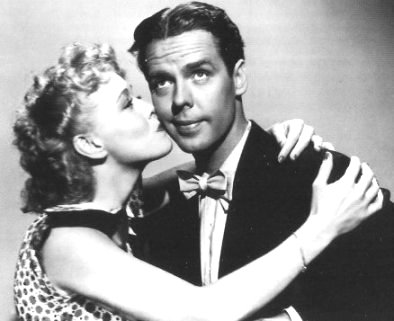
Arthur Lake (b. April 17, 1905, Corbin, Kentucky - d. January 9, 1987, Indian Wells, California) was an American actor known best for bringing Dagwood Bumstead, the bumbling husband of Blondie to life in film, radio, and television.
Early life and career
At the time of his birth in 1905, Arthur Silverlake, Jr.'s father and uncle were touring with a circus in an aerial act known as "The Flying Silverlakes".[1] His mother, Edith Goodwin, was an actress. His parents later appeared in vaudeville in a skit "Family Affair", traveling throughout the South and Southwest United States. Arthur first appeared on stage as a baby in Uncle Tom's Cabin and he and his sister, Florence, became part of the act in 1910.[1] Their mother brought the children to Hollywood to get into films, and Arthur made his screen debut in the silent Jack and the Beanstalk (1917). Florence became a successful actress, achieving a degree of fame as one of the screen wives of comedian Edgar Kennedy.
Universal Pictures signed him to a contract, where he acted in westerns as an adolescent character actor. Shortly after the formation of RKO Pictures in 1928, he signed with that studio, where he made Dance Hall (1929) and Cheer Up and Smile (1930).[1] During this early sound film era, he typically played light romantic roles, usually with a comic "Mama's Boy" tone to them, in films such as Indiscreet (1931) with Gloria Swanson.
Dagwood in Blondie
Arthur Lake is best-known for portraying the Blondie comic strip character of Dagwood Bumstead in twenty-eight[1] Blondie films produced by Columbia Pictures from 1938 until 1950. For the first seven of those years,[1] a radio version was also broadcast with Lake in the Dagwood role. He also portrayed the character in a short-lived 1957 Blondie TV series. His work in the popular Blondie radio show earned him a star on the Hollywood Walk of Fame at 6646 Hollywood Blvd.
Personal life
Lake became very friendly with newspaper tycoon William Randolph Hearst and his mistress Marion Davies. He was a frequent guest at the beach house of Davies, where he met Patricia Lake (née Van Cleeve) (1923–1993). They were married at San Simeon on the 24th of July 1942. The parentage of Patricia Van Cleeve is unclear, but at the time of her death, she claimed to be the daughter of Davies and Hearst.
Lake died of a heart attack in Indian Wells, California on January 9, 1987 and was interred in the Hollywood Forever Cemetery, in the Douras family mausoleum, along with actress Marion Davies and her husband, Horace G. Brown.
References
1.^ Lamparski, Richard (1982). Whatever Became Of ...? Eighth Series. New York: Crown Publishers. pp. 166–67. ISBN 0-517-54855-0.
Louis Allen "Lou" Rawls (December 1, 1933 – January 6, 2006) was an American soul, jazz, and blues singer. He was known for his smooth vocal style: Frank Sinatra once said that Rawls had "the classiest singing and silkiest chops in the singing game." Rawls released more than 70 albums, sold more than 40 million records, appeared as an actor in motion pictures and on television, and voiced-over many cartoons.
Rawls is the subject of an upcoming biopic, tentatively titled Love Is a Hurtin' Thing: The Lou Rawls Story. Rawls' son, Lou Rawls Jr., is the author of the script. Rawls will reportedly be portrayed by the actor Isaiah Washington. Rawls' favorite expression was "Yeah buddy!"
Personal life
According to an Associated Press article, dated December 19, 2005, Rawls tried to annul his two-year marriage to Nina Malek Inman Rawls, a former flight attendant, in order to "protect hundreds of thousands of dollars" that his wife "absconded" with. Nina Rawls, who acted as his manager for two years, explained that she transferred nearly $350,000 of his into an account she solely controlled in order to prevent one of Rawls' daughters from seizing it. The couple had a son together, Aiden Allen Rawls.

In December 2005, it was announced that Rawls was being treated for lung and brain cancer. The singer died on January 6, 2006 at Cedars-Sinai Medical Center in Los Angeles from complications of the cancers, with his wife at his side. Besides his wife and youngest son, he left behind two adult daughters - Louanna Rawls, a wardrobe stylist and future Launch My Line contestant, and Kendra Smith, an adult son, Lou Rawls, Jr, and three granddaughters - Brianna, Katrina, and Chayil. Lou Rawls is entombed at Forest Lawn Memorial Park, Hollywood Hills.
Victor Fleming (February 23, 1889 – January 6, 1949) was an American film director, cinematographer, and producer. His most popular films were The Wizard of Oz (1939), and Gone with the Wind (1939), for which he won an Academy Award for Best Director.
Overview
Victor Fleming was born in La Canada, California. He served in the photographic section during World War 1, and acted as chief photographer for President Woodrow Wilson in Versailles, France.[1] He showed a mechanical aptitude early in life; while working as a car mechanic he met the director Allan Dwan, who took him on as a camera assistant. Fleming soon rose to the rank of cinematographer, working with both Dwan and D. W. Griffith, and directed his first film in 1919.
Many of Fleming's silent films were action movies, often starring Douglas Fairbanks, or Westerns, and with his robust attitude and love of outdoor sports he became known as a "man's director". But he also proved an effective director of women. Under his direction, Vivien Leigh won the Best Actress Oscar, Hattie McDaniel won for Best Supporting Actress, and Ingrid Bergman was nominated. (In fact, nine actors who appeared in films directed by Fleming were Oscar-nominated.)
MGM
In 1932 Fleming joined MGM and directed some of the studio's most prestigious films. Red Dust (1932), Bombshell (1933), and Reckless (1935) showcased Jean Harlow, while Treasure Island (1934) and Captains Courageous (1937) brought a touch of literary distinction to boy's-own adventure stories. His two most famous films came in 1939, when The Wizard of Oz was closely followed by Gone with the Wind.
Fleming's version of Dr. Jekyll and Mr. Hyde (1941), with Spencer Tracy, was generally rated below Rouben Mamoulian's 1931 Pre-Code version, which had starred Fredric March. Fleming's 1942 film version of John Steinbeck's Tortilla Flat starred Spencer Tracy, John Garfield, Hedy Lamarr, and Frank Morgan. Other films that Fleming made with Tracy include Captains Courageous (for which Tracy won his first Oscar), A Guy Named Joe, and Test Pilot. He directed Clark Gable in a total of five films - Red Dust, The White Sister, Test Pilot, Gone With the Wind, and Adventure.
Fleming died suddenly from a heart attack soon after completing Joan of Arc (1948) with Ingrid Bergman. It was one of the few films that he did not make for MGM. Despite mixed reviews, Fleming's film version of the life of Joan received seven Academy Award nominations, winning two Academy Awards. Victor Fleming is buried at Hollywood Forever Cemetery.
Partial directorial filmography
Joan of Arc (1948)
Adventure (1945)
A Guy Named Joe (1943)
Tortilla Flat (1942)
Dr. Jekyll and Mr. Hyde (1941)
Gone with the Wind (1939)
The Wizard of Oz (1939) (co-director)
The Great Waltz (1938) (uncredited)
Test Pilot (1938)
Captains Courageous (1937)
The Good Earth (1937) (uncredited)
The Farmer Takes a Wife (1935)
Reckless (1935)
Treasure Island (1934)
Bombshell (1933)
The White Sister (1933)
Red Dust (1932)
The Wet Parade (1932)
Renegades (1930)
Common Clay (1930)
The Virginian (1929)
The Wolf Song (1929)
Abie's Irish Rose (1929)
The Awakening (1928)
The Rough Riders (1927)
Hula (1927)
The Way of All Flesh (1927)
Mantrap (1926)
The Blind Goddess (1926)
Lord Jim (1925)
A Son of His Father (1925)
Adventure (1925)
The Devil's Cargo (1925)
Code of the Sea (1924)
Empty Hands (1924)
The Call of the Canyon (1923)
To the Last Man (1923)
Law of the Lawless (1923)
Dark Secrets (1923)
Anna Ascends (1922)
Red Hot Romance (1922)
The Lane That Had No Turning (1922)
Woman's Place (1921)
Mama's Affair (1921)
The Mollycoddle (1920)
When the Clouds Roll By (1919)
References
1.^ "Victor Fleming Biography". biography.com. http://www.biography.com/articles/Victor-Fleming-9297044. Retrieved June 26, 2010.
Frank Tuttle (August 6, 1892 - January 6, 1963) was a Hollywood film director and writer who directed films from 1922 (The Cradle Buster) to 1959 (Island of Lost Women).
His output includes The American Venus (1926), the all-star revue Paramount on Parade (1930), the murder mystery The Benson Murder Case (1930), the comedy film This Is the Night (1932) with Cary Grant, and Roman Scandals (1933) starring Eddie Cantor.
On his passing in 1963, at the age of 70, Tuttle was interred in the Westwood Village Memorial Park Cemetery in Los Angeles.
Selected filmography
Springtime for Henry (1934)
Further reading
Frank Tuttle, They Started Talking (Albany: BearManor Media, 2006)
Frank Tuttle Socialists, Socialites, and Sociopaths: Plays and Screenplays (Albany: BearManor Media, 2007)
Daniel Stephen Sugerman (aka Danny; October 11, 1954 – January 5, 2005) was the second manager of the Los Angeles based rock band The Doors, and wrote several books about Jim Morrison and The Doors, including No One Here Gets Out Alive co-authored with Jerry Hopkins, and the autobiography Wonderland Avenue. Sugerman replaced the original Doors manager, Bill Siddons, shortly after Morrison's death in 1971. He helped film director Oliver Stone with the production of the 1991 movie The Doors.
Sugerman began working with The Doors when he was 12 years old, starting with answering their fan mail. As stated by The Doors' drummer John Densmore, Danny was "the manager and driving force behind The Doors" who "guided our career for over 30 years." He lived his life keeping the legacy of The Doors alive.
Sugerman also managed Iggy Pop, and produced his song "Repo Man." He also wrote Appetite For Destruction: The Days of Guns 'n Roses in 1991.
Sugerman married the former Fawn Hall of Iran-Contra fame in 1991 and remained married to her until his death. They briefly met MP3.com cofounder Rod Underhill while Hall was employed as an administrative assistant at the San Diego headquarters of the original MP3.com. Underhill, the founding Music Director of MP3.com, stated that "Sugerman was very interesting. He had appeared to go out of his way to appear visually like Jim Morrison. Same type of haircut, similar clothing. The similarity was uncanny."
Sugerman was interested in working out a distribution deal with MP3.com for a number of live Doors recordings that were yet unreleased. No deal was forthcoming, and Sugerman later determined that it would be practical to offer the recordings on CD to fans via the Doors' own official website.
Sugerman was a recovering heroin addict who found solace in Buddhism. He died on January 5, 2005 at the age of 50 after a prolonged struggle with lung cancer, and was interred in the Westwood Village Memorial Park Cemetery in Los Angeles.
Books
No One Here Gets Out Alive (1980, with Jerry Hopkins)
The Doors (1983)
The Doors, the Illustrated History (1983)
Wonderland Avenue: Tales of Glamour and Excess (1989)
Appetite For Destruction: The Days Of Guns 'n Roses (1991)
Salvatore Phillip "Sonny" Bono (February 16, 1935 – January 5, 1998) was an American record producer, singer, actor, and politician whose career spanned over three decades.
Born in Detroit to Italian immigrants Jean and Santo, Sonny was the youngest of three siblings, with two older sisters, Fran and Betty. Bono attended Inglewood High School in Inglewood, California, but did not graduate.
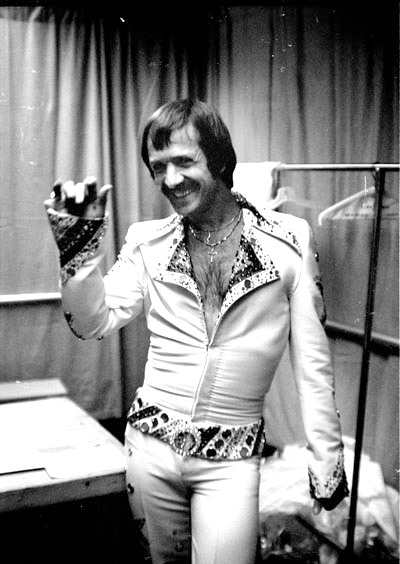
Bono married his first wife, Donna Rankin, on November 3, 1954 and they had a daughter, Christine ("Christy"), born on June 24, 1958, before divorcing in 1962. Following that, Bono married Cher, a singer and entertainer in 1964; Bono and Cher had a daughter, Chastity (now Chaz), on March 4, 1969. Six years later, in 1975, the couple divorced. Bono then married Susie Coelho, but divorced her in 1984. He married again in 1986 to the much younger Mary Whitaker. They had two children, Chesare Elan Bono (a son, born April 25, 1988) and Chianna Marie Bono (a daughter, born February 2, 1991). He became a Scientologist, partly because of the influence of Mimi Rogers, but stated that he was a Roman Catholic on all official documents, campaign materials, web sites, etc. Mary Bono also took Scientology courses. Unrelatedly, when his daughter Chastity came out as a lesbian, he was more accepting than Cher was at first.
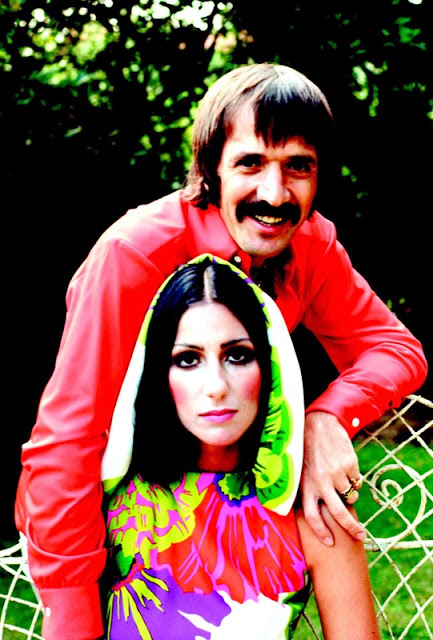
Bono was a champion of the Salton Sea in southeastern California, where a park was named in his honor. The 2005 documentary film Plagues and Pleasures on the Salton Sea (narrated by John Waters) features Bono and documented the lives of the inhabitants of Bombay Beach, Niland, and Salton City, as well as the ecological issues associated with the Sea.
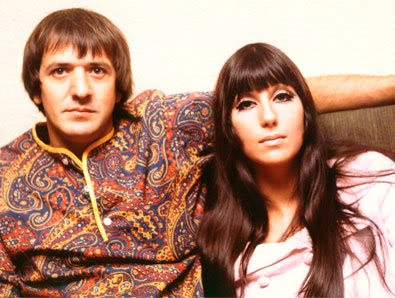
Bono began his music career working at Specialty Records where his song "Things You Do to Me" was recorded by Sam Cooke, and went on to work for the legendary record producer Phil Spector in the early 1960s as a promotion man, percussionist and "gofer". One of his earliest songwriting efforts was "Needles and Pins" which he co-wrote with Jack "Specs" Nitzsche, another member of Spector's production team. Later in the same decade, he achieved commercial success, along with his then-wife Cher, as part of the singing duo Sonny and Cher. Bono wrote, arranged, and produced a number of hit records with singles like "I Got You Babe" and "The Beat Goes On", although Cher received more attention as a performer. He also played a major part in Cher's early solo career with recordings such as "Bang Bang" and "You Better Sit Down Kids."

Bono also recorded as a solo artist under the name of Sonny. He had only one hit single as a solo artist, Laugh At Me. Laugh At Me was released in 1965 and peaked at #10 on the Billboard Hot 100. In live concerts, Bono would sing the song with an introduction of, "I'd like to sing a medley of my hit." His only other single as a solo artist was a follow-up release, "The Revolution Kind," which reached number 70 on the Billboard Hot 100 later that same year. Bono also recorded an unsuccessful Sonny album titled Inner Views in 1967.
Sonny continued to work with Cher through the early and mid-'70s starring in a popular television variety show, The Sonny and Cher Show, which ran on CBS from 1971 to 1974. Their last appearance together was on Late Night with David Letterman on November 13, 1987, when they sang "I Got You Babe."
Bono continued his acting career, doing bit roles in such shows as Fantasy Island and The Love Boat. He played the part of mad bomber Joe Selucci in Airplane II: The Sequel and the part of Franklin Von Tussle in John Waters' Hairspray. In the film Men In Black, Bono is one of several oddball celebrities seen on a wall of video screens that monitor extraterrestrials living among us. In 1986 he also appeared in the horror movie Troll. His last acting role was in the television series Lois & Clark: The New Adventures of Superman (Season 1, Episode 9, originally aired on November 21, 1993), in which he played the Mayor Frank Berkowitz.
Bono poked a little fun at himself when he guest-starred on The Golden Girls, in the episode "Mrs. George Devereaux", aired November 17, 1990, as himself vying with Lyle Waggoner for Dorothy's (Beatrice Arthur) affection in a dream, where Blanche (Rue McClanahan) dreams her husband is still alive. In the dream, Sonny uses his power as mayor of Palm Springs, California to have Waggoner falsely arrested just so he can have Dorothy to himself. Later on, after Blanche awakens from the dream, Dorothy is thrilled to learn she picked Sonny "this time."
Bono entered politics after experiencing great frustration with local government bureaucracy in trying to open a restaurant in Palm Springs, California. With conservative talk radio host Marshall Gilbert as his campaign manager, Bono placed a successful bid to become the new mayor of Palm Springs. He served from 1988 to 1992. He was instrumental in making the city more business-friendly and in spearheading the creation of the Palm Springs International Film Festival, now held each year in Bono's memory.
Bono ran for the Republican nomination for United States Senate in 1992, but the nomination went to the more conservative Bruce Herschensohn, and the election to the Democrat Barbara Boxer. Bono and Herschensohn became close friends after the campaign. Bono was elected to the United States House of Representatives in 1994 to represent California's 44th congressional district. He was one of twelve co-sponsors of a House bill extending copyright. Although that bill was never voted on in the Senate, a similar Senate bill was passed after his death and named the Sonny Bono Copyright Term Extension Act in his honor.
He championed the restoration of the Salton Sea, bringing the giant lake's plight to national attention. Speaker of the House Newt Gingrich made a public appearance and speech at the shore of the lake on Bono's behalf.
In their book Tell Newt to Shut Up, David Maraniss and Michael Weisskopf credit Bono with being the first person to recognize Gingrich's public relations problems in 1995. Drawing on his long experience as a celebrity and entertainment producer, Bono (according to Maraniss and Weisskopf) recognized that Gingrich's status had changed from politician to celebrity, and that Gingrich was not making allowances for that change:
"You're a celebrity now, ... The rules are different for celebrities. I know it. I've been there. I've been a celebrity. I used to be a bigger celebrity. But let me tell you, you're not being handled right. This is not political news coverage. This is celebrity status. You need handlers. You need to understand what you're doing. You need to understand the attitude of the media toward celebrities."
Sonny also had involvement with the hearings related to the Waco Siege on April 19, 1993. He was reported to have been extremely upset while watching a video of the attack on the compound.
On January 5, 1998, Bono died from injuries sustained when he struck a tree while skiing on the Nevada side of Heavenly Ski Resort near South Lake Tahoe, California. He was 62. Bono was survived by his widow Mary Bono, daughters Christy, Chastity, and Chianna, and his son Chesare. His mother Jean Bono, who also survived him, died in January 2005, at 90.
His death came just a little less than a week after Michael Kennedy, a son of Robert F. Kennedy, died in a similar skiing accident in Aspen, Colorado. Bono's wife, Mary, was elected to fill the remainder of his Congressional term. Over 10 years after his death, she continues to champion many of Sonny's causes, including the ongoing fight to save the Salton Sea.
After Bono's death, Mary told an interviewer from TV Guide that Sonny had been addicted to and was seriously abusing prescription drugs, mainly Vicodin and Valium. Though Mary claimed that Sonny's drug use caused the accident, the autopsy found no narcotics and only a very small amount of Valium – not enough to cause impairment, according to the Douglas County Coroner's report.
At Mary Bono's request, Cher gave a eulogy at Sonny's funeral. His final resting place is Desert Memorial Park in Cathedral City, California. The epitaph on Bono's headstone reads: "And the Beat Goes On."
The Copyright Term Extension Act (CTEA) of 1998 extended copyright terms in the United States by 20 years. Since the Copyright Act of 1976, copyright would last for the life of the author plus 50 years, or 75 years for a work of corporate authorship. The Act extended these terms to life of the author plus 70 years and for works of corporate authorship to 120 years after creation or 95 years after publication, whichever endpoint is earlier. Copyright protection for works published prior to January 1, 1978 was increased by 20 years to a total of 95 years from their publication date.
This law, also known as the Sonny Bono Copyright Term Extension Act, Sonny Bono Act, or pejoratively as the Mickey Mouse Protection Act, effectively "froze" the advancement date of the public domain in the United States for works covered by the older fixed term copyright rules. Under this Act, additional works made in 1923 or afterwards that were still copyrighted in 1998 will not enter the public domain until 2019 or afterward (depending on the date of the product) unless the owner of the copyright releases them into the public domain prior to that or if the copyright gets extended again. Unlike copyright extension legislation in the European Union, the Sonny Bono Act did not revive copyrights that had already expired. The Act did extend the terms of protection set for works that were already copyrighted, and is retroactive in that sense. However, works created before January 1, 1978 but not published or registered for copyright until recently are addressed in a special section (17 U.S.C. § 303) and may remain protected until the end of 2047. The Act became Pub.L. 105-298 on October 27, 1998.

Opposition
Opponents of the Bono Act consider the legislation to be corporate welfare and have tried (but failed) to have it declared unconstitutional, claiming that such an act is not "necessary and proper" to accomplishing the Constitution's stated purpose of "promot[ing] the progress of science and useful arts". They argue that most works bring most of the profits during the first few years and are pushed off the market by the publishers thereafter. Thus there is little economic incentive in extending the terms of copyrights except for the few owners of franchises that are wildly successful, such as Disney. They also point out that the Tenth Amendment can be construed as placing limits on the powers that Congress can gain from a treaty. More directly, they see two successive terms of approximately 20 years each (the Copyright Act of 1976 and the Bono Act) as the beginning of a "slippery slope" toward a perpetual copyright term that nullifies the intended effect and violates the spirit of the "for limited times" language of the United States Constitution, Article I, section 8, clause 8.
They question the proponents' life expectancy argument, making the comparison between the growth of copyright terms and the term of patents in relation to the growth of life expectancies. Life expectancies have risen from about 35 years in 1800 to 77.6 years in 2002. Considering the increase in life expectancies during that period of time was a bit more than double but the copyright terms have increased threefold from only 28 years total (under the 1790 act) presents an apparent discrepancy. While copyright terms have increased significantly since the 1790 act, terms of patents have not been extended in parallel; patents adequately reward investment in the field with their mere 20-year term.
Opponents also argue that the Act encourages "offshore production." For example, derivative works could be created outside the United States in areas where copyright would have expired, such works advancing science or the useful arts, and that US law would prohibit these works to US residents. For example, a movie of Mickey Mouse playing with a computer could be legally created in Russia and children worldwide could possibly benefit from watching it, but the movie would be refused admission for importation by US Customs because of copyright, resulting in a deprivation to American children. The first Winnie-the-Pooh book (the rights now owned by Disney) was published in 1926 and would have been public domain in 2001.
Opponents identify another possible harm from copyright extension: loss of productive value of private collections of copyrighted works. A person who collected copyrighted works that would soon "go out of copyright," intending to re-release them on copyright expiration, lost the use of his capital expenditures for an additional 20 years when the Bono Act passed. This is part of the underlying argument in Eldred v. Ashcroft. The Bono Act is thus perceived to add an instability to commerce and investment, areas, which have a better legal theoretical basis than intellectual property, whose theory is of quite recent development and is often criticized as being a corporate chimera. Conceivably, if one had made such an investment and then produced a derivative work (or perhaps even re-released the work in ipse), he could counter a suit made by the copyright holder by declaring that Congress had unconstitutionally made, ex post facto, a restriction on the previously unrestricted.
Opponents also question the proponents' "new works would not be created" argument: the hidden presumption that the goal is to make the creation of new works possible. However, the authors of the United States Constitution evidently thought that unnecessary, instead restricting the goal of copyright is to merely "promot[ing] the progress of science and useful arts". In fact, some works created under time-limited copyright would not be created under perpetual copyright because the creator of a distantly derivative work does not have the money and resources to find the owner of copyright in the original work and purchase a license, or the individual or privately held owner of copyright in the original work might refuse to license a use at any price (though a refusal to license may trigger a fair use safety valve). Thus they argue that a rich, continually replenished, public domain is necessary for continued artistic creation.
Publishers and librarians, among others, brought Eldred v. Ashcroft to obtain an injunction on enforcement of the act. Oral arguments were heard by the U.S. Supreme Court on October 9, 2002, and on January 15, 2003 the court held the CTEA constitutional by a 7-2 decision.
The plaintiffs in the Eldred case have as of 2003 begun to shift their effort toward the U.S. Congress in support of a bill called the Public Domain Enhancement Act that would make the provisions of the Bono Act apply only to copyrights that had been registered with the Library of Congress.
Iron Eyes Cody (April 3, 1904 – January 4, 1999) was an American actor. He was recognized for portraying American Indians in Hollywood films. Near the end of his life, his Italian ancestry was made public. In 1995 he was honored by the American Indian community for his portrayals.
Early life
Cody was born as Espera Oscar de Corti in Kaplan, Louisiana, a son of Antonio de Corti and his wife, Francesca Salpietra, immigrants from Sicily, Italy. They had a local grocery store in Gueydan, Louisiana, where he was raised. In some of his earliest acting credits, Cody was listed as Tony de Corti. Cody was drawn to the Indian people finding comfort/similarities for himself in their struggle. He later changed his name to Tony Cody, and from then on lived his life as if he were of indigenous descent, both on and off the screen. Cody married Bertha "Birdie" Parker, a woman of indigenous descent.
Film career
Cody began his acting career at twelve and worked until the time of his death. He appeared in more than 200 films, including The Big Trail (1930), with John Wayne; Sitting Bull (1954), as Crazy Horse; Nevada Smith (1966), with Steve McQueen; A Man Called Horse (1970), with Richard Harris; and Ernest Goes to Camp (1987), with Jim Varney. In 1953, he appeared twice as Chief Big Cloud in Duncan Renaldo's television series, The Cisco Kid.
He was most famous for his "crying Indian" role in the "Keep America Beautiful" Public Service Announcement (PSA) in the early 1970s.[1] It was an environmental commercial in which an Indian (Cody) sheds a tear after some trash is thrown from a speeding car and lands at his feet. The announcer, William Conrad, of Bullwinkle and Cannon fame, memorably declares: "People start pollution; people can stop it."
The Joni Mitchell song "Lakota," from the 1988 album, Chalk Mark in a Rainstorm, features Cody's chanting.[2] He made a cameo appearance in the 1990 film Spirit of '76.
In the episode of The Sopranos titled "Christopher" (2002), Ralph Cifaretto (Joseph Pantoliano) threatens to expose Cody's apparently still-unknown Sicilian ancestry as leverage against anti-Columbus protests by an Indian group; the gambit fails, with a response that James Caan is not Italian.
Honors
In 1995, the Hollywood American Indian community honored Cody for his contributions to Indian life.[3] In 1996, the New Orleans Times-Picayune reported his Sicilian heritage, but Cody denied it. He lived all his adult life claiming he was American Indian and supported related causes. Cody and his wife Bertha, who was, in fact, an American Indian, adopted several children, all of Indian descent.
Cody died in 1999, aged 94 and was interred in the Hollywood Forever Cemetery. He was survived by his adopted son, American Indian flautist Robert "Tree" Cody.
Thomas King named and created a character based on Iron Eyes in his novel Green Grass, Running Water.
References
1.^ 1970s PSA
2.^ Chris J. Walker, "Larry Klein Is Doing It All", June 1, 2002
3.^ "Was Iron Eyes Cody an American Indian?"