Showing posts with label law enforcement. Show all posts

Wednesday, August 21, 2019

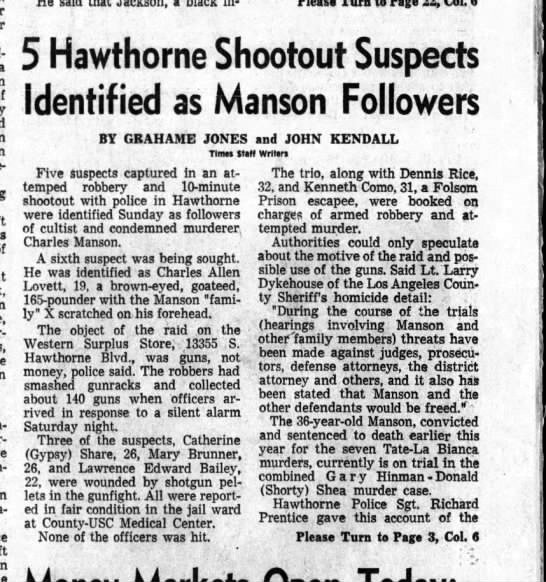
6 Manson Followers Attempt to Rob Western Surplus in Hawthorne 1971


Hawthorne shootout

Manson Family members Mary Brunner, Catherine "Gypsy" Share, Dennis Rice, Charles Lovett, Larry Bailey, and Kenneth Como (Share's husband) drove a white van to a Hawthorne, California Western Surplus Store on August 21, 1971. The group had previously held up a liquor store. 


Western Surplus location today

The group brandished guns and ordered patrons and clerks to lie on the ground. They then took 143 rifles and loaded them into their van, while a store clerk tripped the silent alarm. According to police officers, the group then debated whether to kill all of those in the store.


A police squad car arrived, and Catherine Share opened fire on the vehicle, shattering the windshield. 


As more squad cars arrived, they blocked the van from fleeing, hitting it with more than 50 bullets; the Family members fired nearly 20 rounds at the officers. Police gained control and apprehended the group; Brunner, Share, and Bailey were injured.


Then and Now


Police alleged that the group's plan was to hijack a Boeing 747 and threaten to kill one passenger every hour until Manson and fellow Family members were released from prison. 


Catherine Share (left) and Mary Brunner

Brunner and Share were convicted of one or more crimes and incarcerated at the California Institution for Women where Leslie Van Houten, Susan Atkins, and Patricia Krenwinkel were serving their sentences for their participation in the Tate-LaBianca murders. Brunner disappeared from the public eye after being paroled in 1977. Share served five years for her participation in the Hawthorne shootout and was released in 1975. Following her release from prison, Share disassociated herself from the "Family" and sought surgical treatment to remove the "X" she (and others) had carved into her forehead on Manson's orders during his trial.


Dennis Rice, Kenneth Como, Larry Bailey (left to right)


Charles Lovett


Wednesday, May 22, 2019

California Governor Goodwin Jess "Goodie" Knight 1970 Rose Hills Cemetery


Goodwin Jess "Goodie" Knight (December 9, 1896 – May 22, 1970) was an American politician who was the 31st Governor of California from 1953 until 1959.[1]


Biography

Early years

Knight was born in Provo, Utah, but his family moved to Los Angeles when he was a boy. His father, Jesse Jasper Knight (nephew of mining magnate Jesse Knight), was a mining engineer, but Goodwin followed in his mother's (Lille) father's (John B. Milner) footsteps. This grandfather was a judge in Provo.

Knight attended high school in Los Angeles, at Manual Arts High School. One of his classmates was Jimmy Doolittle. He earned an A.B. in Law and Business from Stanford University, where he was a member of the Stanford Chaparral, in 1919. Knight also attended Cornell University. He served in the U.S. Navy during World War I.


Career

Knight was a judge of the Superior Court in Los Angeles beginning in 1935. He was reelected in 1936 and 1942 without significant opposition. His case load varied from the glamorous to the mundane. He oversaw weddings and divorces for Hollywood starlets.


Political career and governor of California

Knight began his political career in 1944, when he pursued the Republican nomination for the U.S. Senate. He bowed out early, though, to back Fred Houser. He was elected as the 35th Lieutenant Governor of California to serve under Governor Earl Warren in 1946, then reelected in 1950. He became governor himself when Warren resigned to become Chief Justice of the United States in 1953.


While Lieutenant Governor he made a guest appearance on The Jack Benny Show, an episode from San Francisco.


As governor, Knight fought for control of the Republican Party of California with U.S. Senate Majority Leader William Knowland and Vice President Richard Nixon. In 1954, Knight was easily elected to his own full term. At first Knight seemed to make an alliance with Knowland, but this began to sour in 1956 when Knowland supported Nixon for renomination as vice president. In 1957, Knowland announced that he would challenge Knight in the 1958 Republican primary for governor. Knight, known as a moderate, and sympathetic to organized labor, faced a serious threat from more conservative challengers. He was induced by Knowland, Nixon, President Dwight Eisenhower, and others to run for Knowland's Senate seat instead of running for governor again. 


Both Knowland and Knight went down in defeat in 1958, with Knowland losing the gubernatorial race to Edmund G. "Pat" Brown, Sr. and Knight losing the Senate race by over 10% to Clair Engle, severely weakening the heretofore-dominant Republicans in the state. This left Nixon in control of the California party and in line for the presidential nomination, which Knowland and Knight had also desired.


Knight was present at the July 17, 1955, opening of Disneyland, and gave a speech following Walt Disney's famous dedication.

In September 1961, Knight announced a bid for a return to the governorship. He later dropped out of the race for the Republican nomination which was won by Richard Nixon.[2]

In 1964, Knight endorsed Nelson Rockefeller for the Republican nomination against Barry Goldwater. Rockefeller was unsuccessful in stopping Goldwater, the darling of the party's growing conservative wing. Knight never ran for political office again.


Personal life

Knight's first wife, Arvilla, died of a heart attack on October 29, 1952; the couple had two daughters. He married Virginia Carlson (born Virginia Piergue on October 12, 1918 in Fort Dodge, Iowa), the widow of an Army Lieutenant, on August 2, 1954 at the Episcopal Church of Our Savior in Los Angeles.[3] The couple had no children.


Death 

On May 22, 1970, Knight died three months after his daughter Carolyn Knight Weedman committed suicide. She took her life by carbon monoxide asphyxiation from her car in the garage of her home on Lillian Way in Hancock Park and left behind two sons, Jonathan and Robert Weedman. Knight discovered his daughter a day later, and this is believed to have contributed to the stroke that ultimately ended his life. His widow, Virginia, never remarried, and died on November 29, 2010.[4]

Goodwin Knight's funeral took place in Saint James Episcopal Church in Los Angeles, with full military honors. The funeral was attended by then California Governor Ronald Reagan, Arizona Senator Barry Goldwater, General of the Army Omar Bradley and numerous Hollywood and Civic Leaders. 


Knight was initially interred at Hollywood Memorial Park Cemetery, but one year later disinterred and his remains moved to Rose Hills Memorial Park in Whittier, California after his second wife Virginia Knight learned he had purchased a crypt next to his first wife Arvilla.


References

1. Staff writers (1 June 1970). "Milestones". Time.
2. https://www.nytimes.com/1970/05/23/archives/goodwin-j-knight-of-california-dies-governor-19531959-ran-for.html
3. https://archive.org/details/califirstlady00knigrich
4. Valerie J. Nelson (December 1, 2010). "Virginia Knight dies at 92; former first lady of California". The Los Angeles Times. p. AA7.


Saturday, May 4, 2019

"The Mollycoddle" Actress Ruth Renick 1984 Hollywood Forever Cemetery


Ruth Renick (born Ruth Griffin;[1] September 23, 1893 - May 4, 1984)[2] was an American actress on stage and in films.


Early years

Born in Colorado, Texas,[2] Renick was the daughter of Mr. and Mrs. R. H. Griffin.[3] While she was a high school student in Phoenix, Arizona, she joined the Maitland Davis stock theater company, working with the troupe for four months.[4]


Career

In 1916, Renick joined the Redmond stock company, debuting on June 1 in San Jose in When Knighthood Was in Flower.[5] She later acted with the Wilkes stock company in Seattle.[3] With Wilkes, she was featured in ingenue roles.[6] After some time spent working in films, she went to the Fulton Theater in Oakland to be the leading lady in its productions.[4]


Renick ventured into films in 1919, when she signed with the Jesse D. Hampton company.[7] Her film debut came in Hawthorn, U.S.A. (1920).[8] 


Soon after that, she was signed by Douglas Fairbanks and appeared with him in The Mollycoddle.[9]


Controversy over invitation to speak at church

Renick found herself in a controversy in 1928 following the cancellation of an event in which she was to speak to the Men's Club of First Presbyterian Church in Berkeley, California. Renick was to talk about the film The King of Kings (1928) in the same meeting in which the dean of San Francisco Theological Seminary was to speak about what laymen could do for a church. However, on the morning of the scheduled meeting the speakers were notified that it had been canceled.[10] 


When pressed for an explanation, the church's pastor said that its governing body decided "not to have any member of the organized theatrical profession" speak to the church's members.[11] 


The cancellation resulted in front-page coverage in The San Francisco Examiner and the Oakland Tribune, with additional reporting inside each publication.[10][12] She was invited to speak the following week at the First Unitarian Church of Oakland but declined after she received a letter that contained a death threat.[13] 


About six weeks later, Renick spoke to a class at the First Congregational Church of San Francisco, discussing relationships between the church and the theater.[14]


Personal life

In 1924, the question of whether Renick was married came to the public's attention when Wellington N. Bellford was arrested for impersonating an Army officer. Bellford denied that he and Renick were married, while she said, "But we were married."[15] Asked for details about the wedding, Renick replied, "I cannot say when or where, as my husband appears to have denied it."[15] 


Her brother-in-law and sister reported Bellford's impersonation to the police after they investigated the supposed marriage but found that no marriage license had been issued for the couple in Santa Clara County or in San Jose, where Renick had told them that the couple had wed.[15] The impersonation charge against Bellford was dismissed in 1928, and authorities decided that he had used a mock wedding ceremony to trick Renick.[16]


Death

On May 4, 1984, Renick died in Hollywood, California,[2] at age 90. She is interred in the Chapel Columbarium at Hollywood Forever Cemetery


Partial filmography

Hawthorn, U.S.A. (1920)


The Mollycoddle (1920)

She Couldn't Help It (1920)[17]


The Witching Hour (1921)[18]

The White Dove[19]
The Parish Priest[19]
Bar Nothin' (1921)[20]


The Golden Snare (1921)[19]

What's a Wife Worth? (1921)[21]
Children of the Night (1922)[22]:373
The Men of Zanzibar (1922)[23]
Rags to Riches (1922)[22]
Roughshod (1922)[22]:118


Dog Scents (1926)


45 Calibre Echo (1932)


45 Calibre Echo (1932)


45 Calibre Echo (1932)


References

1. "Phoenix Moving Picture Actress Back On Stage". El Paso Herald. Texas, El Paso. December 26, 1921. p. 5. Retrieved 7 February 2019 – via Newspapers.com.
2. Ellenberger, Allan R. (2001). Celebrities in Los Angeles Cemeteries: A Directory. McFarland. p. 147. ISBN 9780786409839. Retrieved 7 February 2019.
3. "Phoenix Actress to Visit Here Few Days". Arizona Republic. Arizona, Phoenix. November 24, 1918. p. 4. Retrieved 7 February 2019 – via Newspapers.com.
4. Soister, John T.; Nicolella, Henry; Joyce, Steve (2014). American Silent Horror, Science Fiction and Fantasy Feature Films, 1913-1929. McFarland. p. 664. ISBN 9780786487905. Retrieved 7 February 2019.
5."Ruth Griffin to Join Redmonds". Arizona Republic. Arizona, Phoenix. May 14, 1916. p. 19. Retrieved 7 February 2019 – via Newspapers.com.
6. "Popular Actress, Formerly With Wilkes, to Be Doug's Leading Lady". The Seattle Star. Washington, Seattle. February 20, 1920. p. 8. Retrieved 7 February 2019 – via Newspapers.com.
7. "Screen Brevities". Richmond Times Dispatch. Virginia, Richmond. December 24, 1919. p. 10. Retrieved 7 February 2019 – via Newspapers.com.
8. "(untitled brief)". Camera!. IV (46): 7. February 25, 1922. Retrieved 7 February 2019.
9. "Ruth Renick at Colonial". The Seattle Star. Washington, Seattle. June 15, 1920. p. 3. Retrieved 7 February 2019 – via Newspapers.com.
10. "Bay Church Bans Address By Actress". The San Francisco Examiner. California, San Francisco. January 13, 1928. p. 1. Retrieved 8 February 2019 – via Newspapers.com.
11. "Church Bars Actress from Making Talk". The San Francisco Examiner. California, San Francisco. January 13, 1928. p. 7. Retrieved 8 February 2019 – via Newspapers.com.
12. "Berkeley Church Split Over Barring Of Actress". Oakland Tribune. California, Oakland. January 13, 1928. p. 1. Retrieved 8 February 2019 – via Newspapers.com.
13. "Death Note Keeps Star from Pulpit". Oakland Tribune. California, Oakland. January 20, 1928. p. 43. Retrieved 8 February 2019 – via Newspapers.com.
14. "Ruth Renick to Speak in Church". The San Francisco Examiner. California, San Francisco. February 29, 1928. p. 13. Retrieved 8 February 2019 – via Newspapers.com.
15. "Ruth Renick's Mate Is Held". The Los Angeles Times. California, Los Angeles. January 13, 1924. p. 15. Retrieved 8 February 2019 – via Newspapers.com.
16. "'Love Pirate' Gets Case Dismissed". The San Francisco Examiner. California, San Francisco. September 16, 1928. p. 18. Retrieved 8 February 2019 – via Newspapers.com.
17. "Adaptation Of Stage Play Makes Satisfactory Crook Comedy Offering". Wid's Daily. XV (54): 13. February 27, 1921. Retrieved 7 February 2019.
18. "Who's Where on Los Angeles Screens". Camera!. IV (1): 6. April 16, 1921. Retrieved 7 February 2019.
19. "Ruth Renick in Curwood Release". Camera!. IV (13): 6. July 9, 1921. Retrieved 7 February 2019.
20. "Bar Nothin'". The Daily Herald. Utah, Provo. October 21, 1921. p. 17. Retrieved 8 February 2019 – via Newspapers.com.
21. "Who's Where". Camera!. IV (20): 14. August 27, 1921. Retrieved 7 February 2019.
Katchmer, George A. (2015). A Biographical Dictionary of Silent Film Western Actors and Actresses. McFarland. p. 365. ISBN 9781476609058. Retrieved 7 February 2019.
22. Solomon, Aubrey (2014). The Fox Film Corporation, 1915-1935: A History and Filmography. McFarland. p. 277. ISBN 9780786486106. Retrieved 7 February 2019.