Sunday, July 14, 2013

Dead French in L.A.: Actress & Teacher Lilyan Chauvin 2008


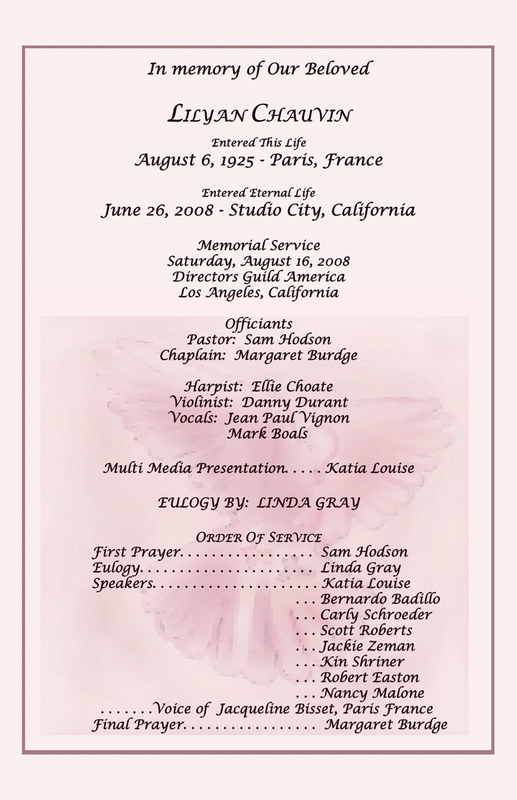
Lilyan Chauvin (August 6, 1925 – June 26, 2008),[1] born Lilyan Zemoz, was a French-American actress, television host, director, writer, former Vice President of Women in Film, author, teacher and private coach.

Her motion picture credits included Silent Night, Deadly Night (1984) and Catch Me If You Can (2002). In the 1990s and 2000s she guest-starred in such shows as The X-Files, Star Trek: Deep Space Nine, Friends, Alias, Malcolm in the Middle and Ugly Betty.[1]


Early life

Chauvin began her career working in broadcasting in France. Her mother was French and her father was Italian. While under contract to a French radio station she had her heart set on becoming a lawyer; however her earnings soon exceeded that of her parents and she gave serious consideration to making show business her way of life. She studied in Paris at the School of Cinema, and at the Jean Louis Barrault School, also in Paris.[1]

Work on stage  

Chauvin moved to New York City on her 21st birthday and became a US citizen. She studied with Uta Hagen and at the Actors Studio in New York. Chauvin also attended the Berlitz school of Languages and took in American movies every day to improve her English. Already proficient in Spanish, German, Italian, and Russian, she soon became one of the school’s top teachers and they sent her out to coach actors in the accents they needed for various roles.[1]

Chauvin's European stage and Actors Equity theatre credits include Macbeth, Medea, Silk Stockings, Camille, and Three for Today. She began landing roles in New York television productions including TV's prestigious Studio One. Soon after she traveled to Los Angeles and found work in film and television.[1]

SILK STOCKINGS (1957)

Film and television

Lilyan Chauvin made her film acting debut in Letter from Cairo (1953), an episode of the long-running series Studio One. Following this, she guest-starred in Crusader (1956). Chauvin made her first motion picture appearance in Lost, Lonely and Vicious (1958) and later starred in Silk Stockings (1957), Walk Like a Dragon (1960), and Bloodlust! (1961). She appeared in the Barbra Streisand film Funny Lady. Other film credits include Yours, Mine and Ours, No Place to Hide, Tickle Me, Born in East L.A., Sublime, Round Trip to Heaven, Duty Dating, Skeleton Woman, Beyond Reason, Silent Night, Deadly Night, Bad Influence, Celebration of Life and A Day in Tribute. Chauvin was a series regular on Days of Our Lives, Mission Impossible, General Hospital and Falcon Crest. Other television credits include Adventures of Superman, Friends, ER, Star Trek: Deep Space Nine, Malcolm in the Middle, Alias, CSI, Ugly Betty, The X-Files, and Murder She Wrote.[1]

Behind the camera

In the industry, Chauvin’s talents are respected equally as a director and actress. Her DGA directing credits include The Young and The Restless, But She Can Type, Celebration 75 and Windows of Heaven. Chauvin directed productions of Last Summer at Bluefish Cove, Effigies, Seacliffe California, In My Minds Eye, The Happy Time and The Deepest Hunger.[1]


Teaching

Lilyan Chauvin was also one of Hollywood’s most prominent, sought after and respected acting and directing coaches in the industry. Many of her techniques have become instrumental teaching tools within the industry and have provided inspiration to many other successful educators. As an author and educator she taught internationally at seminars as a keynote speaker, lecturer and adviser.[1]

As the creator and show runner she co-produced and hosted the television series Hollywood Structured, a comprehensive guide to show business careers, Chauvin explored new facets of the industry each week through interviews with top professionals. The 64 episodes covered acting, directing, make up, documentary filmmaking, producing, music, comedy, cinematography, stunt coordinating, modeling, publicity, writing, dancing, sports announcing, production design, entertainment law, agency, casting, union, special effects and more.

Chauvin wrote Hollywood Scams and Survival Tactics, in which she shared many of her own experiences and survival tactics.[1] She taught acting, multi-cam cinematography and directing for over 10 years at USC and taught acting/directing at UCLA for two years. Some of Chauvin's acting students were Raquel Welch, Suzanne Somers, Margie Haber, Carly Schroeder, Kin and Wil Shriner, and Kevin Nealon. She was a technical advisor and dialogue coach at MGM and worked as a dialogue supervisor/drama coach at Warner Brothers. For many years she ran the Women in Film Director's Workshop which drew large numbers of people from the various aspects of filmmaking.[1]


Honors

Twice nominated for Emmy Awards (for The Young and the Restless and Baa Baa Black Sheep), Chauvin won the 1991 Angel Award for Hollywood Structured, which was co-produced by Chauvin, Julie Johnson and Irene Lamothe. Chauvin appeared weekly as the host on this cable program with, among others, Jacqueline Bisset, Linda Gray, Morey Amsterdam, Danny Glover, Henry Mancini, Anne Francis, Carmen Zapata and others.[1]

Affiliations

Chauvin was on the Women’s Steering Committee of the Directors Guild of America and had over 35 credits as a DGA Director since 1979. She was a member of Screen Actors Guild, the Writers Guild of America, the American Federation of Television and Radio Artist and Equity. Committed to furthering women's causes, especially in the industry, Chauvin was a 39 year member of Women in Film. She served on the organization's Board five times, twice as the Board's Vice President.[1]


Death  

Chauvin died at her Studio City home on Thursday, June 26, 2008, aged 82, following a long battle with breast cancer complicated by recent congestive heart disease.



References

1.^ Lilyan Chauvin Biography Site
Lilyan Chauvin's official website
Glamour Girls of the Silver Screen - The Private Lives and Times

Dead French in L.A.: Filmmaker Gaston Melies OPENS Santa Paula Movie Studio 1911


Gaston Méliès (February 12, 1852 – April 9, 1915) was the brother of the famous French film director Georges Méliès. He also produced and directed a large number of early films in the United States.

Georges and Gaston Melies
Image created by David Pfluger

Gaston and the third and elder Méliès brother, Henri, ran the family shoe factory in Paris. They landed a contract with the French War Ministry that looked to make them both wealthy. Unfortunately, the price of leather increased sharply, and they were unable to meet their costs. The factory shut down and the Méliès lost their business.[1]

Georges Méliès had produced films in France, which had become popular around the world. Some distributors began pirating Méliès work, especially in the United States. Méliès asked his brother Gaston to go the United States and guard Méliès copyrights.


Gaston Méliès arrived in New York City in 1902, formed the Star Film Company and began distributing his brother's films.. By 1903, Gaston began making films himself, mostly documentaries. The films were not successful. In the summer of 1907, Gaston Méliès returned to France take care of some business with Georges. On September 11, 1907, he married Hortense-Louise de Mirmont, an elder sister of Lucien Reulos' wife, who was one of Georges Méliès' first collaborators.;[2] The new couple left Paris a few days after their marriage and travelled from Le Havre to New York on the ship "La Savoie," where they arrived September 28, 1907.

THE IMMORTAL ALAMO (1911)

In need of warmer winters to allow for year round film production, Méliès moved the Star Film Company to San Antonio, Texas, and leased twenty acres including a two-story house and large barn that became the "Star Film Ranch" movie studio.[1] He acted in two of his movies playing a priest in The Immortal Alamo (1911) and The Kiss of Mary Jane (1911).

Santa Paula Studio Editing Room

In April, 1911, Gaston moved the company to Santa Paula, California, following the trend of other movie studios to relocate in California.

THE COWBOY KID (1912)

In 1912 and 1913 Méliès travelled with his family and a film crew of over 20 people in the South Pacific, New Zealand, Australia, Tahiti, Southeast Asia and Japan in search of exotic subjects for his films.[3] For the summer of 1912 and well into 1913 Gaston sent footage back to his son in New York, but it was often damaged or unusable. Gaston was no longer able to fulfill Star Film's obligation to Thomas Edison's company. Gaston lost $50,000 and had to cease production. He went to California, sold the American branch of Star Films to Vitagraph Studios, and then returned to Europe. He and his brother Georges (who blamed Gaston for his own financial difficulties) never spoke to one another again.

Gaston Méliès shooting in Angkor (1913)
From David Pfluger’s collection

Méliès and his wife moved to Corsica in the winter of 1913. He died in Corsica on April 9, 1915 of "shellfish poisoning." He was buried on April 14, 1915 in Saint-Vincent Cemetery in Montmartre, Paris, in a tomb belonging to his second wife's family, De Mirmont.[2]

Gaston Melies Santa Paula Studio
was located at corner of 7th and Main St.


References

1.^ Thompson, Frank. Texas Hollywood: Filmmaking in San Antonio Since 1910. San Antonio: Maverick Publishing Company, 2002. pp 3-8.
 2.^ Thompson, Frank. The Star Film Ranch: Texas' First Picture Show. Republic of Texas Press, 1996. p 7.
3.^ Tracking Shots: Close Ups on NZ Film History: A New Zealand Romance

Saturday, July 13, 2013

Dead French in L.A.: Author Anais Nin Dies in L.A. 1977


Anaïs Nin (Spanish pronunciation: [anaˈiz ˈnin]; born Angela Anaïs Juana Antolina Rosa Edelmira Nin y Culmell, February 21, 1903 – January 14, 1977) was an American author born to Spanish-Cuban-French-Danish parents in France, where she was also raised.


Early life

Anaïs Nin was born in Neuilly, France, to artistic parents. Her father, Joaquín Nin, was a Cuban pianist and composer, when he met her mother Rosa Culmell,[1] a classically trained singer of French and Danish descent who was working in Cuba.[2] Her father's grandfather had fled France during the Revolution, going first to Saint-Domingue, then New Orleans, and finally to Cuba where he helped build that country's first railway.[3]

Nin was raised a Roman Catholic[4] and spent her childhood and early life in Europe. After her parents separated, her mother moved Anaïs and her two brothers, Thorvald Nin and Joaquin Nin-Culmell, to Barcelona, and then to New York City. According to her diaries, Volume One, 1931–1934, Nin abandoned formal schooling at the age of sixteen years and later began working as an artist's model. After being in America for several years, Nin had forgotten how to speak Spanish, but retained her French and became fluent in English.

She spent some time in Spain and Cuba but lived most of her life in the United States where she became an established author. She published journals (which span more than 60 years, beginning when she was 11 years old and ending shortly before her death), novels, critical studies, essays, short stories, and erotica. A great deal of her work, including Delta of Venus and Little Birds, was published posthumously.


The explosion of the feminist movement in the 1960s gave feminist perspectives on Nin's writings of the past twenty years, which made Nin a popular lecturer at various universities; contrarily, Nin disassociated herself from the political activism of the movement.[1]


In 1973 Anaïs Nin received an honorary doctorate from the Philadelphia College of Art. She was elected to the United States National Institute of Arts and Letters in 1974.


Anais Nin died in Los Angeles, California on January 14, 1977 after a three-year battle with cancer.[21] Her body was cremated, and her ashes were scattered over Santa Monica Bay in Mermaid Cove. Her first husband, Hugh Guiler, died in 1985, and his ashes were scattered in the cove as well.[10] Rupert Pole was named Nin's literary executor, and he arranged to have new unexpurgated editions of Nin's books and diaries published between 1985 and his death in 2006.


Philip Kaufman directed the 1990 film Henry and June based on Nin's novel Henry and June: From the Unexpurgated Diary of Anaïs Nin. She was portrayed in the film by Maria de Medeiros.


Dead French in L.A.: Sam "Frenchie" Marx 1933 Father of the Marx Brothers


Samuel Marx, born Simon Marx,[1] (October 23, 1859 – May 10, 1933)[1] was the husband of Minnie Marx, and father of the Marx Brothers.


Life and career

Marx was born in Alsace, France in 1859.[1][2] Due to his place of birth he was known as "Frenchie." He met Minnie in New York where he was working as a dance teacher. They married in 1884 and had 6 sons. Their first son, Manfred, born 1885, died in infancy.[3] The other children were born in 1887, Leonard, 1888, Adolph, 1890, Julius, 1892, Milton and 1901, Herbert.

Marx became a tailor, although not a very good one. He was a talented cook, often convincing the landlord to delay their rent paytime with a good meal.[4] In his show An Evening With Groucho, Groucho reminisces about Sam Marx:[5]

"My father was a tailor, and a very bad one, and Chico was always short of money, and he used to hock my father's shears, so whenever my father made a suit, of course it didn't fit, and the shears would be hanging up in the pawnshop on Ninety-first Street."

Harpo puts the bad tailoring down to the fact that Frenchie never actually took the time to measure a client for a suit, preferring to guess their size. He would then take suits that clients had rejected and travel to New Jersey and sell these door-to-door.

In his last interview, Zeppo joked that his father "was a very bad tailor but he found some people who were so stupid that they would buy his clothes, and so he'd make a few dollars that way for food."[6]

Marx made a cameo appearance in his four sons' film Monkey Business (1931), sitting on top of luggage behind the brothers on the pier as they wave to the First Officer, having slipped off the ship without being arrested as stowaways. Sam Marx died on May 10, 1933, in the Los Angeles home of one of his sons, from complications due to renal failure. He was 73. He is buried in New York.  


References

1.^ La famille paternelle des Marx Brothers (French)
2.^ "Samuel Marx, Father of Four Marx Brothers of Stage and Screen Fame". The New York Times. 1933-05-12. 
3.^ Stefan Timphus. "The Marx Brothers – Family". www.marx-brothers.org. 
4.^ Stefan Timphus. "The Marx Brothers – Parents". www.marx-brothers.org. 
5.^ "An Evening With Groucho Marx (transcript)". 
6.^ The last interview with Zeppo Marx (August 1979)

Dead French in L.A.: Director Louis J. Gasnier 1963 "Reefer Madness"


Louis J. Gasnier (15 September 1875 – 15 February 1963) was a French film director.

THE PERILS OF PAULINE (1914)

Born in Paris, Gasnier was working in theatre when Pathé hired him to direct films in the earliest days of cinema. He directed comedian Max Linder in many of his early short comedies. In 1912 he emigrated to the United States, where he made his name working on several fairly prestigious productions, most notably the serial The Perils of Pauline starring Pearl White, with whom he made several other star vehicles.

GAMBLING SHIP (1933)

Gasnier's career declined with the advent of sound; he was unable to adapt to the new technology's changing of the way films were made—as were more than a few of his fellow silent-film directors—and soon found himself making low-budget programmers for very small studios on the bottom rung of the Hollywood food chain for the "states-rights" market, meaning that many of them got little or no distribution.

REEFER MADNESS (1936)

Arguably his most famous film—although definitely not for artistic reasons—is the anti-marijuana opus Reefer Madness, made in 1936. The film's hysterical, preachy, over-the-top propaganda message has earned it a dedicated cult following, which remains strong to the present day. It is widely available in the public domain and on DVD, and has been frequently shown on many terrestrial and cable TV channels, quite remarkable for an ultra-cheap exploitation movie of the 1930s that apparently had scant distribution when it was originally released. After Reefer Madness, Gasnier made an additional eight films before retiring in 1941, although he did appear as an uncredited extra in a few films after his retirement as a director (he played an elderly Frenchman in the Steve McQueen war film Hell Is for Heroes in 1962). He died in Hollywood at the age of 87 in 1963.


Selected filmography

The Perils of Pauline (1914)
The Exploits of Elaine (1914)
The New Exploits of Elaine (1915)
The Shielding Shadow (1916)
The Mystery of the Double Cross (1917)
The Seven Pearls (1917)
Hands Up! (1918)
The Tiger's Trail (1919)
White Man (1924)
The Parasite (1925)
Parisian Love (1925)
Should Tall Men Marry? (1928)
Darkened Rooms (1929)
Slightly Scarlet (1930)
Mysterious Mr. Parkes (1930)
The Virtuous Sin (1930)
Espérame (1933)
Reefer Madness (1936)

THE VIRTUOUS SIN (1930)

Dead French in L.A.: Mayor Damien Marchesseault Suicide 1868 City Hall


Damien Marchesseault (or Marchesseau) (April 1, 1818 – January 20, 1868) was the seventh Mayor of Los Angeles from May 9, 1859 to May 9, 1860 and then again from January 7, 1861 to May 6, 1865. Marchesseault assumed the office one last time interrupting Cristobal Aguilar's first term in office for three months.


Biography

Born in St.-Antoine-sur-Richelieu, Quebec, Canada, Marchesseault was described as a carousing onetime New Orleans gambler.

During his term as Water Overseer of Los Angeles, Marchesseault and a partner laid wooden water pipes that burst and turned streets into sinkholes.

Struggling with mounting debts, he slipped into an empty Los Angeles City Hall Council chamber on Jan. 20, 1868, and shot himself to death.

Marcheassault Street in Los Angeles is named for him.[1]


Damien Marchesseault is buried at Angelus-Rosedale Cemetery.


Death and suicide note 

The following is a news article about Damien Marchesseault's death that includes the suicide note he wrote to his wife, Mary Clark Marchesseault, taken from the January 21, 1868, issue of the Los Angeles Semi-Weekly News:

Died. --- Damien Marchesseault, for several years Mayor of this city, died at the Mayors office, about 7 o'clock AM, on the 20th INS.

Mr. Marchesseault was a native of Canada, and in early life immigrated to New Orleans, where he has a brother now living. He was in Mexico during the Mexican War, and came to this country in 1849, and settled in this city in 1853; where be [sic?] was for several years engaged in business. He was a man of remarkable energy, of strong convictions, and naturally had many enemies, but leaves a host of friends. The friends and acquaintances of the deceased are requested to attend the funeral at 10 o'clock this morning, from his late residence.

Suicide. - --Damien Marchesseault committed suicide on yesterday morning by shooting himself, the ball entering near the nose, and passing into the brain.


The following letter was found upon the table near the late Damien Marchesseault, addressed to Mrs. Marchesseault; and was place in our hands for publication by the friends of that lady:

Office of the City Marshal, Los Angeles City, January 20, 1868.

My Dear Mary: - By my drinking to excess, and gambling also, I have involved myself to the amount of about three thousand dollars which I have borrowed from time to time from friends and acquaintances. Under the promise to return the same the following day, which I have often failed to do. To such and extend have I gone in this way that I am now ashamed to meet my fellow man on the street; besides that, I have deeply wronged you as a husband, by spending my money instead of maintaining you as it become a husband to do. Though you have near complained of my miserable conduct, you nevertheless have suffered too much. I therefore, to save you from farther disgrace and trouble, being that I cannot maintain you respectably, I shall end this state of thing this very morning. Of course, in all this, there is no blame-attached contrary you have asked me to permit you to earn money honestly by teaching and I refused. You have always been true to me. If I write these few lines, it is to set you a night before this wicked world, to keep slander from blaming you in way manner whatever. Now, my dear beloved, I hope that you will pardon me, and also Mr. Sainsevain. It is time to part, God bless you, and may you be happy yet, your husband Damien Marchesseault.


References

1.^ [1] Google Books

Dead French in L.A.: Philip Fritz BUILDS Jean Bernard's Victorian Houses 1866-1888


Part of the Chinatown Heritage and Visitors Center, this Victorian house was built by an emigrant from Alsace, France named Philip Fritz. The Victorian houses were built in 1886 and 1888 for his family as part of a three-home complex.[1] Originally a carpenter, Fritz became an superintendent of buildings and bridges for the Southern Pacific Railroad.


The grant deed holder was Jean Bernard, after whom the street was named. One of the three homes was relocated to the corner of Wilshire Blvd. and Normandie Ave. The other two houses were moved back 15 feet in the 1930s when the street was widened for a freeway onramp.[2]. Its exterior was repainted July 2006.[3]


Jean Bernard is buried at Calvary Cemetery in East Los Angeles.


[1] “Chinatown Heritage and Visitors Center.” Stanchion. 415 Bernard Street, Los Angeles, CA 90012. 4 October 2010.
[2] “Chinatown Heritage and Visitors Center.” Stanchion. 415 Bernard Street, Los Angeles, CA 90012. 4 October 2010.
[3]“Celebrating Over 30 Years.” Chinese Historical Society of Southern California.